











Executive Overview
Northwest Florida’s relationship with the water is both historic and foundational. Home to Naval Air Station (NAS) Pensacola, the Port of Pensacola, and a dense, rapidly expanding cluster of private defense contractors, marine manufacturers, and advanced technology firms, the region has long served as a vital node in the United States’ maritime defense and commercial infrastructure. However, as global maritime industries undergo rapid technological transformations—driven by automation, advanced materials science, and the urgent demand for renewable energy—traditional regional economies must evolve or risk obsolescence.
Recognizing this critical juncture, the University of West Florida (UWF) has positioned itself at the vanguard of maritime innovation. Central to this effort is the Watercraft and Vessel Engineering (WAVE) Program. Established in 2025 through a transformative $3.3 million grant from Triumph Gulf Coast, the WAVE Program is designed to bridge the historical gap between academic research and commercial application. Operating directly out of the Port of Pensacola, the initiative serves as an applied research incubator, a workforce pipeline, and a collaborative engine for blue-economy startups and established maritime giants alike.
By shifting the educational paradigm from isolated, classroom-bound theory to real-world, on-the-water prototyping and testing, WAVE is addressing some of the most pressing engineering challenges in the modern maritime sector. From autonomous marine robotics to advanced composite manufacturing, the program is not only training the next generation of naval and mechanical engineers but is also anchoring Northwest Florida as a premier national hub for marine technology and economic diversification.

Detailed Chronology: From Concept to Coastal Catalyst
The genesis of the WAVE Program is rooted in a strategic effort to diversify Northwest Florida’s economy following historic regional challenges, leveraging funds dedicated to long-term economic resilience.
2025: The Catalyst and Funding
In early 2025, the Triumph Gulf Coast board approved a $3.3 million grant to UWF’s Department of Mechanical Engineering. Triumph Gulf Coast, which administers funds recovered from the 2010 Deepwater Horizon oil spill, targeted this investment to create high-wage, high-skill jobs in sectors less vulnerable to economic downturns.
With this capital infusion, UWF quickly established the infrastructure for the WAVE Program. Rather than housing the program exclusively on its main campus, the university secured space directly within the Port of Pensacola. This operational decision was highly strategic: it placed students, faculty, and research equipment directly adjacent to active commercial shipping channels, deep-water berths, and industrial marine manufacturers.
Late 2025 to Early 2026: Operational Integration and Infrastructure Development
Throughout the latter half of 2025, the WAVE facility at the Port of Pensacola was outfitted with state-of-the-art engineering tools, including advanced digital design suites, computational fluid dynamics (CFD) modeling software, and specialized fabrication equipment for composite materials.

By early 2026, the program had established active collaborative channels with prominent local maritime entities, including the high-performance sail racing syndicate, New York Yacht Club American Magic. The proximity of American Magic’s training and development base in Pensacola created an immediate, high-stakes testing ground for UWF’s engineering talent.
May 2026: First Graduation Milestones and Workforce Proof of Concept
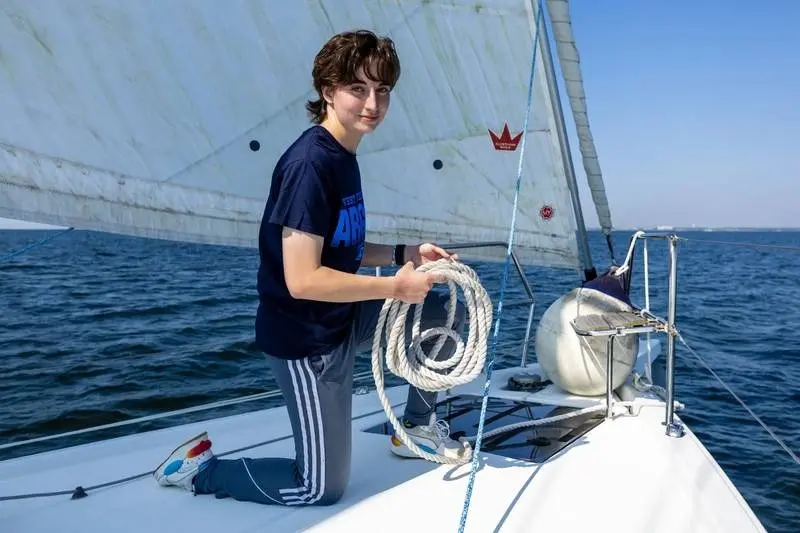
The efficacy of the WAVE model was demonstrated rapidly. By May 2026, the program celebrated its first cohort of graduates who had benefited from the integrated curriculum. Among them was Keanu Peoples, who earned his Bachelor of Science in Mechanical Engineering. Peoples’ trajectory—transitioning from a hands-on undergraduate internship with American Magic directly into a full-time engineering role within the marine racing industry—validated the program’s core mission: turning academic rigorousness into immediate, high-value employment.
[2025: Grant Awarded] ──> [Late 2025: Port Facility Opens] ──> [Early 2026: Industry Partnerships] ──> [May 2026: First Graduates/Hires]Supporting Context & Metrics: The Pillars of the WAVE Initiative
To understand the structural impact of the WAVE Program, it is necessary to examine the specific technical pillars and regional economic dynamics that define its operations. The program operates at the intersection of three critical sectors:
                  ┌──────────────────────────────┐
                  │      ADVANCED RESEARCH       │
                  │   • Marine Autonomy & AI     │
                  │   • Advanced Composites      │
                  └──────────────┬───────────────┘
                                 │
                                 ▼
┌──────────────────────────────┐ ◀─▶ ┌──────────────────────────────┐
│     ECONOMIC DEVELOPMENT     │     │    WORKFORCE DEVELOPMENT     │
│ • Port of Pensacola Hub      │     │ • Industry Certifications    │
│ • Blue-Economy Startups      │     │ • Pipeline to Defense/Marine │
└──────────────────────────────┘     └──────────────────────────────┘
1. Advancing Research in Real-World Testing Environments
Traditional engineering programs are often constrained by the physical separation between the classroom and the operating environment. WAVE dismantles this barrier by utilizing a three-tiered research pipeline:
- On-Campus Design and Simulation: Faculty and students utilize UWF’s main campus laboratories to conduct fundamental research, generate CAD models, and simulate hydrodynamic stresses.
- Portside Prototyping: At the Port of Pensacola facility, these digital designs are translated into physical prototypes. Here, researchers and industry partners collaborate on custom assemblies and structural modifications.
- Open-Water Validation: Unlike landlocked institutions, WAVE has immediate access to Pensacola Bay and the Gulf of Mexico. This allows for rapid, iterative testing of hull designs, propulsion systems, and autonomous guidance software under real maritime conditions (waves, currents, salinity, and wind).
2. Supporting Economic Development and the "Blue Economy"
The "Blue Economy"—encompassing sustainable economic activities related to oceans and coastal zones—is a multi-billion-dollar frontier. WAVE acts as a technical accelerator for this sector by partnering with startups and established companies that lack the capital to maintain in-house R&D departments.
The program focuses on several key technological areas:
- Vessel and Maritime Systems: Optimizing hull efficiency, structural integrity, and propulsion to reduce fuel consumption and carbon emissions.
- Autonomy and Marine Robotics: Developing unmanned surface vessels (USVs) and underwater vehicles (UUVs) for environmental monitoring, defense reconnaissance, and industrial inspection.
- Marine Renewable Energy: Researching systems that harness tidal, wave, and offshore wind energy to power coastal communities and marine installations.
- Advanced Manufacturing: Integrating 3D printing, advanced composite materials, and automated assembly techniques into traditional shipbuilding workflows.
3. Preparing a High-Value, AI-Enabled Workforce
The modern maritime industry is no longer just about steel and diesel; it is increasingly digital, automated, and reliant on artificial intelligence. The WAVE curriculum is designed to reflect this shift, ensuring graduates possess both traditional engineering fundamentals and modern digital competencies.
| Focus Area | Training & Certifications Offered | Target Industries |
|---|---|---|
| Advanced Materials | Composite Materials Fabrication & Testing | Shipbuilding, Aerospace, Defense |
| Digital Engineering | Advanced CAD, CFD, & Digital Twin Modeling | Naval Architecture, Marine Manufacturing |
| Automation & AI | Marine Robotics, Autonomous Systems Programming | Maritime Security, Oceanography, Logistics |
Official Statements and Case Studies
The real-world value of the WAVE Program is best illustrated by the experiences of its students and the strategic vision of its leadership.
Student Success: The Case of Keanu Peoples
For Keanu Peoples, the WAVE Program was the bridge between academic theory and a dream career in high-performance marine engineering. Reflecting on his journey from UWF to a full-time role with American Magic, Peoples emphasized the importance of the program’s practical, hands-on methodology:
"The opportunity to transition directly from my mechanical engineering studies at UWF into an internship—and ultimately a full-time career—with an organization like American Magic was entirely enabled by the practical, hands-on environment of the WAVE Program. We weren’t just looking at schematics on a screen; we were working alongside world-class professionals, understanding how materials behave under extreme stress in the water, and learning how to solve complex engineering problems in real-time. It gave me a massive competitive advantage entering the workforce."
Institutional Vision: Connecting Academia to Regional Industry
UWF administrative and program leaders view WAVE not merely as an academic department, but as a critical public utility for regional economic growth. According to program representatives, the strategic location at the Port of Pensacola is the key differentiator:
"Our location at the Port of Pensacola is fundamental to our identity. It allows us to operate at the exact intersection of academic research and commercial reality. We have created a portal through which local businesses, defense contractors, and global innovators can easily access the university’s intellectual capital and specialized testing equipment. By solving practical, immediate engineering challenges for our partners, we are simultaneously ensuring our students graduate with the exact skills the modern maritime industry demands."
Future Outlook: Anchoring the Gulf Coast’s Maritime Future
As the WAVE Program matures beyond its initial establishment phase, its strategic trajectory points toward becoming the premier maritime research and development hub for the entire Gulf Coast region.
Expanding the Autonomous and AI Horizon
The next decade of maritime engineering will be defined by autonomous shipping and AI-driven navigation. UWF plans to expand WAVE’s research capabilities in autonomous systems, aiming to develop next-generation USVs capable of long-duration environmental monitoring and maritime border security. By integrating AI and machine learning into the engineering curriculum, WAVE is preparing its students for an era where naval architects must also be software and systems engineers.
Strengthening the Defense and Aerospace Pipeline
Given the proximity of NAS Pensacola and major defense contractors across the Florida Panhandle, WAVE is uniquely positioned to support national security initiatives. The program’s focus on advanced composites and digital tools has direct applications not only in shipbuilding but also in the aerospace sector. This dual-use capability ensures that WAVE graduates remain highly sought after by defense firms, aerospace manufacturers, and federal agencies.
A Call for Collaborative Innovation
The long-term success of the WAVE Program relies on a continuous loop of collaboration. UWF leaders are actively inviting new partnerships with:
- Maritime Startups: Offering incubator space, prototyping facilities, and engineering consultation to help young companies bring new technologies to market.
- Government and Defense Agencies: Providing applied research capabilities to solve national security, coastal protection, and marine transport challenges.
- Commercial Manufacturers: Collaborating on advanced manufacturing techniques, composite testing, and workforce training programs to keep local industries globally competitive.
By aligning academic excellence with the physical and industrial assets of Northwest Florida, the WAVE Program is doing more than teaching engineering—it is actively drafting the blueprint for the future of the American maritime economy.


