











Executive Overview
For decades, modern urban planning has been framed as a zero-sum culture war: a pitched battle between the proponents of walkable, transit-oriented communities and the defenders of automotive supremacy. Urbanists push for protected bike lanes, wider sidewalks, and pedestrian-only plazas, while motorists—accustomed to decades of sprawling, car-centric design—fear losing their lanes, parking spots, and freedom of movement.
However, a provocative new report suggests that this adversarial framing is built on a false premise. Entitled “How to Design for Cars in People-Centered Places,” the guide is a collaborative effort between urban design firm Happy Cities and international mobility consultancy Mobycon. Its core thesis is as startling as it is counterintuitive: walkable cities are actually better for drivers than cities designed exclusively for motorists.
According to the report’s authors, the traditional American model of auto-centric design—characterized by endless asphalt, sprawling multi-lane arterials, and ubiquitous surface parking—fails drivers just as profoundly as it fails pedestrians and cyclists. Instead of delivering the promised freedom of high speeds and seamless travel, car-dependent infrastructure traps motorists in unending gridlock, unpredictable travel times, and stressful parking hunts.
Conversely, multimodal paradises like Amsterdam, Paris, and Barcelona demonstrate that when cities prioritize human-scale movement, they can simultaneously streamline and optimize journeys for those behind the wheel. By implementing targeted design strategies that accommodate driving without compromising pedestrian safety or transit efficiency, urban leaders can dissolve the traditional "cars versus people" divide. In doing so, advocates for livable streets can build powerful coalitions with the motoring public, overcoming political backlash and unlocking more ambitious, transformative urban futures.
Detailed Chronology & Report Genesis
The release of “How to Design for Cars in People-Centered Places” marks a significant pivot in contemporary urban planning discourse, synthesizing decades of lessons learned from European mobility transitions into actionable frameworks for global cities.
The Evolution of the "Complete Streets" Debate
For the past twenty years, the "Complete Streets" movement has served as the gold standard for progressive transportation planning. The goal was admirable: design rights-of-way to accommodate all users—pedestrians, cyclists, transit riders, and motorists—simultaneously.
Yet, as cities attempted to retrofit legacy infrastructure, planners increasingly ran into a fundamental geometric reality. Major arterial roads could not successfully be everything to everyone. Trying to squeeze protected bike lanes, frequent bus stops, wider sidewalks, and high-speed vehicular traffic into a single corridor often produced a compromised hybrid that satisfied no one. Cyclists still felt unsafe next to fast-moving heavy vehicles; pedestrians found the corridors loud, polluted, and hostile; and drivers grew frustrated by reduced speeds and chaotic traffic flows.
Recognizing these compounding friction points, researchers at Happy Cities and Mobycon began examining how world-class, human-centric cities actually managed vehicular traffic. They discovered a paradox: cities famous for their pedestrianization—such as Amsterdam and Copenhagen—frequently outperformed auto-dominated American cities like Atlanta on metrics as quintessentially driving-focused as job accessibility by car.
Bridging the Divide
Realizing that automobile dependency was an immovable reality for millions of urban and suburban residents, the research teams set out to bridge the chasm between ideologically driven urbanists and the driving majority. The resulting guide, published in mid-2026, outlines a blueprint for abandoning the failed "all-things-to-all-streets" model in favor of a bifurcated, highly functional network design that deliberately caters to motorists—on motorists’ terms—without sacrificing the human experience.

Supporting Context & Metrics: Rethinking the Street
To understand why people-centered design benefits drivers, one must first dismantle how traditional transportation engineering evaluates success. For generations, North American traffic engineers relied heavily on performance metrics like Level of Service (LOS). Rooted in the mid-20th-century obsession with maximizing vehicular throughput, LOS graded streets from A to F based purely on how fast cars could move.
The report argues that cities must permanently discard LOS in favor of a new taxonomy that evaluates streets based on their primary function: flow versus place.
+-------------------------------------------------------------------+
                       THE DUAL-STREET TAXONOMY
+-----------------------------------+-------------------------------+
|           FLOW STREETS            |         PLACE STREETS         |
+-----------------------------------+-------------------------------+
| • Purpose: Move vehicles at       | • Purpose: Walk, bike, shop,  |
|   steady, predictable speeds.     |   dine, linger, and connect.  |
| • Design: Minimized friction, few | • Design: Human-scale, low    |
|   intersections, high separation. |   speeds, high connectivity.  |
+-----------------------------------+-------------------------------+
1. Separating "Flow" from "Place"
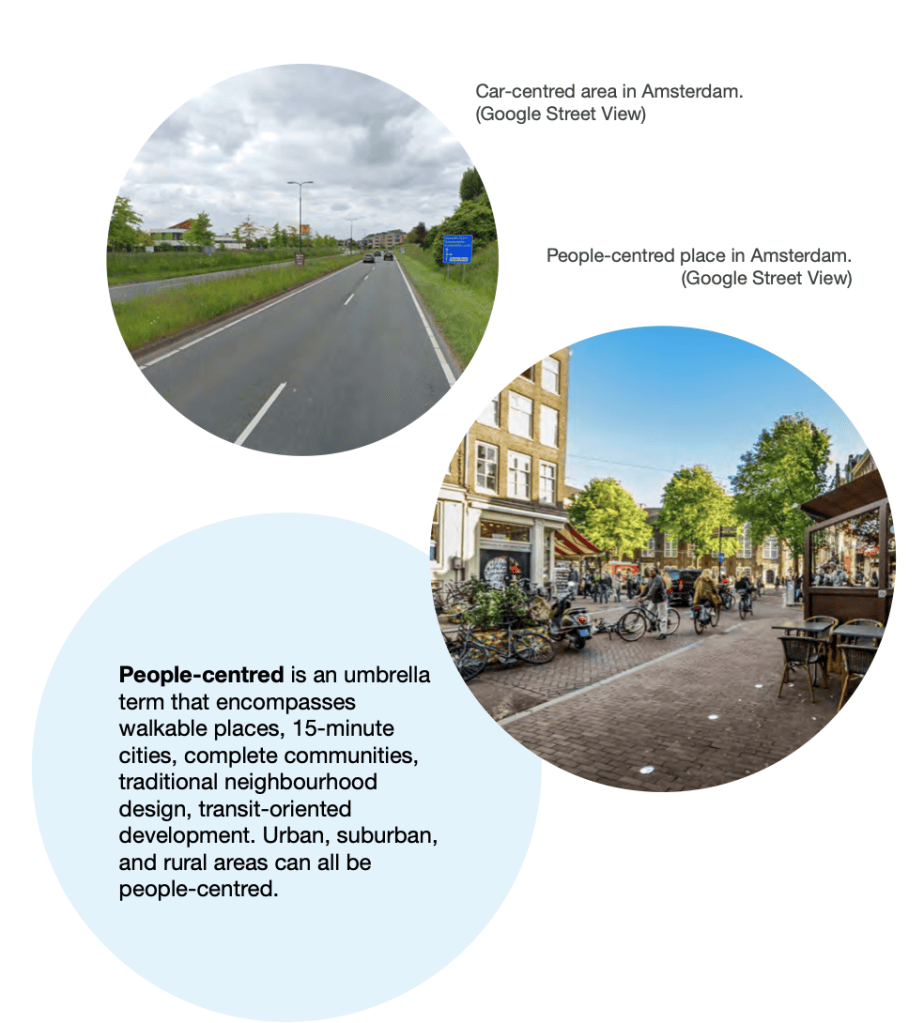
The central design flaw of the modern "stroad"—the dangerous, high-speed hybrid street lined with strip malls and driveways—is that it attempts to be both a flow street and a place street simultaneously.
- Flow Streets: These thoroughfares exist primarily to move cars at steady, uninterrupted speeds across urban regions. They feature minimal pedestrian crossings, controlled access, and robust separation from human-scale activities.
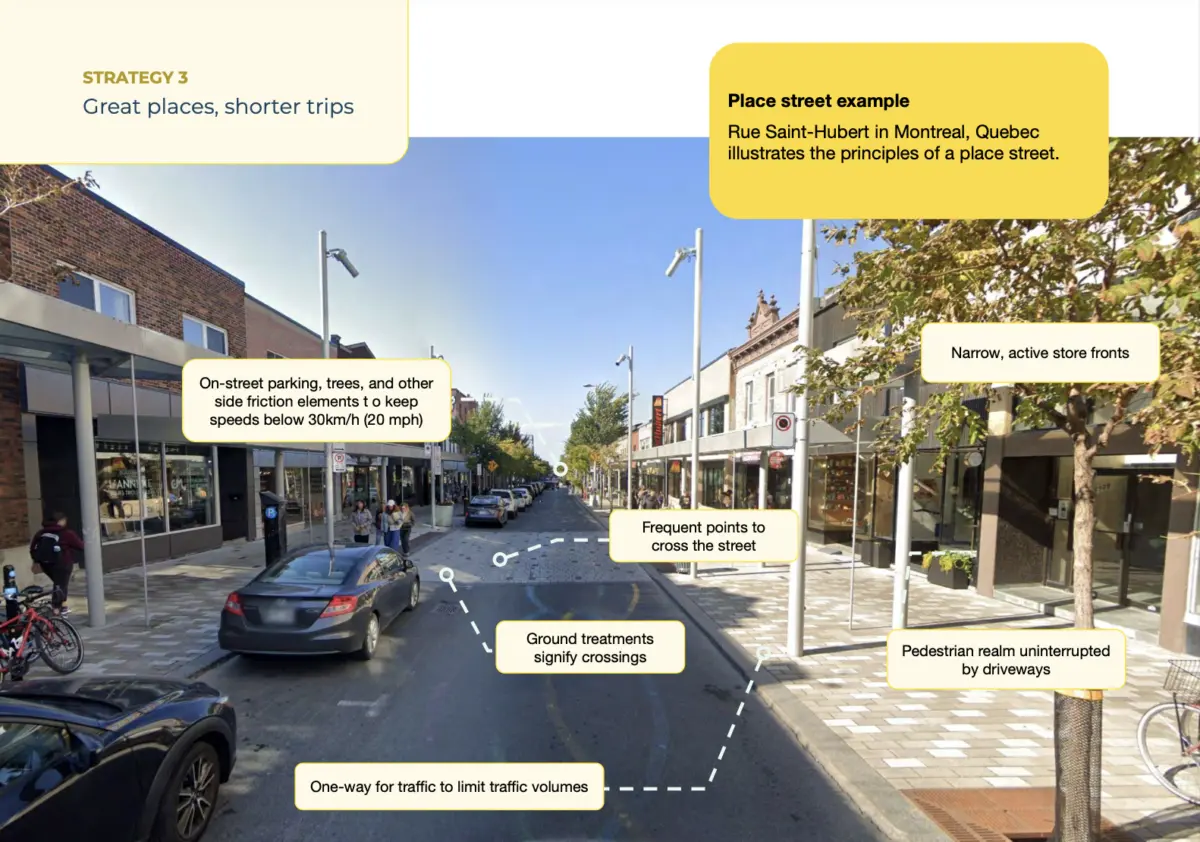
- Place Streets: These are human habitats designed to encourage walking, bicycling, shopping, dining, and community gathering.
According to the report, no single street can successfully prioritize both flow and place. When cities attempt to blend them, they create hostile environments where walking is hazardous, shopping is unpleasant, and driving is frustratingly erratic. By establishing clear networks of dedicated flow streets and ring roads (such as Barcelona’s superblock perimeters or Amsterdam’s downtown bypass rings), cities can safely channel automotive traffic around human-centric neighborhoods rather than through them.
2. Proximity Over Speed: The "Going Slower is Faster" Philosophy
Traditional traffic planning equates efficiency with speed: if cars go faster, journeys take less time. However, urban planners note that this metric ignores the sprawling land-use patterns that high-speed roads encourage. When cities are built for fast cars, destinations are pushed further apart, necessitating longer, more numerous vehicle trips.
By contrast, dense, land-use-efficient, walkable cities shorten the physical distance between destinations. Citing a Dutch adage that translates to "going slower is faster," the report highlights how compact urban design dramatically reduces overall trip lengths. Even if a motorist drives at a more leisurely pace through a well-designed urban core, the total time required to run errands or commute is often significantly lower than navigating the sprawling gridlock of an auto-centric metropolis.
3. Predictability Trumps Peak Speeds
Empirical research cited in the report reveals a crucial psychological truth about motorists: drivers value travel-time consistency significantly more than raw speed.
A motorist caught in auto-centric sprawl might experience a 10-minute commute on a clear morning, but a 35-minute slog during the evening rush hour. In contrast, a well-managed multimodal transportation network—where transit carries the peak commuter load and localized traffic calming keeps vehicular flow steady—offers predictable journey times. Drivers overwhelmingly prefer a reliable, 20-minute drive every single day over the volatile, high-stress roulette of car-dominated gridlock.
4. Strategic, Predictable Parking
Another major point of friction in urban redesign is the treatment of parking. Pro-car advocates frequently fight tooth and nail against the removal of on-street parking spaces, fearing that retail businesses will wither and drivers will be stranded.
The Happy Cities and Mobycon guide proposes a nuanced middle ground:
- On Slow, Narrow Streets: Allowing accessible on-street parking on single-lane, low-speed roads where bike lanes are physically impractical. Here, parked cars serve a valuable safety function, acting as a physical buffer between moving traffic and pedestrians walking on the sidewalk.
- At District Edges: Siting cleverly concealed multi-story or underground parking garages at the periphery of bustling commercial districts.
Crucially, the report notes that drivers do not actually demand parking directly in front of their final destination; rather, they dread the exhausting, 10-minute hunt for a spot. When cities provide predictable, easy-to-find parking structures paired with delightful, pedestrian-friendly walking environments, motorists are more than willing to park a few blocks away and enjoy a pleasant stroll to their destination.
Official Statements & Expert Perspectives
The release of “How to Design for Cars in People-Centered Places” has sparked rigorous debate across international planning circles, drawing praise from urban practitioners who recognize the urgent need to defuse political polarization over street design.
-
Nick Falbo, Senior Transportation Planner at Mobycon, emphasized that the ultimate goal of multimodal design is not to punish motorists, but to expand freedom of choice while improving overall system efficiency:
"What people don’t realize is [places like the Netherlands are] also great for driving. You have more access to jobs in 30 minutes by car in Amsterdam than you do in Atlanta. And part of the Dutch story isn’t just how they’ve made it great for people walking, biking, and taking transit; it’s how they’ve actually made it work for people driving as well."
Falbo added that shifting away from combative rhetoric is essential for project survival:
"It becomes this sort of ‘cars versus people’ discussion. [But] you can support driving in a way that doesn’t compromise the integrity of the place for people walking and biking and taking transit."
-
Houssam Elokda, Managing Principal at Happy Cities and co-author of the report, pointed out that ignoring the realities of driving leads directly to community backlash, canceled initiatives, and stalled municipal progress:
"When you’re in the work of building people-centered places, one of the biggest challenges is the backlash that you get from drivers. The project either never makes it to getting funded, or never gets approved. Or if it does get built, the second one doesn’t get built, and the third one doesn’t get built, because the needs of drivers were not effectively met. You create this alienation… but it doesn’t have to be that way."
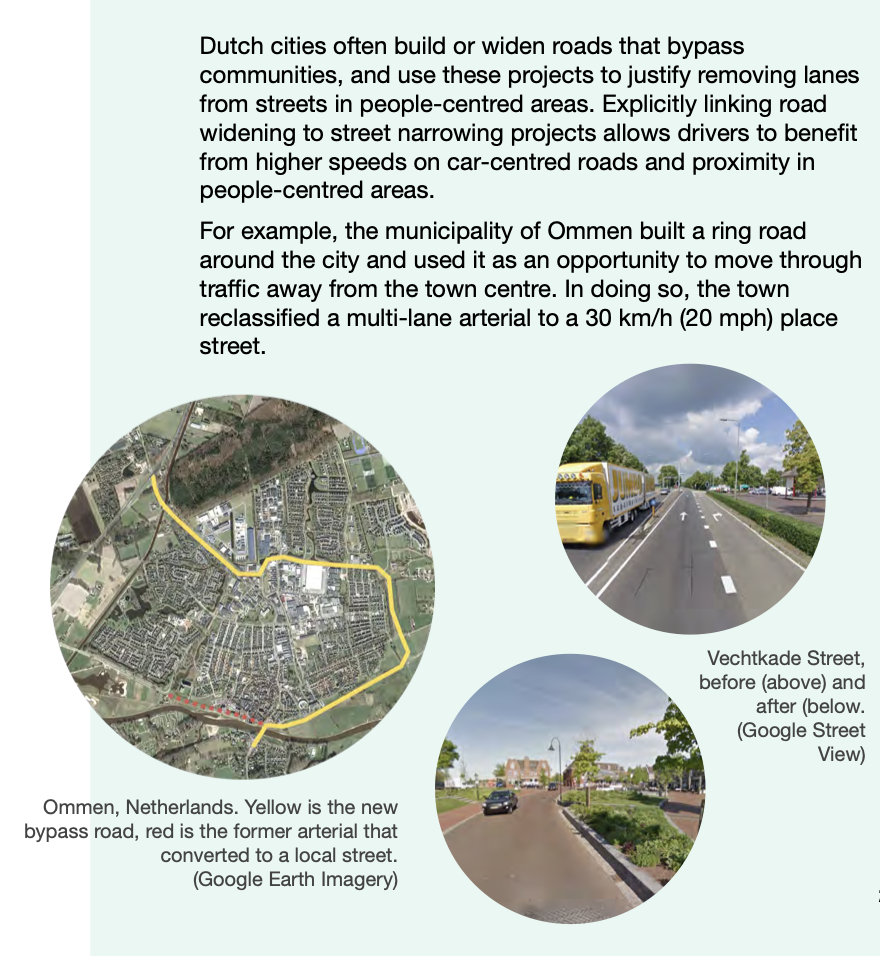
Elokda argues that building robust flow networks at the macro level gives cities the political capital to be uncompromising on micro-level place streets:
"[When you connect flow streets at the network level,] it allows you to be uncompromising on place streets. Because [then you can say to drivers], ‘I’ve met your needs there—but here, we’re not going to compromise. We’re going to build the people-centered streets that we want and we deserve.’"
Future Outlook: Building Coalitions for the 21st-Century City
As cities grapple with the intersecting crises of climate change, housing affordability, and traffic fatalities, the imperative to build sustainable, walkable communities has never been more urgent. Yet, as transportation departments have learned time and again, top-down mandates that alienate the motoring public routinely invite fierce political counter-revolutions.
The insights articulated in “How to Design for Cars in People-Centered Places” offer a pragmatic roadmap out of this ideological gridlock. By recognizing that drivers are not natural enemies of urbanism, but rather victims of a poorly engineered status quo, advocates can reframe the conversation.
The path forward does not require watering down the principles of livable streets; rather, it demands expanding the coalition for reform. When urban planners design networks that offer motorists reliable travel times, predictable parking, and uncongested bypass corridors, they remove the primary grievances driving political resistance.
Ultimately, the future of the successful 21st-century city relies on a simple, unifying realization: when we stop trying to force every single street to do everything poorly, and instead curate a harmonious ecosystem of dedicated flow networks and vibrant place-based communities, everyone wins—whether they arrive on foot, on two wheels, by bus, or behind the wheel of a car.


