











WASHINGTON, D.C. — In the high-stakes arena of global power projection, the old military adage remains undefeated: amateurs study tactics, while professionals study logistics. For the United States Armed Forces, the ability to project power across the globe relies almost entirely on the civilian mariners who crew the gray-hulled auxiliary ships of the U.S. Navy’s Military Sealift Command (MSC).
However, a prolonged labor crisis, coupled with a rapidly deteriorating global security environment, has brought the U.S. maritime industrial base to a critical juncture.
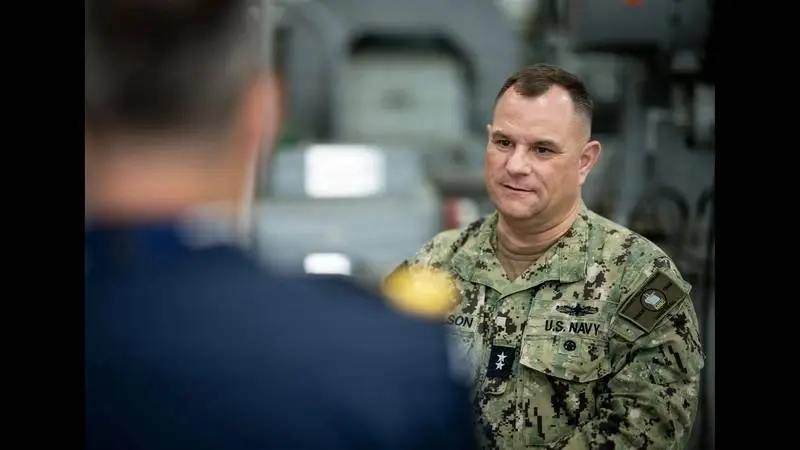
In a comprehensive interview on Maritime Matters: The MarineLink Podcast, Rear Admiral Benjamin Nicholson, Commander of the Military Sealift Command, laid out a sweeping, multi-front strategy to revitalize the nation’s civilian mariner (CIVMAR) workforce. From sweeping overhauls in compensation and quality-of-life benefits to tactical adjustments forged in the combat zones of the Middle East, Nicholson’s message was clear: the United States must rebuild its maritime labor force, or risk losing its ability to sustain a global military presence.

Executive Overview: The Silent Enabler of American Seapower
The Military Sealift Command operates a fleet of approximately 125 civilian-crewed, non-combatant vessels that perform critical logistics missions worldwide. These ships are the lifeblood of the U.S. Navy. They conduct underway replenishments (UNREP) to deliver fuel, ammunition, food, and spare parts to combatant vessels at sea, allowing carrier strike groups and amphibious ready groups to remain on station indefinitely without port calls.
Despite their vital role, MSC has operated under the shadow of a severe personnel deficit for over a decade. The shortage of qualified civilian mariners has led to burnout, extended deployments, and a declining retention rate, creating a vicious cycle that threatens national security.
To break this cycle, RADM Nicholson has championed a aggressive restructuring of how MSC recruits, compensates, and retains its workforce. By shifting the narrative from a simple "job at sea" to a mission of critical national importance—and backing that narrative with competitive compensation and modern shipboard amenities—MSC is attempting to stage a historic turnaround in maritime recruitment.
+-----------------------------------------------------------------+
|                  MILITARY SEALIFT COMMAND AT A GLANCE           |
+-----------------------------------------------------------------+
|  • Active Fleet: ~125 auxiliary & support vessels               |
|  • Core Mission: Global replenishment, transport, & logistics   |
|  • Primary Personnel: Civilian Mariners (CIVMARs)               |
|  • Key Challenge: Workforce deficit vs. high operational demand  |
|  • Strategic Focus: Pay parity, connectivity, and combat readiness|
+-----------------------------------------------------------------+
Detailed Chronology: From Peacetime Logistics to Active Combat Zones
The urgency behind MSC’s current transformation cannot be separated from the escalating geopolitical conflicts of the mid-2020s. The operational environment has shifted dramatically from routine peacetime transits to active, contested environments.

2023–2025: The Red Sea Crucible
The prolonged conflict in the Red Sea and Bab-el-Mandeb strait served as a wake-up call for U.S. maritime planners. Iranian-backed Houthi forces launched sustained drone, cruise missile, and ballistic missile attacks against commercial shipping and naval vessels. MSC supply ships, which routinely transit these waters to keep U.S. and allied warships armed and fueled, found themselves operating directly inside the weapons engagement zones.
This conflict demonstrated that civilian mariners are no longer operating in safe rear echelons; they are on the front lines of modern state-sponsored and proxy warfare. The experience forced MSC to rapidly adapt its training, shipboard defense protocols, and post-deployment psychological support structures.
2025–2026: The Pacific Pivot and the Tyranny of Distance
As tensions in the Indo-Pacific theater continue to simmer, MSC’s focus has shifted to the vast expanses of the Pacific Ocean. Unlike the relatively confined waters of the Middle East, a potential conflict in the Pacific presents the "tyranny of distance."
Supply lines stretching across thousands of miles of open ocean require a vastly larger and more resilient fleet of tankers and dry cargo ships. Throughout 2026, MSC has engaged in large-scale joint exercises designed to test distributed maritime operations (DMO), proving that logistics ships must be able to operate independently, often under emissions control (EMCON) conditions, to evade sophisticated adversary surveillance.
Supporting Context & Metrics: The Scale of the Mariner Deficit
The primary bottleneck facing MSC is not a lack of hulls, but a lack of qualified personnel to sail them. To understand the depth of the crisis, one must look at the mariner-to-billet ratio.
Historically, a healthy maritime logistics force requires a mariner-to-billet ratio of at least 1.5 to 1. This means that for every shipboard position (billet), there are 1.5 qualified mariners on the payroll. This ratio ensures that crews can rotate off ships for mandatory training, medical leave, and well-deserved vacation time without delaying ship deployments.
In recent years, MSC’s ratio plummeted to near-critical levels, occasionally dropping below 1.2 to 1 for specific highly specialized ratings, such as marine engineers, electronics technicians, and certified deck officers.
Mariner-to-Billet Ratio Health Scale:
[ 1.0 - 1.1 ] Critical Failure (Ships cannot sail / severe crew burnout)
[ 1.2 - 1.3 ] High Stress (No margin for leave or training; high attrition)
[ 1.4 - 1.5 ] Operational Equilibrium (Healthy rotation and sustainable operations)
The consequences of this deficit were severe:
- Extended Tours: Mariners scheduled for four-month tours were routinely asked to remain on board for six to eight months.
- Delayed Maintenance: Ships remained at sea longer, delaying scheduled shipyard maintenance and accelerating material degradation.
- Attrition: Burnout drove experienced mariners to seek employment in the domestic commercial sector (such as Jones Act coastal shipping or the booming offshore wind industry), where schedules are highly predictable and connectivity with families is superior.
Official Statements: Restructuring the Value Proposition
Speaking on the Maritime Matters podcast, RADM Benjamin Nicholson emphasized that solving the recruitment and retention crisis requires addressing both the material and spiritual needs of the modern mariner.
Restructuring Pay and Benefits
To compete with a lucrative domestic commercial market, MSC has initiated a comprehensive overhaul of its compensation packages.
"We have to be competitive with the commercial industry," RADM Nicholson noted. "That means looking closely at our base pay, our overtime structures, and our retention bonuses. If a mariner can make the same money working on a tugboat or an offshore supply vessel close to home, we have to offer a compelling financial package to bring them into the global mission."
The upgraded pay scales focus heavily on specialized technical ratings, such as licensed marine engineers and qualified members of the engine department (QMEDs), who are in high demand globally.
Improving Quality of Life at Sea
Beyond financial compensation, Nicholson highlighted "the quality-of-life gap" as a primary driver of attrition. In an era where younger generations expect constant digital connectivity, being cut off from family for months at a time is a non-starter for many prospective recruits.
To combat this, MSC has accelerated the rollout of high-speed satellite internet across its entire auxiliary fleet.
"We are working tirelessly to ensure our mariners have reliable, high-speed connectivity," Nicholson said. "Being able to FaceTime your family, manage your bank accounts, or simply stream entertainment during off-hours is no longer a luxury—it is a baseline operational requirement for retention."
Elevating "The Mission"
While pay and internet access are critical, Nicholson argued that the ultimate differentiator for MSC is the unique nature of its mission.
"Our mariners are not just moving commercial cargo from Port A to Port B," Nicholson emphasized. "They are an integral part of the national security apparatus of the United States. When you sail with MSC, you are directly supporting the defense of our nation and our allies. There is a profound sense of purpose in that."
Future Outlook: Building a Resilient Maritime Shield
As MSC looks toward the late 2020s and early 2030s, the command is pursuing a multi-pronged modernization strategy designed to ensure the U.S. military can sustain a fight in any contested environment.
+--------------------------------------------------------------------------+
|                     MSC'S STRATEGIC ROADMAP FOR THE FUTURE               |
+--------------------------------------------------------------------------+
| 1. WORKFORCE STABILIZATION                                               |
|    • Achieve and maintain a 1.5 mariner-to-billet ratio.                 |
|    • Implement standardized, predictable rotation schedules.             |
|                                                                          |
| 2. FLEET MODERNIZATION                                                   |
|    • Transition away from legacy steam-propulsion auxiliary ships.       |
|    • Integrate Next-Generation Logistics Ships (NGLS) for littoral ops.  |
|                                                                          |
| 3. TACTICAL TRAINING ENHANCEMENTS                                        |
|    • Provide advanced damage control and CBRN defense training.          |
|    • Integrate civilian crews into tactical combat training exercises.   |
+--------------------------------------------------------------------------+
Transitioning the Fleet
A key element of the future outlook is shipboard modernization. MSC is actively decommissioning its oldest, most maintenance-intensive vessels—particularly legacy steam-powered combat stores ships—and replacing them with modern, diesel-electric platforms. These newer ships require smaller, highly automated crews, partially mitigating the impact of the mariner shortage while offering safer, more ergonomic working environments.
Integrating Next-Generation Logistics Ships (NGLS)
To support distributed operations in shallow littoral waters, such as those found in the First and Second Island Chains of the Western Pacific, MSC is preparing for the introduction of the Next-Generation Logistics Ship (NGLS). These smaller, more agile vessels will act as the "connectors" between large fleet replenishment oilers and dispersed Marine Littoral Regiments, requiring new operational doctrines and specialized crew training.
Legislative and Political Support
Ultimately, RADM Nicholson’s vision requires sustained political and financial backing from Congress. Rebuilding the U.S. Merchant Marine and MSC is increasingly recognized on Capitol Hill as a bipartisan national security priority. Expanded funding for the Maritime Security Program (MSP) and the newly minted Tanker Security Program (TSP) are critical steps toward ensuring the nation maintains a robust pool of merchant mariners capable of being mobilized in times of conflict.
As the global maritime commons become increasingly contested, the men and women of the Military Sealift Command remain the indispensable foundation of American global influence. Through competitive compensation, modern shipboard technology, and a renewed commitment to the strategic mission, MSC is charting a course to ensure that when the nation calls, the supply lines will hold.


