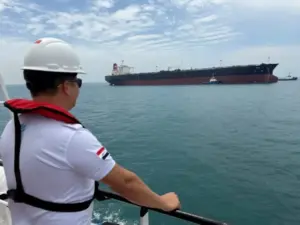





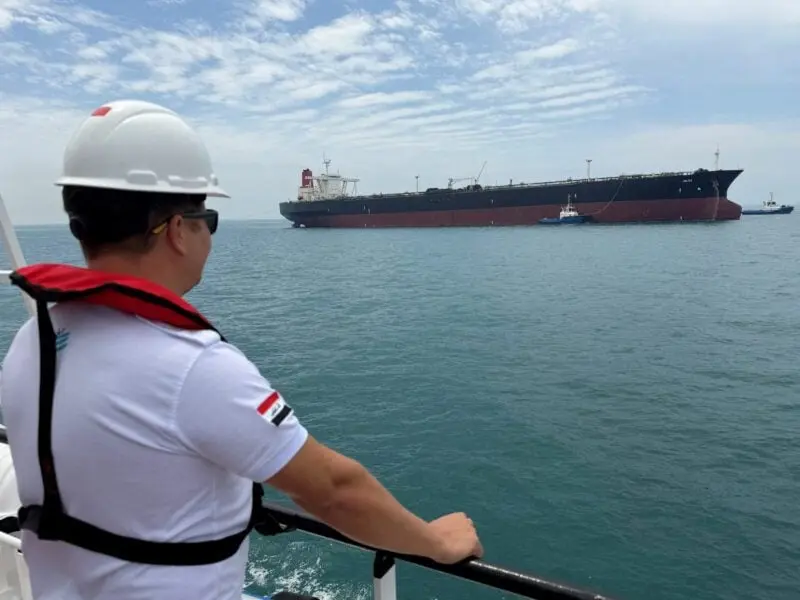
LONDON — The blast materialized without warning, a sudden, violent tear of orange flame fracturing the midnight blackness of the Strait of Hormuz. Standing on the bridge of his 300-meter-long supertanker, a veteran Filipino captain in his early 40s reacted with the split-second instincts forged over decades at sea. Grasping the helm controls, he veered his massive vessel—laden with two million barrels of highly volatile crude oil—around the burning wreckage of the ship ahead. Drones and missiles buzzed through the humid night air overhead.
After steering his ship clear of the immediate impact zone, the captain picked up his secure communications line to notify the United States Navy. The message was brief, professional, and chillingly routine.
This near-miss, recounted to Bloomberg on the condition of anonymity due to commercial sensitivities, is no longer an isolated crisis. Instead, it has become the standard cost of doing business in the world’s most critical maritime choke point. As diplomatic efforts between Washington and Tehran remain frozen—following the Trump administration’s rejection of an Iranian proposal to reopen the waterway to regular traffic—the global economy has become quietly dependent on a highly perilous, militarized shadow transit system.
Under the watchful eye of the U.S. military, an informal armada of tankers is keeping the world’s energy supply alive through sheer grit, "old-school" navigation, and extraordinary financial incentives.
Executive Overview: The Militarized Choke Point
The Strait of Hormuz, a narrow waterway separating the Persian Gulf from the Gulf of Oman, has long been the jugular vein of the global energy market. Historically, any disruption to its traffic has triggered immediate panic in commodity markets. Yet, in the autumn of 2026, a strange and fragile paradox has emerged. Despite ongoing hostilities, drone strikes, and state-sponsored sabotage, Middle East crude oil flows have staged a stunning recovery, climbing back to nearly 98% of their pre-war levels.
Middle East Crude Oil Flows Through Hormuz (2026)
| Metric | Details | Source |
|---|---|---|
| Daily Volume | ~17.5 Million Barrels per Day | JPMorgan Chase & Co. |
| Pre-War Recovery Rate | 98% of Historical Levels | Goldman Sachs Group Inc. |
| Estimated Targeting Risk | 1-in-20 chance of being hit | Shipping Industry Executives |
| Confirmed Seafarer Fatalities | 24 Deaths since conflict inception | International Maritime Organization |
This stabilization has not been achieved through diplomatic breakthroughs. Rather, it is the result of a highly coordinated, semi-covert collaboration between the U.S. Navy and the global merchant marine. Operating under a quiet version of "Project Freedom," American forces are actively routing, tracking, and shielding commercial tankers as they navigate a gauntlet of Iranian mines, loitering munitions, and anti-ship missiles. For the shipping companies, commodity traders, and crew members willing to brave the crossing, the rewards are astronomical—though the human and material risks remain precariously high.
Detailed Chronology: Navigating the Blackout Corridor
To understand how 17.5 million barrels of oil continue to pass through a active combat zone every day, one must examine the precise, step-by-step choreography of a modern Hormuz transit.

[PERSION GULF]
      │
      ▼
[PRE-ENTRY FORTIFICATION] ──► Sandbags & water drums stacked on bridge; fire pumps activated
      │
      ▼
[THE BLACKOUT INITIATION] ──► AIS transponder deactivated; all external lights extinguished
      │
      ▼
[OMANI COAST SHADOW RUN]  ──► Vessel hugs coastline (100m depth); manual "old school" navigation
      │
      ▼
[US NAVY ACTIVE ESCORT]   ──► 30-minute tactical check-ins; overhead air cover (jets/helicopters)
      │
      ▼
[GULF OF OMAN (EXIT)]     ──► AIS reactivated; cargo transferred / high-seas journey resumes
Phase 1: Pre-Entry Fortification
Before a tanker enters the high-risk zone, the crew transforms the vessel into a floating fortress. On both oil tankers and liquefied natural gas (LNG) carriers, crew members stack heavy sandbags and large steel drums filled with water around the bridge and accommodation spaces. This crude armor is designed to absorb the shrapnel of a drone or light missile strike, protecting the essential personnel steering the ship.
Simultaneously, the ship’s emergency fire pumps are activated and run continuously. Hoses are pressurized and laid out across the decks, ready to combat immediate ignitions.
Phase 2: The Blackout
As the vessel approaches the mouth of the Strait, the captain orders a total electronic and visual blackout. The ship’s breaker connecting to the Automatic Identification System (AIS)—the global transponder system that broadcasts a ship’s identity, speed, and location—is pulled.
On the bridge, the instruction is absolute: no navigational lights, no mobile phones, and only a single, low-emission radar unit left active. The radio silence is total, broken only by the quiet murmurs of an expanded bridge watch scanning the dark waters with night-vision optics.
Phase 3: Hugging the Omani Coast
To avoid the heart of Iranian patrol zones, tankers hug the coastline of Oman. Here, the sea depth drops to approximately 100 meters—more than deep enough for even the largest Very Large Crude Carriers (VLCCs) to sail safely. However, navigating within a mile of the jagged Omani cliffs in total darkness is an immense test of seamanship.
"I’m just lucky because I still remember the traditional navigation, the old school," the Filipino captain explained during an interview from his home country, where he was recovering from a grueling three-month tour. "They required no navigational lights. It’s quite challenging. We had to get our bearings using the physical silhouette of the coast and traditional lighthouses as our primary references."
Phase 4: The U.S. Navy Shield
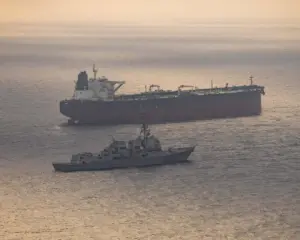
Throughout the transit, the silent vessels are never truly alone. Under the quiet escort protocols established in early summer, the U.S. Navy provides commercial captains with highly specific route coordinates and tactical waypoints.
Every 30 minutes, the tankers break radio silence for a brief, coded check-in with American military coordinators to report their progress and log any suspicious radar contacts or missile sightings. Overhead, the low rumble of U.S. fighter jets and the thrum of naval helicopters offer a reassuring, visible shield against potential aggressors.
Supporting Context & Economic Metrics: The Trillion-Dollar Incentive
The willingness of shipowners to subject their multi-million-dollar assets—and their crews—to such extreme danger is driven by a simple, brutal economic reality: the global energy supply cannot survive without the Strait of Hormuz, and the financial rewards for keeping it open are unprecedented.
       ┌────────────────────────────────────────────────────────┐
       │   Global Shipping Company (Reaps high charter rates)   │
       └───────────────────────────┬────────────────────────────┘
                                   │
                     Pays 6 months' bonus salary
                                   │
                                   ▼
       ┌────────────────────────────────────────────────────────┐
       │   Merchant Seafarer (Accepts high-risk transit)        │
       └───────────────────────────┬────────────────────────────┘
                                   │
                     Sends remittances back home
                                   │
                                   ▼
       ┌────────────────────────────────────────────────────────┐
       │    Local Economies (e.g., Philippines, India)          │
       └────────────────────────────────────────────────────────┘
The Cost of the Bypass
While regional powers are actively seeking alternatives, bypassing the Strait of Hormuz remains an agonizingly slow and prohibitively expensive endeavor. For instance, Abu Dhabi’s Crown Prince, Sheikh Khaled, is currently spending billions of dollars on infrastructure projects designed to pipe crude oil directly to ports on the Indian Ocean, bypassing the Iranian-threatened waterway entirely.
However, engineering realities dictate that these pipelines can only handle a fraction of the Gulf’s total export capacity. For the vast majority of global oil and gas markets, the Strait remains irreplaceable.
The Financial Windfall
Because the risk of transit is estimated at roughly 1-in-20, freight rates and crew wages have surged to historic highs.
- Tanker Charter Rates: During peak supply squeezes, shipowners have commanded up to $1 million a day for vessels willing to make the run.
- Crew Compensation: To secure crews for these hazardous journeys, shipowners are offering extraordinary hazard pay. Some companies are paying crew members an additional six months of salary simply to complete a single, three-month shuttle run through the Strait.
- Demographics: For seafarers hailing from lower-income nations like the Philippines and India, these bonuses represent life-changing sums of money, capable of securing their families’ financial futures.
Official Statements and Diplomatic Impasse
The current militarized status quo is the direct consequence of a collapse in high-level diplomacy. Efforts to restore normal transit rights through the Strait broke down completely after the U.S. administration rejected a comprehensive compromise package offered by Tehran. Since then, the waterway has functioned as an active gray-zone conflict arena.
In a statement addressing the ongoing operations, U.S. Central Command (CENTCOM) defended the military’s robust role in securing the commercial lanes:
"American forces have assisted thousands of ships through the Strait of Hormuz in recent months by providing coordinated protection. We remain laser-focused and will continue working with U.S. interagency partners, regional countries, and the shipping industry to increase the maritime traffic flow."
However, maritime labor organizations warn that this military umbrella is not impenetrable. The International Maritime Organization (IMO) recently reported that at least 24 seafarers have lost their lives in regional vessel attacks since the hostilities began.
"Tankers are always at risk, all the time," noted the Filipino captain, reflecting on the cold reality of his profession. "It’s a very dangerous vessel. One spark, one drone strike in the wrong compartment, and the entire ship is lost."
Future Outlook: A Fragile Equilibrium
The current system keeping Middle East oil flowing to the global market is a marvel of military coordination and merchant resilience, but it is also highly unstable.
Currently, the global economy is enjoying a deceptive stability, with crude flows hovering near pre-war levels. Yet this equilibrium relies entirely on two highly volatile factors: the continued willingness of underpaid seafarers to risk their lives for hazard pay, and the U.S. military’s ability to deter a full-scale state-on-state confrontation in the narrow channel.
Should a single missile strike result in a catastrophic environmental disaster or a mass-casualty event involving a civilian crew, the delicate logistics of the "Blackout Corridor" could disintegrate overnight. Insurers would likely pull coverage, crews would refuse to sail, and the 17.5 million barrels of oil that the world takes for granted would instantly vanish from the market.
For now, the captains of the merchant fleet continue to quiet their transponders, douse their lights, and steer into the dark.
"My family is quite scared," the captain admitted, preparing for his next inevitable deployment. "But I told them that I can handle the situation. I’m very proud. I enjoy my job, actually. If we don’t sail, the world stops."