





By Editorial Staff
Published October 1, 2026
Executive Overview
The global maritime supply chain is facing its most volatile period since the mid-20th century. According to the highly anticipated intelligence brief released on October 1, 2026, by Windward—a leading maritime AI and predictive risk management platform—the ongoing "crisis in the Gulf" has transitioned from a localized geopolitical flashpoint into a systemic, multi-theater disruption. Shipping routes traversing the Persian Gulf, the Strait of Hormuz, the Gulf of Oman, and the Red Sea have become high-risk zones, forcing commercial operators to make unprecedented operational and financial decisions.
The report highlights a marked escalation in both kinetic and non-kinetic threats. Commercial vessels are no longer merely collateral damage in regional disputes; instead, they are being targeted with sophisticated electronic warfare, including Global Navigation Satellite System (GNSS) spoofing and Automatic Identification System (AIS) manipulation. Simultaneously, physical threats from unmanned aerial vehicles (UAVs), waterborne improvised explosive devices (WBIEDs), and state-sponsored vessel seizures have reached levels that challenge the viability of traditional shipping corridors.

As the crisis deepens, the global shipping fleet has bifurcated. On one hand, Tier-1 container lines and major energy conglomerates are increasingly abandoning these high-risk straits in favor of the costly detour around the Cape of Good Hope. On the other hand, a burgeoning "dark fleet" utilizes deceptive shipping practices (DSPs) to navigate these dangerous waters, carrying sanctioned commodities under the cover of electronic noise. This Windward Intelligence Report serves as a critical diagnostic tool for compliance officers, insurers, and defense analysts trying to navigate an increasingly fractured maritime landscape.
Detailed Chronology: The Evolution of the Gulf Crisis
To understand the severity of the situation detailed in Windward’s October 1, 2026, briefing, it is essential to trace the compounding events that led to the current state of emergency. The crisis did not emerge in a vacuum; it is the result of a multi-year escalation in gray-zone warfare and shifting geopolitical alliances.
[Late 2025] ──> [Spring 2026] ──> [Summer 2026] ──> [Oct 1, 2026]
Asymmetric      GNSS Spoofing     Shadow Fleet       Windward Report
UAV Attacks     & AIS Hijacking   STS Transfers      Systemic Crisis
Phase I: The Normalization of Asymmetric Warfare (Late 2025)
The final quarter of 2025 saw a shift from sporadic, politically motivated shipping disruptions to a sustained campaign of asymmetric warfare. Regional militant groups, backed by state sponsors, weaponized low-cost drone technology to target commercial vessels transiting the Bab-el-Mandeb strait. What began as an effort to pressure specific nation-states quickly expanded into a generalized threat to any vessel associated with Western financial institutions or allied security frameworks.
Phase II: The Dawn of Electronic Battlespaces (Spring 2026)
By March 2026, the nature of the conflict evolved from physical interception to electronic disruption. Windward’s historical data noted a 300% increase in GNSS spoofing incidents in the Eastern Mediterranean, the Red Sea, and the Persian Gulf. Commercial tankers reported "phantom" positions, with onboard GPS systems placing them miles inland or in entirely different territorial waters. This electronic interference not only increased the risk of collisions in narrow channels but also complicated search-and-rescue operations, sowing deep anxiety among maritime underwriters.
Phase III: The Rise of the Shadow Fleet and Covert Transshipments (Summer 2026)
During the summer of 2026, the crisis became highly lucrative for illicit actors. As mainstream shipowners rerouted their vessels, a vast network of unregulated, under-insured "dark fleet" vessels moved in to fill the vacuum. These vessels systematically disabled their AIS transponders or used advanced spoofing techniques to conduct ship-to-ship (STS) transfers of crude oil in the Gulf of Oman and the Arabian Sea. This "shadow economy" served a dual purpose: it bypassed international sanctions and funded the very entities perpetuating the regional instability.
Phase IV: Direct Escalation and State-Sponsored Seizures (September–October 2026)
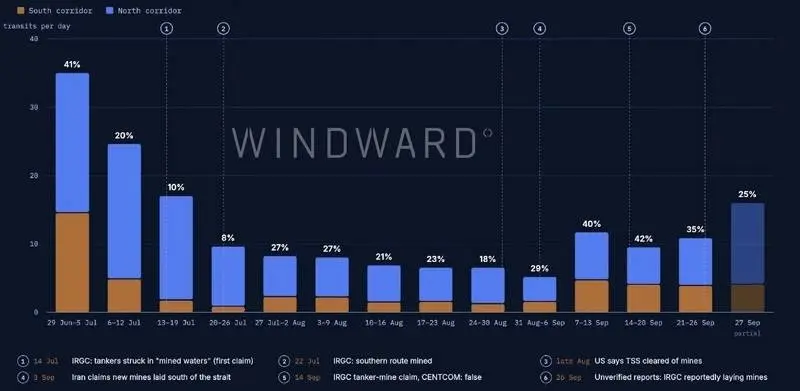
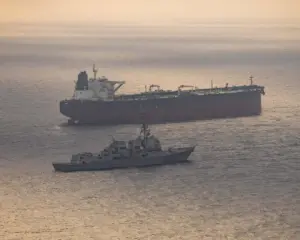
In the weeks leading up to the October 1 report, the crisis reached a boiling point. State-backed naval forces began conducting aggressive boardings and seizures of commercial vessels transiting the Strait of Hormuz, citing vague regulatory infractions. These actions effectively closed the strait to several international flags, prompting immediate naval deployments from global coalitions and triggering the urgent risk reassessments published in Windward’s latest brief.
Supporting Context & Metrics: Quantifying the Disruption
The Windward Intelligence Report does not merely describe the crisis qualitatively; it provides robust, data-driven metrics that illustrate the profound economic and operational toll on global trade. Through the integration of satellite imagery, behavioral AI, and historical shipping databases, Windward has quantified the parameters of this maritime emergency.
Deceptive Shipping Practices (DSPs) on the Rise
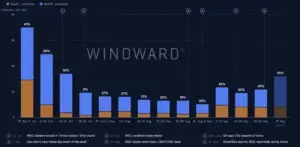
One of the most alarming trends identified in the report is the exponential rise in Deceptive Shipping Practices (DSPs) within the Gulf region.
| Metric / Indicator | Q3 2025 Baseline | Q3 2026 Current | Percentage Change |
|---|---|---|---|
| AIS "Dark" Incidents (Daily Average) | 14 | 48 | +242% |
| GNSS Spoofing Anomalies (Monthly) | 112 | 640 | +471% |
| Flag-Hopping (Vessels changing registry <90 days) | 35 | 98 | +180% |
| Unregulated STS Transfers (Gulf of Oman) | 22 | 74 | +236% |
The data indicates that "dark activity"—the intentional disabling of a vessel’s AIS transponder to mask its location—is no longer a tactic reserved solely for sanctioned oil tankers. Dry bulk carriers and container ships are increasingly going dark to avoid targeting by militant groups, creating an incredibly chaotic operational environment for maritime security forces.
The Financial Toll of Rerouting
The decision to bypass the Suez Canal and the Red Sea in favor of the Cape of Good Hope has fundamentally altered global shipping economics. Windward’s analytical models calculate the following impact for a standard Very Large Crude Carrier (VLCC) and a 15,000 TEU container ship:
- Transit Duration: Rerouting around Africa adds approximately 10 to 14 days to a voyage between Asia and Northern Europe.
- Fuel Consumption: An additional 800 to 1,200 metric tons of fuel is consumed per voyage, adding roughly $600,000 to $900,000 in direct bunker costs depending on current low-sulfur fuel prices.
- Carbon Emissions: A localized crisis has transformed into a global environmental setback, with maritime carbon emissions for Europe-bound cargo increasing by an estimated 25% to 35% due to the extended distances.
- Supply Chain Capacity: The longer transit times have effectively absorbed 12% to 15% of global container fleet capacity, leading to artificial shortages of empty containers in Asian manufacturing hubs and driving up spot freight rates.
[Asia Hubs] ──(Suez Canal Route: 30 Days - HIGH RISK)──> [Europe Ports]
[Asia Hubs] ──(Cape Route: 44 Days - SECURE BUT COSTLY)─> [Europe Ports]
War Risk Insurance and Risk Premium Surges
The insurance sector has responded to the heightened risk profile with dramatic pricing adjustments. According to Windward’s market synthesis, War Risk Premiums for transiting the Red Sea and the Strait of Hormuz have surged from 0.07% of a vessel’s hull value in early 2025 to as high as 1.5% to 2.0% in October 2026. For a modern container vessel valued at $150 million, a single transit through the risk zone now incurs an additional insurance cost of up to $3 million, rendering the route economically non-viable for many operators.

Official Statements and Industry Reactions
The release of the Windward Intelligence Report has reverberated across the maritime industry, prompting sharp reactions from trade bodies, regulatory agencies, and security coalitions.
Maritime AI Leadership Perspective
In an advisory statement accompanying the report’s release, security analysts at Windward emphasized the necessity of shifting from reactive security measures to predictive, data-driven strategies:
"The crisis in the Gulf has exposed the limitations of traditional maritime security frameworks. In an era where adversaries leverage both physical drones and digital spoofing, relying on manual vessel tracking is a liability. Shipowners, charterers, and underwriters must utilize real-time behavioral AI to identify anomalies before a vessel enters a high-risk zone. The data from our October 1 report demonstrates that risk is no longer static; it is highly dynamic and digitally manipulated."
International Shipping Bodies Demand Action
The International Chamber of Shipping (ICS) and the Baltic and International Maritime Council (BIMCO) issued a joint statement calling for enhanced multilateral naval protection in the region:
"The findings in the latest Windward report are a stark reminder that the freedom of navigation—a cornerstone of global economic stability—is under direct assault. We urge allied naval forces to expand the scope of security operations in the Gulf and the Red Sea. Commercial seafarers cannot continue to bear the brunt of geopolitical conflicts. Without decisive, coordinated international intervention, the economic fallout will be felt by consumers worldwide in the form of inflated goods and energy prices."
Insurers Tighten Compliance Standards
Leading marine underwriters in London and Singapore have indicated that they are incorporating Windward’s behavioral data directly into their underwriting guidelines. A representative from a major international P&I (Protection and Indemnity) Club noted:
"We can no longer write policies based simply on the flag a ship flies or its declared destination. The level of AIS spoofing and deceptive ship-to-ship transfers detailed in the October 1 brief requires us to demand continuous, verifiable data streams from our clients. Vessels that exhibit patterns of unexplained dark activity or GNSS anomalies will face immediate premium adjustments or the potential cancellation of coverage."
Future Outlook: Navigating the "New Normal"
As the industry looks toward the final quarter of 2026 and the beginning of 2027, the Windward Intelligence Report suggests that the disruptions in the Gulf are unlikely to resolve swiftly. Instead, the maritime sector must adapt to a "new normal" characterized by systemic instability and technological warfare.
The Permanent Shift to the Cape Route
Many major carriers are now treating the Cape of Good Hope detour not as a temporary emergency measure, but as a permanent operational strategy. Infrastructure investments are already shifting; bunkering ports along the African coast, such as Port Louis (Mauritius), Durban (South Africa), and Walvis Bay (Namibia), are undergoing rapid expansions to accommodate the massive influx of diverted commercial traffic.
The Technological Arms Race in Maritime Transit
To counter the threat of GNSS spoofing and electronic hijacking, the maritime industry is poised for a technological overhaul. Shipbuilders and maritime tech firms are accelerating the deployment of alternative navigation systems that do not rely solely on GPS or GLONASS.
[Vessel Sensors] ──> [Inertial Navigation Systems (INS)] ──> [AI Risk Engine] ──> Safe Transit
                 ──> [Celestial/Optical Tracking]       ──>
These include:
- Inertial Navigation Systems (INS): Using gyroscopes and accelerometers to track a vessel’s position relative to a known starting point, completely independent of external satellite signals.
- Optical and Celestial Tracking: Modernized, automated versions of traditional seafaring navigation that use cameras and star-trackers to verify positioning.
- Encrypted AIS: Industry-wide pressure is building on the International Maritime Organization (IMO) to develop next-generation, cryptographically secured AIS standards to prevent malicious spoofing and signal cloning.
Increased Regulatory Scrutiny on the "Shadow Fleet"
The proliferation of the dark fleet, as documented by Windward, will inevitably draw harsher regulatory crackdowns. Western governments and financial regulators are expected to implement more stringent "know your vessel" (KYV) and "know your cargo" (KYC) mandates. Financial institutions, port authorities, and maritime service providers will be legally required to screen vessels against advanced behavioral AI databases to ensure they have not engaged in deceptive practices or sanctions evasion in the Gulf.
Ultimately, the Windward Intelligence Report of October 1, 2026, serves as a watershed moment for global shipping. It underscores a fundamental truth: in the modern geopolitical arena, the safety of ocean-going commerce can no longer be taken for granted. Survival and profitability in this new era will belong to the operators who can successfully merge traditional seamanship with cutting-edge digital intelligence.