





Executive Overview
For thousands of vacationers aboard Royal Caribbean International’s massive Oasis of the Seas, a September getaway delivered an unexpectedly delicate reminder of the complex engineering feats required to operate a floating resort at sea. On Tuesday, September 29, 2026, guests scattered across select decks of the 5,602-passenger vessel received an unusual and slightly jarring notification letter slipped under their stateroom doors. The memorandum detailed an impending, temporary shutdown of the ship’s critical vacuum plumbing system, rendering onboard toilets completely non-operational for two separate two-hour windows on Wednesday, September 30, 2026.
While sudden utility interruptions can easily cause panic among travelers accustomed to land-based amenities, Royal Caribbean engineered the maintenance window to coincide precisely with a scheduled port stop in Nassau, Bahamas. By timing the two-hour blackouts—scheduled from 10:00 a.m. to 12:00 p.m. and again from 1:00 p.m. to 3:00 p.m.—during peak onshore excursion hours, the cruise line aimed to minimize inconvenience for the vast majority of passengers.
Nevertheless, the occurrence highlights the relentless, behind-the-scenes maintenance required to sustain mega-ships like the Oasis-class. Furthermore, because this marks the second time in less than three months that the vessel has undergone an identical, scheduled vacuum system suspension under nearly identical circumstances in Nassau, industry observers and passengers alike have begun questioning the underlying integrity and demands of the ship’s waste management infrastructure. This report provides an authoritative, in-depth look at the operational challenges, itinerary adjustments, historical context, and engineering realities surrounding the plumbing maintenance aboard Oasis of the Seas.
Detailed Chronology of Events
The chain of events leading up to the plumbing maintenance notice began days before the ship even left its homeport, heavily influenced by volatile autumn weather patterns along the United States East Coast.
Weather Disruptions and Itinerary Shifts
Oasis of the Seas originally set sail from New York City on Sunday, September 27, 2026, embarking on a highly anticipated 7-night Perfect Day Bahamas cruise. However, departure was delayed due to a powerful nor’easter that battered the region with high winds, heavy rain, and rough coastal seas. The meteorological hazard disrupted multiple cruise itineraries departing from New York and surrounding ports, forcing cruise operators to adapt on the fly to ensure passenger safety.
As a result of the weather-induced delay, the massive vessel had to adjust its schedule early in the voyage. The ship’s planned visit to Port Canaveral, Florida, scheduled for Tuesday, September 29, was entirely omitted. To compensate for the lost day and maintain as much of the promised vacation experience as possible, Royal Caribbean adjusted the itinerary to proceed directly toward the Bahamas, keeping the subsequent stops in Nassau on September 30 and the private island destination, Perfect Day at CocoCay, on October 1, strictly on the agenda.
The Delivery of the Stateroom Notices
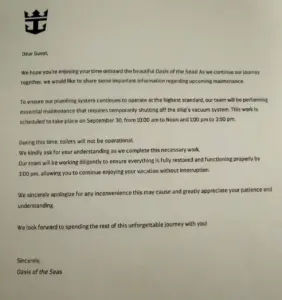
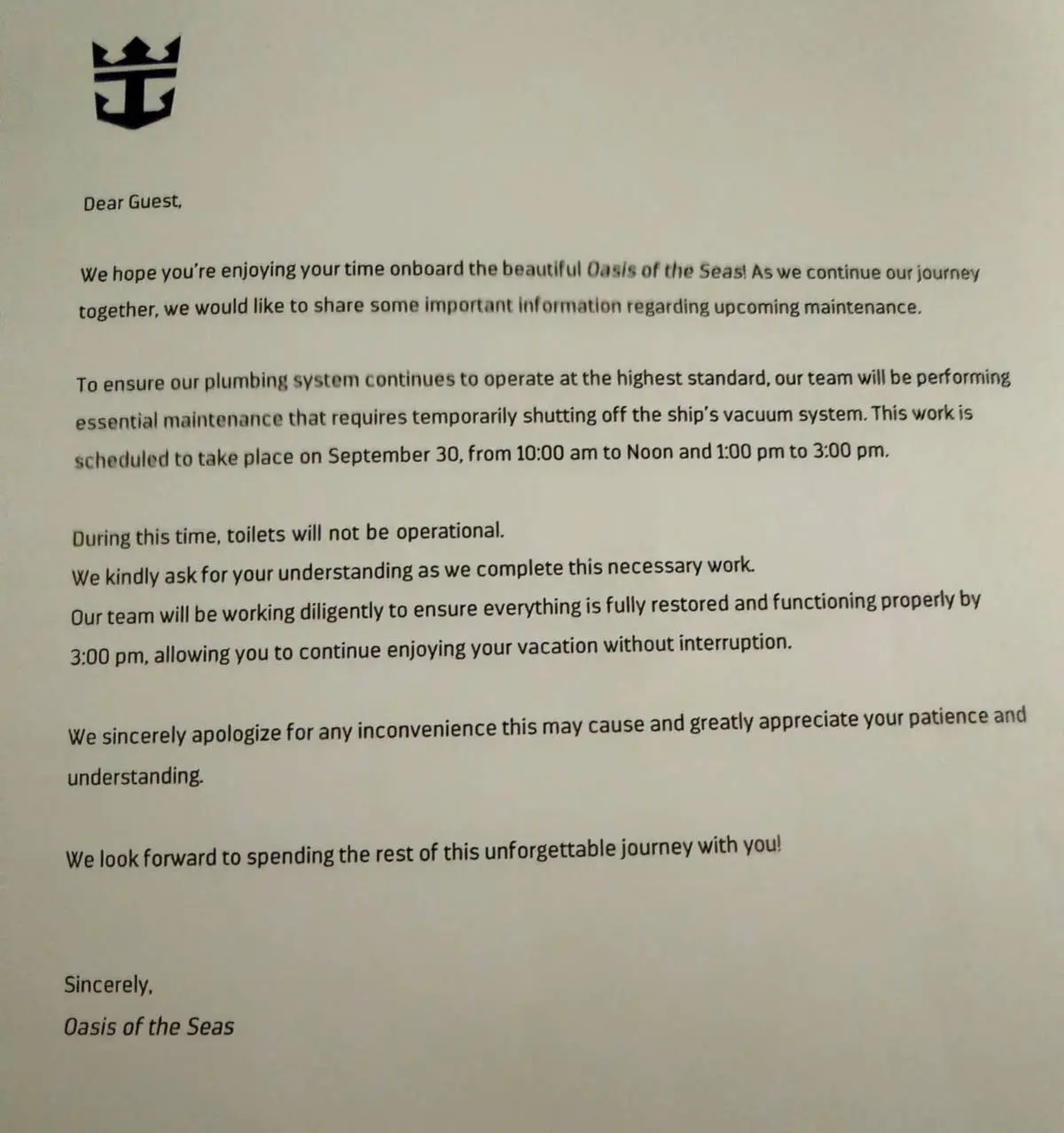
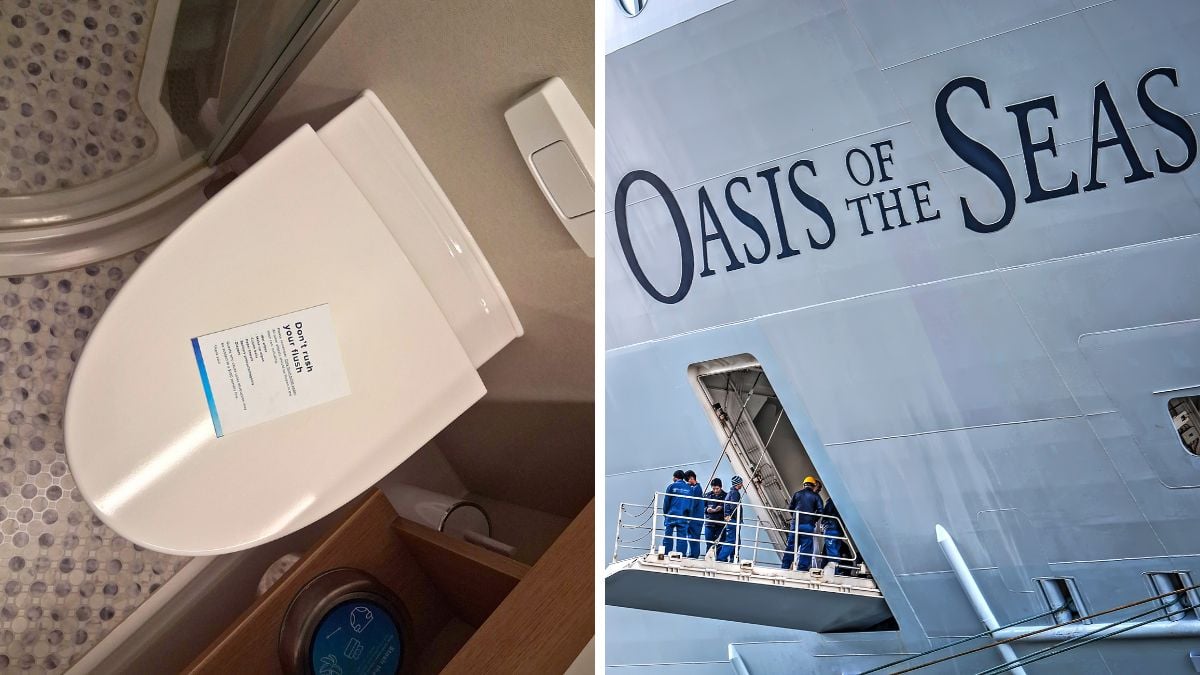
On Tuesday, September 29—while the ship was underway toward the Bahamas—guests on select decks began finding an unexpected piece of correspondence waiting in their staterooms. The letter, which quickly made its rounds on social media platforms such as dedicated passenger Facebook groups, laid out the engineering realities of keeping an Oasis-class vessel functioning at peak performance.
Interestingly, confusion immediately rippled through the passenger base as it became apparent that the delivery of the notices was not entirely uniform. Travelers residing on Decks 11 and 12 reported receiving the letters early, while passengers accommodated on Decks 6, 9, 10, and 14 noted a complete absence of the notification in their rooms initially, leading to speculation regarding the localized nature of the upcoming maintenance or simply staggered distribution patterns by the stateroom attendants.
The Maintenance Windows
According to the official communication distributed by the ship’s engineering department, the critical infrastructure work was broken down into two distinct, highly controlled blocks of time on Wednesday, September 30:
- First Window: 10:00 AM – 12:00 PM (Local Nassau Time)
- Second Window: 1:00 PM – 3:00 PM (Local Nassau Time)
The timing was inextricably linked to the ship’s modified berthing schedule in Nassau. Originally slated to arrive at 10:30 a.m., the weather-adjusted itinerary pushed the arrival time forward to 7:30 a.m., with an all-aboard time of 5:30 p.m. Because the non-flushable windows fell directly between 10:00 a.m. and 3:00 p.m., the vast majority of vacationers were expected to be off the ship exploring the Bahamian capital, lounging at local resorts, or participating in shore excursions, thereby drastically lowering the human load on the ship’s internal utilities during the shutdown.
Supporting Context and Metrics: Anatomy of a Mega-Ship
To truly understand why a temporary toilet shutdown is necessary—and how a vessel of this scale manages waste—it is helpful to examine the sheer scope and engineering metrics of Oasis of the Seas.
Scale and Capacity
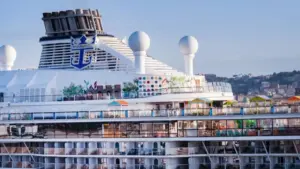
As one of the world’s largest cruise ships, Oasis of the Seas is essentially a floating smart city. Measuring 1,187 feet in length, with a gross tonnage exceeding 226,838 GT, the ship accommodates a maximum capacity of roughly 6,780 guests, supported by over 2,200 international crew members. On any given sailing, the ship routinely carries well over 7,500 souls.
Supplying water, processing wastewater, and managing sanitation for a population equivalent to a small town requires an advanced, industrial-grade engineering plant. The plumbing system cannot rely on traditional gravity-fed household infrastructure; instead, it depends on a high-powered, ship-wide vacuum drainage network.
How Cruise Ship Vacuum Toilets Work
Similar to the systems utilized on commercial airliners, marine vacuum toilets rely on negative pressure rather than standard water volume to clear the bowl. When a passenger presses the flush button, a pneumatic valve opens, and the differential pressure—created by powerful central vacuum pumps running continuously in the ship’s engine spaces—rapidly sucks the waste and a minimal amount of water through small-diameter piping at speeds of up to 150 miles per hour.
This system offers massive advantages at sea:
- Water Conservation: Traditional toilets use several gallons of fresh or desalinated water per flush. Vacuum systems use as little as a half-gallon, drastically reducing the burden on the ship’s onboard reverse osmosis water makers.
- Flexibility in Pipe Routing: Because waste is propelled by air pressure rather than gravity, pipes can run horizontally, vertically, or even upward, allowing engineers to route plumbing throughout complex structural steel frameworks.
However, the Achilles’ heel of a vacuum drainage network is its sensitivity to foreign objects. If a single valve fails, or if a blockage occurs in a primary trunk line, the vacuum pressure across an entire zone can drop, necessitating a complete, localized system reset or shutdown to safely clear obstructions, inspect seals, or perform mechanical overhauls on the central pumps.
Official Statements and Operational Transparency
Royal Caribbean’s handling of the maintenance window reflects a careful balance between corporate transparency and operational discretion. The letter provided to guests was designed to be informative while reassuring vacationers that the disruption would be handled swiftly and efficiently by the technical crew.
Excerpts from the Onboard Notification
The correspondence issued to passengers read, in part:
"To ensure our plumbing system continues to operate at the highest standard, our team will be performing essential maintenance that requires temporarily shutting off the ship’s vacuum system. During this time, toilets will not be operational."
Recognizing the potential for guest anxiety regarding such a fundamental utility, the letter concluded with a strong operational guarantee:
"Our team will be working diligently to ensure everything is fully restored and functioning properly by 3:00 PM, allowing you to continue enjoying your vacation without interruption."
The Absence of Granular Engineering Details
Despite the clarity regarding when the maintenance would occur, Royal Caribbean’s communications noticeably omitted why the specific maintenance was mandatory. Phrases such as "essential maintenance" and "to ensure our plumbing system continues to operate at the highest standard" are standard corporate terminology that leaves room for interpretation.
While cruise lines routinely schedule preventive maintenance during port days to service gray-water and black-water holding tanks, seawater intake valves, or pneumatic control panels, the lack of specific root-cause analysis has fueled speculation among seasoned cruisers, particularly given the historical context of the ship’s recent maintenance record.
Historical Context: A Recurring Phenomenon?
What elevates this plumbing incident from an isolated logistical footnote to an item of broader industry interest is its striking similarity to events earlier in the year.
The July 29, 2026 Precedent
An investigative review of maritime reporting reveals that Oasis of the Seas experienced an almost identical scenario just two months prior. On July 29, 2026, Cruise Hive documented an identical maintenance letter distributed to guests aboard the exact same ship.
Remarkably, the operational parameters of the July shutdown mirrored the September event down to the minute:
- The ship was docked in Nassau, Bahamas.
- The maintenance windows were set for the exact same hours (10:00 a.m. to 12:00 p.m. and 1:00 p.m. to 3:00 p.m.).
- The rationale provided to guests was word-for-word identical regarding the "vacuum system" and "essential maintenance."
Analyzing the Recurrence
The repetition of identical two-hour maintenance windows during port stops in Nassau has raised valid questions within the cruising community. Is Royal Caribbean executing a standardized, fleet-wide preventive maintenance schedule for Oasis-class vessels every 60 days? Or is the engineering team repeatedly addressing a persistent, chronic issue within the vacuum generation plant, valve manifolds, or black-water holding interfaces?
Because cruise operators guard proprietary engineering data closely, definitive answers remain elusive. However, maritime engineers note that large-scale vacuum systems on ships carrying upwards of 6,000 guests undergo immense mechanical stress. Continuous usage, combined with the occasional introduction of improper items into the system by passengers, can lead to accelerated wear on pneumatic valves and sealing gaskets, requiring periodic recalibration and preventative servicing.
The Human Element: Passenger Behavior and System Vulnerability
No discussion of cruise ship plumbing is complete without addressing the golden rule of maritime sanitation: The System Only Tolerates What Nature Intends.
Cruise lines go to extraordinary lengths—placing bold signage in every stateroom head, public restroom, and elevator lobby—to educate passengers on the strict limitations of marine plumbing. Despite these continuous reminders, foreign objects remain the single largest cause of unscheduled plumbing failures across the modern cruise industry.
What Does NOT Belong in a Cruise Ship Toilet:
- Cleansing and Disinfectant Wipes: Even products marketed as "flushable" do not break down rapidly enough in a high-speed vacuum pipe, routinely catching on pipe joints and creating massive clogs.
- Feminine Hygiene Products: Highly absorbent materials expand dramatically when exposed to moisture and vacuum pressure, instantly halting flow within branch lines.
- Paper Towels and Tissues: Facial tissues and commercial paper towels are engineered to hold their strength when wet, making them disastrous for marine plumbing.
- Diapers, Cotton Swabs, and Dental Floss: These items frequently slip past individual bowls and wedge themselves into automated pneumatic control valves, disabling entire deck zones.
When a blockage occurs, it rarely affects just one stateroom. Because multiple cabins share common branch lines feeding into vertical drainage drops, a single improper flush in one cabin can cause sewage backups in adjacent staterooms, necessitating emergency engineering intervention that can take hours to resolve.
By contrast, scheduled preventative maintenance—such as the planned shutdowns experienced on Oasis of the Seas—allows engineering teams to proactively inspect valves, clear minor accumulations, and test vacuum pressure levels before a catastrophic, unscheduled failure can occur during a day at sea.
Future Outlook: Engineering Resilience in Mega-Cruising
As the cruise industry continues to build larger ships designed to maximize passenger capacity and onboard entertainment, the underlying utility infrastructure must evolve in tandem. The experiences aboard Oasis of the Seas in July and September of 2026 serve as a valuable case study in modern cruise ship operations.
Key Takeaways for Future Itineraries
- Strategic Timing Mitigates Impact: By scheduling disruptive utility maintenance during peak port hours (such as the Nassau stops), cruise operators successfully insulate the passenger experience from the harsh realities of heavy engineering upkeep.
- Communication is Crucial: Providing clear, written advance notice enables guests to plan their onboard routines accordingly—such as using port facilities or public restrooms before returning to the ship—thereby reducing passenger frustration.
- The Importance of Passenger Compliance: The longevity and reliability of marine vacuum systems depend heavily on traveler compliance regarding what enters the bowl. Enhanced educational campaigns by cruise lines remain vital to reducing emergency repair incidents.
Ultimately, while finding a notice about non-operational toilets under a stateroom door can give any traveler pause, the structured execution of these maintenance windows demonstrates the high level of proactive care required to keep the world’s most impressive floating cities running smoothly. As Oasis of the Seas continues its autumn deployment in the Bahamas, the engineering crew’s meticulous attention to infrastructure ensures that passengers can return to enjoying their dream vacations with minimal disruption, secure in the knowledge that behind every magical cruise experience lies a dedicated team keeping the wheels—and the pipes—turning efficiently.