







Published by the Marine Accident Investigation Branch (MAIB)
Executive Overview
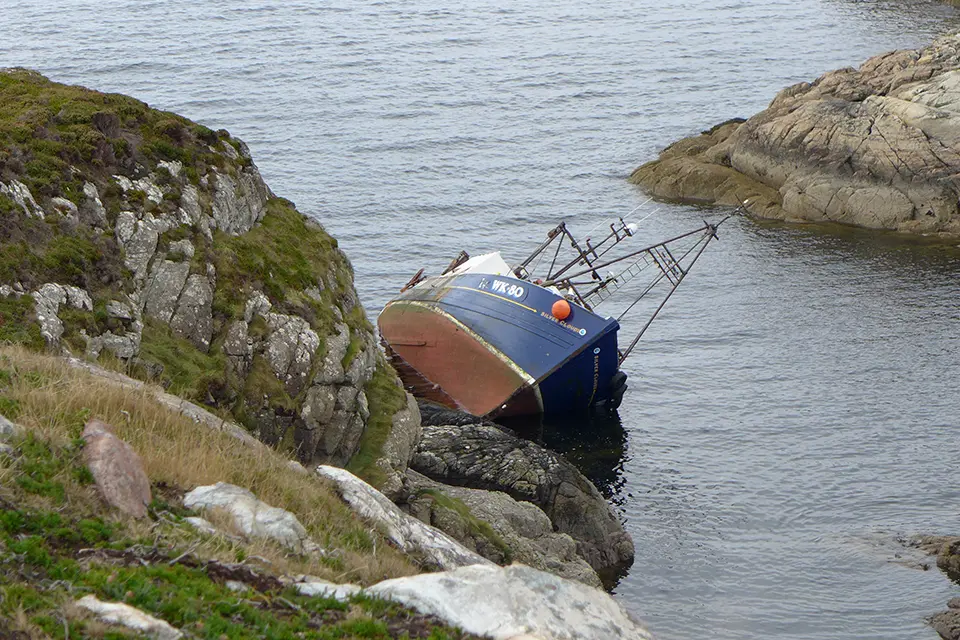
Maritime safety authorities have officially released their comprehensive accident investigation report concerning the harrowing grounding and eventual total loss of the commercial fishing vessel Silver Cloud II (WK 80). The incident, which unfolded in the early hours of October 14, 2025, occurred on the jagged, unforgiving shoreline of Rubha Rodha near Lochinver, Scotland. While the dramatic event mercifully resulted in no loss of human life, it serves as a stark, sobering reminder of the perennial perils faced by commercial fishers navigating some of the most volatile coastal waters in the British Isles.
The Silver Cloud II, a registered fishing vessel bearing the port letters and number WK 80, struck the rocky outcrops of Rubha Rodha under conditions that maritime investigators have scrutinized with intense professional rigor. The vessel’s subsequent inability to retract from the shallows, compounded by punishing sea states, relentless tidal forces, and the severe structural compromise sustained during initial impact, culminated in its tragic sinking and complete write-off.

The publication of the Marine Accident Investigation Branch (MAIB) report sheds critical light on the cascading chain of events that transformed a routine navigation transit into a marine emergency. Through exhaustive forensic analysis, interviews with surviving crew members, examination of electronic navigation logs, and environmental assessments, the MAIB report constructs a definitive narrative of what went wrong. More importantly, the document outlines vital safety lessons designed to prevent similar disasters from befalling other vessels operating within the highly competitive and physically demanding commercial fishing sector.
Detailed Chronology of the Incident
To fully comprehend the sequence of events that led to the demise of the Silver Cloud II, investigators reconstructed the vessel’s final hours with meticulous attention to detail.
The Approach and Environmental Conditions
On the evening leading up to October 14, 2025, the Silver Cloud II was operating off the northwest coast of Scotland. Weather conditions in the vicinity of Lochinver were characterized by deteriorating visibility, moderate to heavy swells, and gusting winds typical of the late-autumn transition in the North Atlantic approaches. Despite the challenging meteorological environment, the vessel’s bridge team proceeded with their operational schedule, navigating coastal waters well-known for their complex bathymetry, submerged hazards, and fierce tidal streams.
The Grounding at Rubha Rodha
At approximately the time noted in the official timeline, the Silver Cloud II made catastrophic contact with the rocky shelf at Rubha Rodha. The impact was immediate and violent, instantly breaching the vessel’s hull integrity and compromising internal watertight compartments. The sudden deceleration threw crew members off balance, instantly transitioning the atmosphere on board from routine watchkeeping to desperate crisis management.

Realizing the severity of the situation, the skipper initiated emergency protocols. Distress alerts were broadcasted to Her Majesty’s Coastguard, triggering a rapid, multi-agency emergency response coordinated from the mainland.
Evacuation and Rescue Operations
The efficiency of the emergency services played a decisive role in averting a fatal outcome. Local lifeboat crews from the Royal National Lifeboat Institution (RNLI), operating out of nearby stations, launched immediately into the hazardous sea conditions. Concurrently, search and rescue helicopter assets were scrambled to the scene.
Despite the darkness, heavy swell, and perilous proximity to the jagged rocks of Rubha Rodha, the rescue teams executed a textbook extraction of the Silver Cloud II crew. The mariners were safely winched or transferred from the stricken vessel just as conditions on the wreck deteriorated beyond manageable margins.
The Loss of the Vessel
With the crew safely ashore, attention shifted to salvaging the physical asset. However, the sheer exposure of the Rubha Rodha location rendered marine salvage operations nearly impossible in the immediate aftermath. Battered by relentless waves and rising tides, the Silver Cloud II was subjected to structural forces that it could no longer withstand. Within hours of the initial grounding, the vessel flooded completely, slipped from the rocks, and sank into deep water, resulting in its total loss.
Supporting Context & Metrics
The loss of the Silver Cloud II (WK 80) is not an isolated incident within the broader framework of UK maritime safety, but rather part of a continuing statistical challenge confronting the commercial fishing industry.
The Vulnerability of the Inshore Fleet
Statistical data compiled over successive decades by maritime safety agencies consistently identifies commercial fishing as one of the most hazardous civilian occupations in the world. Within the UK fleet, smaller inshore and mid-water vessels—such as the Silver Cloud II—face disproportionate risks compared to large-scale merchant shipping. Factors contributing to these elevated risk profiles include:
- Fatigue: Gruelling shift patterns and extended hours at sea significantly degrade cognitive function and situational awareness among bridge teams.
- Navigation Complexity: Operating close to shore, in confined channels, and around hazardous headlands like Rubha Rodha demands continuous, unyielding vigilance.
- Economic Pressures: The drive to maintain catch quotas and operational efficiency can inadvertently encourage risk-taking behaviors, such as pressing on through adverse weather or reduced visibility.
Technological and Human Factors
The MAIB investigation into the Silver Cloud II delves deeply into the interplay between modern bridge technology and human decision-making. While contemporary fishing vessels are outfitted with sophisticated electronic charting systems, GPS, radar, and automated identification systems (AIS), technology alone cannot eliminate risk.
Investigators analyzed whether over-reliance on electronic navigation aids, potential distractions on the bridge, or misinterpretation of radar data played a contributory role in the vessel’s failure to clear the hazards of Rubha Rodha. Furthermore, the report examines the vessel’s safety management systems, emergency preparedness drills, and the efficacy of the onboard lifesaving appliances utilized during the evacuation.
Official Statements and Findings
The release of the MAIB accident investigation report has prompted statements from maritime regulators, industry bodies, and safety advocates emphasizing the importance of transparency and continuous learning.
Insights from the Investigation Report
The official report provides an exhaustive, step-by-step breakdown of the mechanical, environmental, and human factors that converged on October 14, 2025. Key areas highlighted within the document include:
- Passage Planning: A critical evaluation of how the voyage was planned, noting discrepancies between intended tracks and the actual track executed prior to the grounding.
- Bridge Resource Management (BRM): An assessment of communication, task distribution, and leadership dynamics within the bridge team during the critical moments leading up to the impact.
- Post-Grounding Response: Commendation for the calm and disciplined execution of abandonment procedures by the crew, which directly contributed to the zero-fatality outcome, alongside an appraisal of the coordination between local rescue authorities.
Regulatory and Industry Reaction
Maritime authorities have reiterated that the primary purpose of an MAIB investigation is not to apportion blame or liability, but rather to prevent future accidents through the widespread dissemination of safety lessons.
In light of the findings, industry leaders have called upon all commercial vessel operators, skippers, and deckhands to review the report in detail. Training organizations are expected to incorporate the specific scenarios faced by the crew of the Silver Cloud II into future certificate of competency courses, ensuring that the hard-earned lessons of this incident translate into enhanced operational safety across the entire fleet.
Future Outlook
As the commercial fishing sector looks toward the future, the legacy of the Silver Cloud II (WK 80) will undoubtedly shape discussions surrounding regulatory compliance, technological integration, and safety culture.
Recommendations for Moving Forward
The MAIB report concludes with a series of concrete, actionable safety recommendations directed at vessel owners, skippers, and relevant industry associations. These recommendations focus on:
- Enhanced Training: Reinforcing the principles of effective passage planning, particularly when navigating in proximity to coastal hazards and under conditions of restricted visibility.
- Safety Culture Promotion: Encouraging an open reporting culture where near-misses and navigational concerns can be discussed without fear of reprisal, thereby empowering all crew members to speak up if they perceive an impending hazard.
- Equipment Familiarity: Ensuring that all crew members maintain a high level of proficiency with emergency communication gear, survival equipment, and evacuation procedures.
Conclusion
The grounding and subsequent loss of the Silver Cloud II off Lochinver stands as a stark reminder of the unforgiving nature of the sea. While the physical vessel has been lost to the depths off Rubha Rodha, the invaluable data captured within the MAIB investigation report ensures that its misfortune will serve as a beacon of safety for generations of mariners yet to come.
Media Enquiries and Further Information
For journalists, researchers, and maritime professionals seeking further details regarding the Silver Cloud II investigation report, official documentation can be accessed directly via the MAIB Online Report Portal.
For direct media enquiries (telephone only):
- Office Hours (Monday to Friday): 01932 440015
- Out of Hours (Emergency / Urgent Press Queries): 0300 7777878