








Executive Overview
In a year marked by escalating regulatory demands and accelerating climate imperatives across the maritime sector, European short-sea Roll-on/Roll-off (RoRo) operator CLdN has delivered a major sustainability performance milestone. According to data published in its newly released CSR Report 2026, the company’s owned vessel fleet achieved an average carbon intensity of 32g CO₂ per tonne-kilometer (CO₂/tonne-km) in 2025. This represents a sharp drop from the 37g CO₂/tonne-km recorded in 2024, demonstrating a year-on-year reduction of over 13.5% in operational emissions intensity.
CLdN Fleet Carbon Intensity Evolution
┌─────────────────────────────────────────────────────────┐
│ 2024: 37g CO₂/tonne-km                                  │
├─────────────────────────────────────────────────────────┤
│ 2025: 32g CO₂/tonne-km  [▼ 13.5% Reduction]             │
└─────────────────────────────────────────────────────────┘
This structural decline in carbon output positions CLdN among the most carbon-efficient short-sea logistics providers operating in Northwestern Europe. The results highlight the cumulative impact of multivariant decarbonization strategies, combining multi-fuel engine technology, vessel hull enhancements, digital route optimization, and expanded shore-power capabilities at key European port terminals.
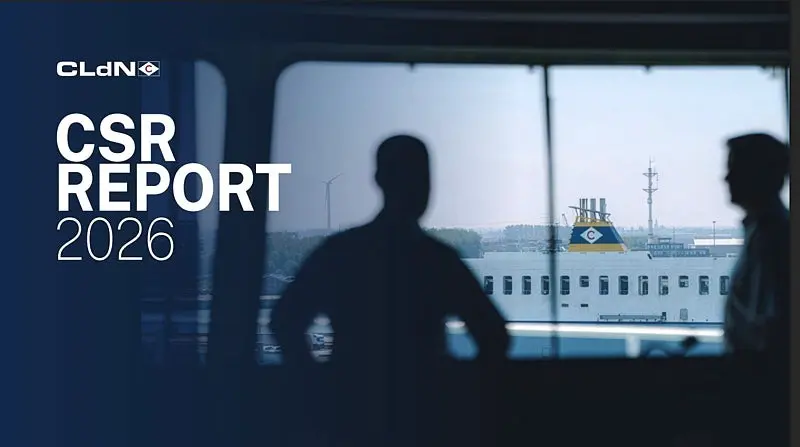
The performance metrics form the core of CLdN’s CSR Report 2026, a comprehensive document detailing the organization’s approach to Environmental, Social, and Governance (ESG) stewardship. The report evaluates the company’s material impacts, systemic climate risks, and emerging commercial opportunities as maritime transport integrates into the European Union’s decarbonization frameworks, including the EU Emissions Trading System (EU ETS) and the FuelEU Maritime regulation. Stakeholders, cargo owners, and industry analysts can examine the complete disclosures within the CLdN CSR Report 2026.
Detailed Chronology
The trajectory toward achieving 32g CO₂/tonne-km reflects a sustained, multi-year capital expenditure program and operational restructuring. A chronological examination reveals how strategic planning laid the foundation for these performance gains:
Decarbonization Timeline
├── 2021-2023: Fleet Modernization & LNG Dual-Fuel Expansion
├── 2024: Baseline Year (37g CO₂/tonne-km) & EU ETS Maritime Integration
├── 2025: Achievement Year (32g CO₂/tonne-km) & Shore-Power Rollouts
└── 2026: Publication of CSR Report 2026 & Next-Phase Zero-Emission Planning
Phase I: Fleet Modernization & Engine Optimization (2021–2023)
Prior to its recent operational achievements, CLdN initiated an aggressive fleet renewal program. Recognizing that vessel design dictates baseline energy efficiency for decades, the group invested in a series of ultra-efficient, high-capacity RoRo vessels. These ships featured optimized hull forms, low-friction silicon coatings, and dual-fuel propulsion engines capable of burning Liquefied Natural Gas (LNG) as well as drop-in bio-LNG and synthetic alternatives. During this period, early integration of shore-side electricity (cold ironing) infrastructure began at core hub terminals in Zeebrugge and Rotterdam.
Phase II: The 2024 Baseline & Regulatory Shifts
By 2024, CLdN recorded an average fleet emissions figure of 37g CO₂/tonne-km. While already outperforming conventional road transport and many regional maritime peers, 2024 served as a critical baseline year. The formal inclusion of maritime transport into the EU ETS in January 2024 increased financial accountability for carbon outputs. In response, CLdN accelerated operational measures, including engine load optimization, weather routing adjustments, and trial blending of drop-in biofuels to reduce carbon intensity across high-frequency corridors connecting Belgium, the Netherlands, the UK, Ireland, Spain, and Scandinavia.
Phase III: The 2025 Operational Breakthrough
Throughout 2025, the compounding benefits of fleet retrofits, modern vessel deployments, and terminal efficiencies yielded measurable results. Operational data confirmed a 5g drop in carbon intensity, lowering the fleet average to 32g CO₂/tonne-km. Key catalysts included:
- Maximized utilization of LNG dual-fuel capacity on trunk routes.
- Strategic expansion of shore-power connections, eliminating auxiliary engine burn during port turnarounds.
- Integration of machine-learning trim and draft management systems across the active fleet.
Phase IV: Publication of the CSR Report 2026
In early 2026, CLdN published its latest Corporate Social Responsibility report. Aligned with modern European reporting standards—including elements of the Corporate Sustainability Reporting Directive (CSRD)—the document outlines the material risks facing short-sea shipping while benchmarking the company’s ESG performance metrics, carbon accounting methodologies, and social governance structures.
Supporting Context & Metrics
To appreciate the significance of reaching 32g CO₂/tonne-km, the achievement must be viewed within the context of wider freight logistics, European transportation policy, and the technical mechanics of short-sea shipping.
Comparative Carbon Intensity in Freight Transport
Direct freight transport accounts for a major portion of supply chain Scope 3 emissions. Short-sea shipping serves as a vital alternative to long-haul road transport across Europe. Converting cargo from over-the-road trucking to short-sea maritime routes—often referred to as modal shift—offers immediate structural carbon reductions.
| Transport Mode | Average Carbon Intensity (g CO₂/tonne-km) |
|---|---|
| CLdN Fleet Average (2025) | 32 |
| CLdN Fleet Average (2024) | 37 |
| Standard RoRo Industry Average (Short-Sea) | 45 – 60 |
| Heavy Goods Vehicle (HGV – Diesel Truck) | 80 – 120 |
| Air Freight (Short-Haul Cargo) | 500 – 900 |
Data illustrates the structural carbon advantages of high-efficiency short-sea RoRo shipping over traditional road and air freight modalities.
By dropping to 32g CO₂/tonne-km, CLdN offers supply chain partners a mechanism to cut their Scope 3 transport emissions. Moving standard semi-trailers or un-accompanied freight via CLdN’s network generates a fraction of the carbon footprint associated with driving the equivalent distance via highway networks.
Emissions Comparison per Tonne-Kilometer (g CO₂)
┌───────────────────────────────────────────────────────────┐
│ CLdN Fleet (2025): 32g                                   │
├───────────────────────────────────────────────────────────┤
│ Industry Average RoRo: 50g                                │
├───────────────────────────────────────────────────────────┤
│ Heavy Diesel Truck (HGV): 100g                            │
└───────────────────────────────────────────────────────────┘
Technical Levers Behind the Emissions Reduction
The transition from 37g to 32g CO₂/tonne-km required coordinated technical and operational enhancements:
       ┌──────────────────────────────────────────────────┐
       │   Key Technical Levers driving 32g CO₂/tonne-km  │
       └─────────────────────────┬────────────────────────┘
                                 │
   ┌─────────────────────────────┼─────────────────────────────┐
   ▼                             ▼                             ▼
┌───────────────────────┐ ┌────────────────────────┐ ┌────────────────────────┐
│ Alternative Propulsion│ │ Terminal Electrification│ │ Hydrodynamic Efficiency│
│ • LNG Dual-Fuel       │ │ • Shore Power / Cold   │ │ • Silicon Hull Coatings│
│ • Bio-LNG Blends      │ │   Ironing Integration  │ │ • Trim & Draft AI      │
│ • Synthetic Fuel Prep │ │ • Zero Auxiliary Burn  │ │ • Propeller Cleaning   │
└───────────────────────┘ └────────────────────────┘ └────────────────────────┘- Alternative Fuel Integration: Modern dual-fuel engines operating on LNG burn cleaner than traditional Heavy Fuel Oil (HFO) or Very Low Sulfur Fuel Oil (VLSFO). LNG usage reduces CO₂ emissions by roughly 20% on a tank-to-wake basis, while eliminating sulfur oxides ($SO_x$) and fine particulate matter, and reducing nitrogen oxides ($NO_x$) emissions. The incorporation of certified bio-LNG further depresses lifecycle greenhouse gas intensity.
- Terminal Electrification & Shore Power: Auxiliary engines historically ran during port berth stays to power onboard lighting, refrigeration, and operational systems. By connecting ships to shore-side renewable electricity grids across major terminals, CLdN eliminated localized emissions and lowered overall fuel usage per voyage cycle.
- Hydrodynamic and Operational Efficiency: Upgrades to hull coatings using low-friction fluoropolymer silicones reduced hydrodynamic drag. Coupled with automated voyage planning software that optimizes vessel speed against tidal flows and port slot availability, ships burn less fuel per nautical mile without compromising schedules.
The Regulatory Landscape: EU ETS and FuelEU Maritime
The timing of these emissions reductions matches the implementation of strict climate regulations across the European Union:
- EU ETS for Maritime: Enacted in 2024, the inclusion of shipping requires vessel operators to purchase and surrender emission allowances (EUA) for their carbon emissions on voyages within, into, or out of EU ports. Lowering fleet intensity directly shields CLdN and its customer base from exposure to volatile carbon market pricing.
- FuelEU Maritime: Implemented in January 2025, this mandate targets the greenhouse gas (GHG) intensity of energy used onboard ships. By establishing strict baseline limits that become progressively tougher every five years, FuelEU Maritime penalizes carbon-intensive fuels while rewarding early adoption of renewable and low-carbon fuels. Achieving 32g CO₂/tonne-km positions CLdN comfortably within early compliance windows.
Official Statements
Reflecting on the publication of the report and the fleet’s technical achievements, CLdN management emphasized that operational decarbonization is both an environmental necessity and a key commercial advantage.
In detailed commentary accompanying the release of the report, executive leadership highlighted the role of targeted investments:
"Achieving an average fleet carbon intensity of 32g CO₂/tonne-km in 2025 validates our long-term strategy of investing in modern, high-capacity vessels and continuous operational improvement. Moving from 37g to 32g in a single year demonstrates that targeted capital deployment, operational discipline, and energy-transition technologies can yield immediate, measurable carbon reductions.
As regulatory mechanisms like EU ETS and FuelEU Maritime reshape European logistics, providing carbon-efficient short-sea services allows our customers to shrink their Scope 3 footprint while maintaining reliable, cost-effective supply chains. Our CSR Report 2026 offers full transparency into these metrics, showing how we manage material risks, lower our footprint, and build a sustainable short-sea freight network for Europe."
The report highlights that transparency in carbon accounting is essential as enterprise cargo owners face increasing corporate climate disclosure obligations across Europe.
Future Outlook
While achieving 32g CO₂/tonne-km marks a significant milestone, CLdN’s CSR Report 2026 outlines a forward-looking roadmap aimed at deep decarbonization over the next decade.
          Target Pathway to Net-Zero
  37g CO₂/tonne-km ──► 32g CO₂/tonne-km ──► Sub-25g Target ──► Net-Zero
     (2024)               (2025)               (2030)         (2050)
Strategic Objectives Through 2030
Looking ahead, CLdN’s decarbonization pathway focuses on several key areas:
- Scaling Renewable and Synthetic Fuels: While LNG provided the initial step-change in emissions reduction, moving below 30g CO₂/tonne-km will require scaling up drop-in bio-LNG (liquefied biomethane) and non-biological renewable synthetic fuels (e-LNG, synthetic diesel). The fleet’s modern dual-fuel engines are designed to burn these fuels without requiring major mechanical retrofits.
- Next-Generation Zero-Emission Vessel Concepts: Beyond dual-fuel platforms, CLdN continues to explore alternative fuel vectors, including battery-hybrid systems, green methanol, and wind-assisted propulsion systems (such as rotor sails or rigid wings). These technologies could further lower fuel consumption on open-sea transit routes.
- End-to-End Multimodal Integration: Terminal infrastructure strategy will focus on turning port hubs into green energy nodes. Future capital expenditures plan for expanded solar generation at terminal sites, full fleet connection capabilities to zero-emission shore-power, and direct rail-to-sea intermodal transfers to maximize freight efficiency across every leg of the trip.
Future Decarbonization Pillars
├── 1. Alternative Fuels: Bio-LNG & E-Fuels
├── 2. Wind-Assisted & Hybrid Propulsion
├── 3. Integrated Green Terminals & Rail Intermodal Hubs
└── 4. Transparent ESG & Regulatory Compliance
As logistics chains undergo systemic decarbonization, CLdN’s progress—dropping emissions intensity to 32g CO₂/tonne-km and publishing transparent ESG data in its CSR Report 2026—establishes a strong benchmark for short-sea maritime operations in Europe.
To review the complete metrics, ESG methodologies, and risk frameworks, access the full publication: CLdN Corporate Social Responsibility Report 2026.