







By Katie Hogge Moore
Senior Manager, Digital Engagement, Ocean Conservancy
6-Minute Read
Executive Overview
Our blue planet is an overwhelmingly vast and mysterious world, hiding its greatest secrets beneath miles of shifting, sunless water. Nowhere is this more apparent than in the western reaches of the North Pacific Ocean, east of the Philippines, where the ocean floor plummets into the legendary Mariana Trench. Spanning a protected marine national monument area of more than 95,000 square miles, this colossal underwater expanse contains an intricate ecosystem of submerged islands, active volcanic arcs, and a geological depression so profound it challenges our fundamental understanding of the Earth.
As we peer deeper into the abyss, humanity is forced to confront both the breathtaking scale of our natural world and its profound fragility. While once considered completely isolated from human influence, the deepest trenches on Earth are now serving as a stark barometer for global environmental pressures. This comprehensive exploration answers the most critical questions about the Mariana Trench, examining its monumental scale, the extreme physics governing its depths, the remarkable life forms that call it home, and the pressing conservation challenges threatening its future.

Supporting Context & Metrics: Decoding the Scale of the Trench
To truly grasp the magnitude of the Mariana Trench, one must abandon everyday terrestrial frames of reference. The trench is not merely a crack in the ocean floor; it is a monumental geological feature that redefines planetary proportions.
Depth Comparisons: Beyond Everest and the Titanic
The deepest known point within the Mariana Trench is the hauntingly desolate Challenger Deep, plunging nearly 36,000 feet (approximately 11,000 meters) below the ocean’s surface. To put this vertical drop into perspective, consider the world’s tallest peak: Mount Everest stands at roughly 29,000 feet above sea level. If you were to submerge Mount Everest entirely into the Challenger Deep, its peak would still be blanketed by more than a mile of crushing ocean water.
For maritime history enthusiasts, the RMS Titanic rests at a formidable depth of roughly 12,500 feet below sea level. Challenger Deep plunges to depths nearly three times that of the world’s most famous shipwreck.
The "Grand Canyon of the Ocean"
While oceanographers frequently nickname the Mariana Trench the "Grand Canyon of the ocean" to visualize its immense scale, the comparison wildly undersells the trench’s true proportions. The footprint of the Mariana Trench is estimated to be 120 times larger than Arizona’s Grand Canyon. To reach the seafloor of Challenger Deep, an explorer would have to stack six Grand Canyons vertically on top of one another. Furthermore, the trench is remarkably wide, stretching roughly 43 miles across—making it approximately five times wider than it is deep.
The Physics of the Abyss: Crushing Water Pressure
Perhaps the most punishing aspect of the Mariana Trench is its incomprehensible water pressure. In the marine environment, pressure increases by one atmosphere (roughly 14.7 pounds per square inch, or PSI—equivalent to the weight of a standard bowling ball resting on every square inch) for every 33 feet (10 meters) of descent.
At a depth of 2,000 feet, a submersible experiences pressure equivalent to 60 bowling balls stacked on every square inch of its hull. However, at the bottom of Challenger Deep, the atmospheric pressure escalates to an astronomical 16,000 PSI. This force is comparable to having an entire, fully grown African elephant pressing down on every single square inch of a vessel. To translate this into a human-scale metric: a human body exposed to the bottom of the Mariana Trench would experience a force equivalent to having 50 jumbo jetliners piled directly on top of them.
Detailed Chronology: From the HMS Challenger to Modern Submersibles
The history of our engagement with the Mariana Trench is a testament to human curiosity, engineering prowess, and the relentless drive for scientific discovery.

- 1875 — The First Sounding: The existence of the deep ocean trench was completely unknown until the landmark expedition of the British Royal Navy ship HMS Challenger. Using a rudimentary and time-consuming method, scientists lowered a heavily weighted rope into the Pacific Ocean and were utterly baffled when the line ran out nearly five miles down. This foundational discovery birthed the modern era of deep-sea oceanography.
- January 23, 1960 — The Historic Trieste Dive: Oceanographers Jacques Piccard and Don Walsh achieved the unthinkable, descending inside the U.S. Navy bathyscaphe Trieste to the absolute floor of Challenger Deep. The treacherous, pitch-black journey took nearly five hours, proving that human exploration of the planet’s most extreme environments was mathematically and mechanically possible.
- March 2012 — The First Solo Dive: Famed filmmaker and explorer James Cameron made history by piloting the Deepsea Challenger submersible to the seafloor in a heavily publicized solo dive. Reaching the bottom in a little over two and a half hours, Cameron’s expedition ushered in a new era of high-definition imaging and scientific sampling.
- 2022 — Expanding Scientific Frontiers: Oceanographer Dr. Dawn Wright completed a historic four-hour descent into Challenger Deep aboard a modern submersible, mapping localized topography and bringing a critical scientific lens to the ecology of the hadal zone.
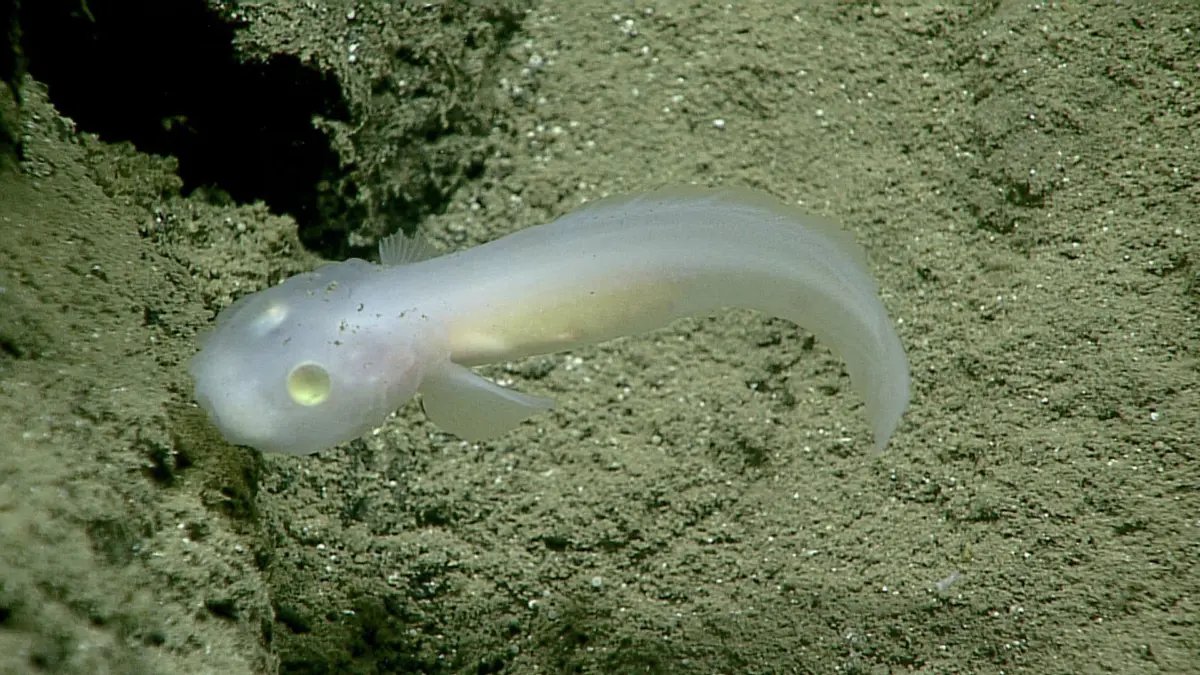
- 2025 — A Biological Milestone: Advanced robotic mapping and deep-sea exploration campaigns yielded a staggering discovery: over 7,000 new species were formally cataloged or identified within the Mariana Trench ecosystem, fundamentally altering our understanding of planetary biodiversity. Among them is the delicate, gelatinous hadal snailfish (Pseudoliparis swirei), officially crowned the deepest-dwelling fish known to science.
Official Statements and Scientific Insights
The exploration of the Mariana Trench is not merely a quest for records; it is a vital scientific imperative managed by international bodies, marine institutions, and conservation groups dedicated to safeguarding the health of the global ocean.
Marine geologists studying the trench’s origin point to a complex planetary process known as subduction. The Earth’s crust is fragmented into massive tectonic plates gliding over the semi-fluid mantle. When two oceanic plates collide, one is forcibly dragged downward beneath the other into the mantle. This tectonic friction creates a deep subduction trench and routinely triggers powerful seismic activity. Radioisotope dating estimates that the tectonic plates responsible for carving out the Mariana Trench are upwards of 180 million years old.
Despite the crushing pressures, near-freezing temperatures, and total absence of sunlight, the trench teems with specialized life. Deprived of photosynthetic energy, these ecosystems rely on chemosynthesis—harnessing chemical energy expelled from deep-sea hydrothermal vents—or subsist on "marine snow," the slow descent of organic detritus, including whale falls, drifting down from the upper ocean layers.
Filming expeditions by institutions like the National Oceanic and Atmospheric Administration (NOAA) have captured rare live footage of ethereal creatures, such as ghost fish belonging to the family Aphyonidae. These visual observations provide unprecedented baseline data on how organisms maintain homeostasis under extreme environmental stress.
Future Outlook: Protection, Vulnerability, and Conservation
In recognition of its irreplaceable scientific and ecological value, the United States government established the Mariana Trench Marine National Monument, placing over 95,000 square miles of surrounding waters under federal protection. This designation restricts commercial fishing, deep-sea mining exploration, and other extractive industries within the monument boundaries, marking a vital victory for global conservation.
Yet, legislative protection does not equate to absolute immunity. The modern era has exposed the grim reality that no ecosystem on Earth remains untouched by human activity. During multiple deep-sea submersible expeditions to the bottom of the Mariana Trench, researchers have visually confirmed the presence of synthetic marine debris—including plastic bags resting quietly on the unblemished seafloor thousands of meters below the surface. This unsettling discovery underscores the far-reaching and pervasive nature of global plastic pollution.
Furthermore, cumulative stressors like a changing global climate threaten the thermal and chemical stability of the deep ocean. Compounding these threats is a glaring knowledge gap: more than 70% of the global ocean remains entirely unmapped and unexplored. Science cannot effectively advocate for the protection of environments it does not yet understand.
Safeguarding wondrous ecological frontiers like the Mariana Trench and Challenger Deep requires a unified, global commitment. From the bustling coastlines and sandy beaches we cherish to the pitch-black abyss of the hadal zone, the health of our ocean is indivisible.
The future of our blue planet depends on collective action. Find out how you can join Ocean Conservancy’s movement to secure a healthy ocean and a thriving planet for generations to come.