









Executive Overview
In the rapidly evolving landscape of global travel technology, legacy incumbents face an existential crossroad. As artificial intelligence fundamentally reshapes how consumers discover, plan, and book their journeys, established giants must determine whether their hard-won scale, brand equity, and consumer trust can successfully weather the current technological epoch.
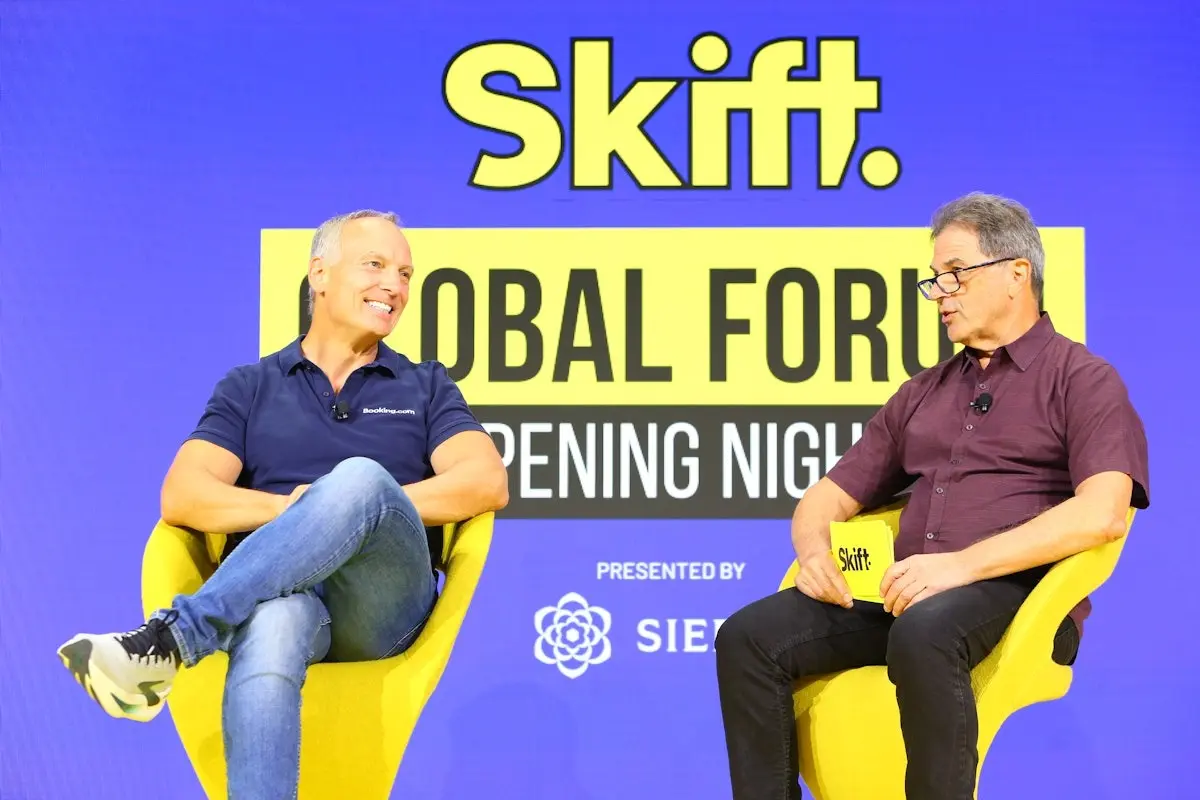
During a high-profile session at the Skift Global Forum—moderated expertly by Skift’s Dennis Schaal—Booking Holdings CEO and President Glenn Fogel laid bare the strategic calculus facing the world’s leading online travel agencies (OTAs). Rather than putting all of its digital eggs into a single algorithmic basket, Booking Holdings is deploying a diversified, venture-capital-style portfolio strategy. The company is actively placing five simultaneous artificial intelligence bets across its robust ecosystem of global brands, acknowledging the high-risk, high-reward nature of modern technological disruption.
"Most of them are not going to be great, but just one has to be a big winner," Fogel remarked, capturing the pragmatic yet aggressively forward-looking ethos driving Booking Holdings today.

As core AI infrastructure becomes increasingly commoditized—with foundation models, application programming interfaces (APIs), and deployment frameworks growing easier and cheaper for upstarts to build—the definition of a competitive moat is shifting. For Fogel, the true differentiator for incumbent brands is not the technology itself, which can be replicated or rented, but rather the proprietary assets that algorithms alone cannot manufacture: deep consumer trust, massive transactional liquidity, entrenched supplier relationships, and historical behavioral data at scale.
This deep-dive report explores Fogel’s strategic vision, dissects the mechanics of Booking Holdings’ multi-pronged AI initiatives, analyzes the broader competitive pressures facing legacy travel entities in the era of generative AI, and projects the trajectory of the online travel sector as it navigates the next decade of digital transformation.
Detailed Chronology: The Evolution of OTAs and the AI Pivot
To fully grasp the magnitude of Booking Holdings’ current maneuvers, one must examine the chronological progression of the online travel industry over the past three decades.
Phase 1: The Digitization of Inventory (Late 1990s – 2010s)
In the early days of online travel, the primary technological disruption was the migration of fragmented inventory—hotel rooms, airline seats, and rental cars—from offline travel agents and global distribution systems (GDS) to consumer-facing web browsers. Companies like Priceline (which later became Booking Holdings) and Expedia built massive digital yellow pages, competing primarily on search engine optimization (SEO), paid acquisition via Google, and inventory breadth. Scale was measured by the number of properties listed and the efficiency of performance marketing spend.

Phase 2: The Mobile and Super-App Era (2010s – Early 2020s)
As smartphones permeated global consumer habits, travel platforms shifted focus to mobile apps, seamless checkout experiences, and loyalty programs. The battleground moved toward friction reduction—minimizing the steps required to book a room or flight while dealing with multi-currency transactions and real-time customer service. During this period, Booking.com, Agoda, and KAYAK solidified their positions as indispensable digital intermediaries connecting hundreds of millions of travelers with millions of accommodation providers worldwide.
Phase 3: The Generative AI Disruption (2023 – Present)
The public debut of advanced generative AI models in late 2022 and early 2023 marked the beginning of a new paradigm. Suddenly, natural language interfaces promised to replace traditional point-and-click search filters. Consumers could now type complex, highly contextualized prompts—such as, "Plan a 10-day family trip to southern Italy focusing on historic towns with boutique hotels under $300 a night, good public transit, and gluten-free dining options"—and receive a comprehensive itinerary in seconds.
For OTAs, this capability presented both a profound threat and an extraordinary opportunity. The threat: if conversational AI assistants built by tech titans (such as OpenAI, Google, or Apple) become the primary gateway for travel planning, traditional OTAs risk being relegated to invisible back-end fulfillment engines, losing direct customer relationships and suffering margin compression. The opportunity: by integrating advanced conversational AI directly into their own platforms, OTAs can transform cumbersome search funnels into intuitive, personalized, end-to-end travel assistants that know the user’s preferences, past bookings, and loyalty status.
It is within this third phase that Glenn Fogel and Booking Holdings launched their aggressive, multi-faceted algorithmic offensive. Rather than waiting to see which consumer-facing AI paradigm would dominate, Fogel opted to seed multiple internal and external experiments simultaneously, hedging technological bets across the enterprise.
Supporting Context & Metrics: The Economics of Scale vs. Agility
In analyzing the statements made by Fogel at the Skift Global Forum, several critical industry dynamics emerge regarding the economics of travel technology, customer acquisition costs (CAC), and the democratization of software development.
The Democratization of Technology
Fogel’s observation that "the technology itself is becoming easy to build" strikes at the heart of modern software engineering. In previous decades, deploying sophisticated machine learning models required millions of dollars in proprietary infrastructure, specialized data science teams, and years of research. Today, open-source large language models (LLMs), enterprise cloud computing credits, and modular APIs allow even well-funded startups to spin up functional conversational agents and recommendation engines in weeks.
When technology is democratized, it ceases to be a sustainable competitive advantage. If every startup can build a sleek AI travel planner using the exact same underlying foundation models, the barrier to entry for software creation plummets. Therefore, the battleground shifts entirely to proprietary data, distribution channels, and consumer trust.
Booking Holdings’ Competitive Moat
Against this backdrop of technological democratization, Booking Holdings commands a formidable array of structural assets that nimble startups struggle to replicate:
- Massive Liquidity and Inventory: Booking.com alone features millions of listings spanning hotels, alternative accommodations, flights, car rentals, and attractions. A user asking an AI assistant to book a specific remote villa in Croatia needs the platform to actually possess the verified inventory, real-time availability, secure payment processing, and contractual backing to execute the transaction safely.
- Customer Trust and Brand Equity: Travel is a high-stakes endeavor. A consumer experiencing a canceled flight or a double-booked hotel room at midnight in a foreign country requires immediate, reliable customer support and financial recourse. Established brands carry institutional trust that unproven AI startups lack.
- Behavioral and Transactional Data: While LLMs understand language, Booking Holdings understands intent and actual behavior. Decades of historical booking patterns, cancellation rates, seasonal pricing adjustments, and verified reviews provide a rich training and operational dataset that cannot be scraped from the public internet.
The Venture Capital Approach to Corporate Innovation
By adopting a venture capital mindset within a publicly traded multinational corporation, Booking Holdings is deliberately courting internal failure to secure external relevance. By running five parallel AI experiments across its portfolio brands (which include Booking.com, Priceline, Agoda, KAYAK, and OpenTable), the leadership team acknowledges that predicting the exact consumer interface of the future is impossible.
One experiment might focus on conversational trip-planning assistants; another on automated customer service resolution via generative voice agents; a third on back-end supplier optimization and dynamic pricing; a fourth on personalized marketing creative generation; and a fifth on hyper-local experiential discovery. Even if four of these initiatives yield mediocre results or are ultimately sunsetted, a single breakout success can generate billions of dollars in incremental gross bookings value (GBV) and secure the company’s market dominance for the next decade.
Official Statements and Industry Perspectives
The discourse between Glenn Fogel and Dennis Schaal at the Skift Global Forum highlighted broader anxieties and strategic imperatives shared across the entire travel distribution ecosystem.

Fogel’s core thesis—that incumbent brands must interrogate their fundamental value proposition when technology is democratized—resonates deeply with executive suites from aviation to hospitality.
"If the technology gets democratized, what do we have that no one else can replicate?" — Glenn Fogel, CEO & President, Booking Holdings
This question serves as an acid test for corporate strategy in the mid-2020s. For years, digital travel companies relied on superior digital marketing execution, bidding on Google keywords, and optimizing conversion funnels. However, as generative AI reshapes search engines into answer engines (ushering in the era of Search Generative Experience and conversational discovery), traditional SEO and paid search mechanics are undergoing seismic disruption.
Industry analysts responding to Fogel’s remarks have pointed out that while OTAs have historically excelled at performance marketing, their future depends on transitioning from transactional intermediaries to trusted lifestyle companions.
Dennis Schaal, probing Fogel during the session, emphasized the urgency with which legacy players must adapt their organizational cultures to foster agile experimentation. Large incumbents are notoriously prone to bureaucratic inertia, risk aversion, and legacy system entanglement. By framing AI integration through a venture capital lens—where failure of individual bets is explicitly budgeted for and expected—Fogel is attempting to inject startup-style agility into a corporate colossus with billions in annual revenue.
Furthermore, suppliers—such as major hotel chains (Marriott, Hilton) and airlines (Delta, United)—are watching these developments closely. While OTAs provide invaluable global reach, suppliers continue to push for direct bookings through their own loyalty apps. As AI assistants grow more powerful, the question of who owns the direct relationship with the traveler—the AI platform, the OTA, or the direct supplier—remains the central geopolitical struggle of the modern travel economy.
Future Outlook: The Next Decade in Travel Technology
As we look toward the remainder of the 2020s and into the 2030s, several key trends and inflection points will dictate whether Booking Holdings and its peers successfully navigate the algorithmic horizon.
1. The Rise of Agentic AI
We are rapidly transitioning from conversational AI (chatbots that answer questions) to agentic AI (autonomous software agents capable of executing complex, multi-step workflows on behalf of users). In the travel context, an agentic AI will not only suggest a vacation itinerary but will autonomously monitor flight price fluctuations, book the optimal combination of flights and hotels, reserve restaurant tables weeks in advance, secure travel insurance, and dynamically rebook arrangements if a flight is delayed—all without human intervention unless an exception arises.
For Booking Holdings, ensuring that its inventory and booking APIs are seamlessly integrated into these autonomous agent networks will be critical. If AI agents bypass traditional OTA interfaces entirely to transact directly with suppliers, OTAs must position themselves as the premier back-end infrastructure or the preferred consumer-facing agent of choice.
2. The Battle for the Direct Consumer Relationship
The ultimate prize in travel technology is top-of-mind awareness. When a consumer decides to take a vacation, where do they go first? Historically, the answer was Google, Booking.com, or Expedia. Today, younger demographic cohorts are increasingly turning to TikTok for inspiration, ChatGPT for itinerary planning, and specialized apps for booking.
To counter this fragmentation, Booking Holdings’ multi-brand strategy must ensure that at least one of its consumer-facing touchpoints becomes the habitual starting point for travel intent. By infusing Booking.com and KAYAK with intuitive AI planning tools, the company aims to intercept travelers before they venture into generic third-party chat interfaces.
3. Redefining Customer Service and Personalization
Beyond discovery and booking, the post-booking experience represents the most ripe arena for AI disruption. Travel is inherently unpredictable; weather disruptions, labor strikes, missed connections, and medical emergencies create immense friction.
Booking Holdings is heavily investing in AI-driven customer service solutions capable of resolving complex logistical breakdowns instantly in multiple languages. By replacing static call centers and frustrating hold music with empathetic, highly capable generative voice and chat agents, OTAs can drastically reduce operational costs while dramatically improving Net Promoter Scores (NPS).
4. Regulatory and Ethical Horizons
As AI systems assume greater control over consumer finances and personal data, regulatory scrutiny will intensify. Issues surrounding data privacy, algorithmic bias, transparent pricing, and liability when AI-driven itineraries fail will take center stage. Fogel and other industry leaders will need to navigate an increasingly complex patchwork of international AI regulations, ensuring that their automated systems maintain ethical standards and consumer protection.
Conclusion
Glenn Fogel’s disclosures at the Skift Global Forum underscore a profound truth about modern corporate leadership: in an era of exponential technological change, standing still is the ultimate risk.
By embracing a portfolio approach to artificial intelligence—acknowledging that uncertainty is inevitable, that most individual experiments will falter, but that disciplined audacity will yield decisive winners—Booking Holdings is actively rewriting its playbook. The democratization of AI technology means that software tools are no longer a proprietary advantage; true power lies in scale, trust, transactional liquidity, and deep-seated consumer relationships.
As the travel industry stands on the precipice of the agentic AI revolution, the ultimate verdict on Booking Holdings’ strategy will not be written in boardrooms or earnings reports, but in the frictionless, personalized journeys experienced by hundreds of millions of travelers across the globe. For legacy incumbents, the message is clear: harness the technology, protect the core, and be willing to bet boldly on the unknown.