







Executive Overview
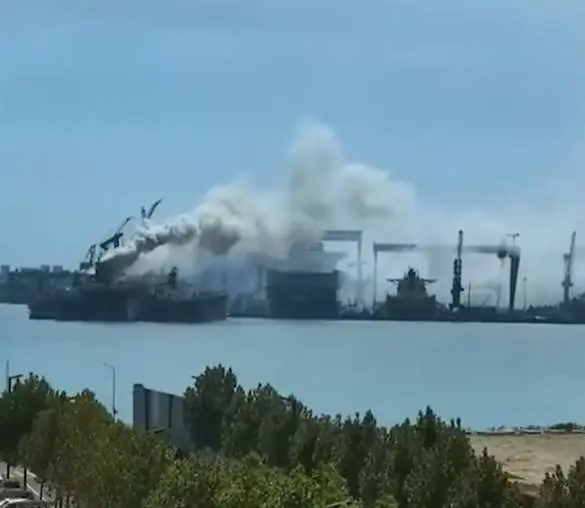
On Thursday, a catastrophic fire erupted aboard a foreign-flagged dry bulk carrier undergoing routine maintenance and repairs at the state-owned Qingdao Beihai shipyard in eastern China. The industrial disaster resulted in the deaths of 25 people, making it one of the deadliest maritime industrial accidents in the region in recent years. Of the 42 personnel onboard at the time of the incident, only 12 were evacuated safely without injury, while five others sustained injuries requiring urgent hospitalization.
The vessel involved has been identified as the Ocean Melody, a 20-year-old Liberia-flagged dry bulk carrier. The tragedy occurred at a facility controlled by China State Shipbuilding Corporation (CSSC), the world’s largest shipbuilding conglomerate and a critical pillar of China’s military-industrial complex.
The scale of the loss of life immediately triggered a high-level political response. Chinese President Xi Jinping issued an urgent directive calling for exhaustive search-and-rescue operations, a rigorous and transparent investigation into the cause of the blaze, and the swift enforcement of accountability measures.
This incident exposes the persistent safety challenges plaguing the global ship repair sector, where tight schedules, aging merchant vessels, and hazardous "hot work" often intersect with devastating consequences.
Detailed Chronology of the Incident
[August 31] Vessel Arrives at Qingdao Beihai Shipyard
       │
[Thursday, 11:15 AM] Fire Ignites During Maintenance/Inspection
       │
[Thursday, Afternoon] Fire Extinguished; 25 Confirmed Dead, 5 Injured
       │
[Post-Incident] President Xi Demands Investigation & Accountability
The Outbreak of the Fire
The disaster began at approximately 11:15 a.m. local time (0315 GMT) on Thursday. The Ocean Melody was positioned in a repair berth at the Qingdao Beihai shipyard, where it had been undergoing comprehensive hull inspections and structural repairs since its arrival on August 31.
According to initial reports from state-run news agency Xinhua, the fire ignited deep within the vessel’s structure while repair crews and ship personnel were engaged in active maintenance and inspection works.
Emergency Response and Containment
At the time of ignition, 42 people—comprising both ship crew members and shipyard subcontracted laborers—were onboard. The fire spread rapidly through the confined, steel-walled compartments of the vessel, trapping workers below deck.
The shipyard’s internal emergency response units, alongside municipal firefighting teams from Qingdao, mobilized to the scene. First responders managed to evacuate 12 people safely from the upper decks and exterior staging areas. Five individuals who suffered from severe smoke inhalation and thermal burns were rescued and rushed to local hospitals, where they remain in stable condition.
By the early afternoon, municipal and industrial firefighting brigades had successfully contained and extinguished the blaze. However, during subsequent search-and-rescue sweeps through the smoke-filled, heat-damaged interior of the vessel, rescue teams recovered the bodies of 25 victims who had succumbed to toxic fumes and extreme temperatures.
Supporting Context & Metrics
The Vessel: Ocean Melody
The vessel at the center of the tragedy, the Ocean Melody, is an aging asset within the global merchant fleet:
- Type: Dry Bulk Carrier
- Age: 20 years old
- Flag State: Liberia (a popular open registry/flag of convenience)
- Ship Manager: Yuyangkunpeng Shanghai Ship Management Co., Ltd.
- Registered Owner: Huili Shipping Co., Ltd.
Aging bulk carriers require frequent and extensive steel replacement, particularly in cargo holds and ballast tanks, due to the corrosive nature of bulk cargoes and seawater. This structural maintenance invariably requires "hot work"—such as welding, gas cutting, and grinding—which presents a perpetual fire hazard if safety protocols are not meticulously enforced.
| Metric / Parameter | Vessel Details |
|---|---|
| Vessel Name | Ocean Melody |
| Vessel Type | Dry Bulk Carrier |
| Flag of Registry | Liberia |
| Age | 20 Years |
| Ship Manager | Yuyangkunpeng Shanghai Ship Management |
| Registered Owner | Huili Shipping Co., Ltd. |
| Arrival Date at Yard | August 31 |
The Facility: Qingdao Beihai Shipyard
The incident occurred at the Qingdao Beihai shipyard, a massive facility operated by a subsidiary of China State Shipbuilding Corporation (CSSC).
CSSC is a state-owned enterprise (SOE) of immense strategic importance, serving as China’s primary naval shipbuilder and the world’s largest designer and builder of commercial vessels and offshore equipment.
- Industrial Capacity: According to corporate recruitment and promotional materials, the Qingdao Beihai unit possesses an annual shipbuilding capacity of 3 million deadweight tons (DWT).
- Repair Capabilities: The facility is equipped to repair and overhaul up to 212 large commercial vessels per year, making it a critical hub for global shipping lines operating in East Asia.
The Inherent Hazards of Ship Repair
Shipyards, particularly those handling dry-docking and repair work, are recognized as some of the most hazardous industrial environments in the world. Several factors contribute to this risk profile:
- Confined Spaces: Vessels are honeycombed with double-bottom tanks, fuel reservoirs, and cargo holds where toxic gases can accumulate and escape routes are highly restricted.
- Hot Work Hazards: Welding and cutting torch operations generate sparks and molten slag that can easily ignite adjacent insulation, residual fuel oils, or flammable protective coatings.
- Co-contracting and Language Barriers: On a foreign-flagged vessel in a Chinese yard, operations involve a complex mix of ship officers, foreign crew members, shipyard managers, and local subcontractors. Communication gaps regarding safety permits and isolation protocols frequently contribute to accidents.
Official Statements and Corporate Responses
The political and economic fallout from the disaster was immediate, reflecting the severity of the loss of life and the strategic importance of the shipyard’s parent company.
Presidential Intervention
In a rare and rapid intervention for an industrial accident, Chinese President Xi Jinping issued a public directive demanding a comprehensive response.
According to state media, President Xi instructed local authorities and CSSC management to:
- Spare no effort in treating the injured and supporting the families of the deceased.
- Launch a swift, thorough, and transparent investigation to determine the root cause of the fire.
- Implement strict accountability measures against any parties found negligent.
- Conduct a nationwide safety audit across similar industrial and maritime facilities to prevent systemic recurrences.
Corporate and Regulatory Disclosures
China CSSC Holdings, the publicly traded arm of the state-owned conglomerate, released an official regulatory filing confirming the incident:
"A fire broke out on a foreign-flagged cargo ship during maintenance work at the shipyard of our Qingdao subsidiary. The company and relevant local authorities immediately mobilized all available resources to manage the situation on-site. All search, rescue, and post-accident handling efforts are actively under way."
The corporate statement sought to reassure investors and the public that the group was cooperating fully with municipal fire safety officials and federal workplace safety investigators.
Future Outlook and Industry Implications
The tragedy at the Qingdao Beihai shipyard is expected to reverberate across both the domestic Chinese industrial sector and the global maritime transport industry.
[Fatal Fire in Qingdao]
       │
       ├──► Regulatory Crackdown & Safety Audits across Chinese Shipyards
       │
       ├──► Potential Maintenance Delays for Global Dry Bulk Fleet
       │
       └──► Escalating Legal & Insurance Liabilities for Vessel Owners
Domestic Regulatory Crackdown
In the wake of President Xi’s directive, the Ministry of Emergency Management and the State Administration of Science, Technology and Industry for National Defense (which oversees defense-related shipbuilders like CSSC) are anticipated to launch a sweeping safety campaign.
Shipyards across China will likely face unannounced inspections, stricter enforcement of "hot work" permits, and mandatory safety stand-downs. While necessary to improve safety, these regulatory measures could temporarily reduce repair capacity and extend turnaround times for vessels currently booked for dry-docking in China.
Global Dry Bulk Fleet Operations
As China is the dominant global destination for ship repair and retrofitting, any systemic slowdown in Chinese yard throughput will tighten the supply of dry bulk carriers. Shipowners may experience delays in scheduled surveys, ballast water treatment system installations, and structural repairs, potentially driving up spot charter rates in the short term due to reduced active tonnage.
Insurance and Liability Disputes
The investigation will focus heavily on whether the fire was sparked by shipyard workers or ship crew members, and whether proper gas-free certifications were obtained before work commenced.
The outcome will dictate a complex legal battle involving:
- The vessel’s hull and machinery (H&M) insurers.
- Protection and Indemnity (P&I) clubs representing Huili Shipping.
- CSSC’s corporate liability insurers.
Given the loss of 25 lives, the financial liabilities, wrongful death claims, and structural damage assessments are expected to run into tens of millions of dollars, highlighting the high stakes of safety compliance in the maritime supply chain.