









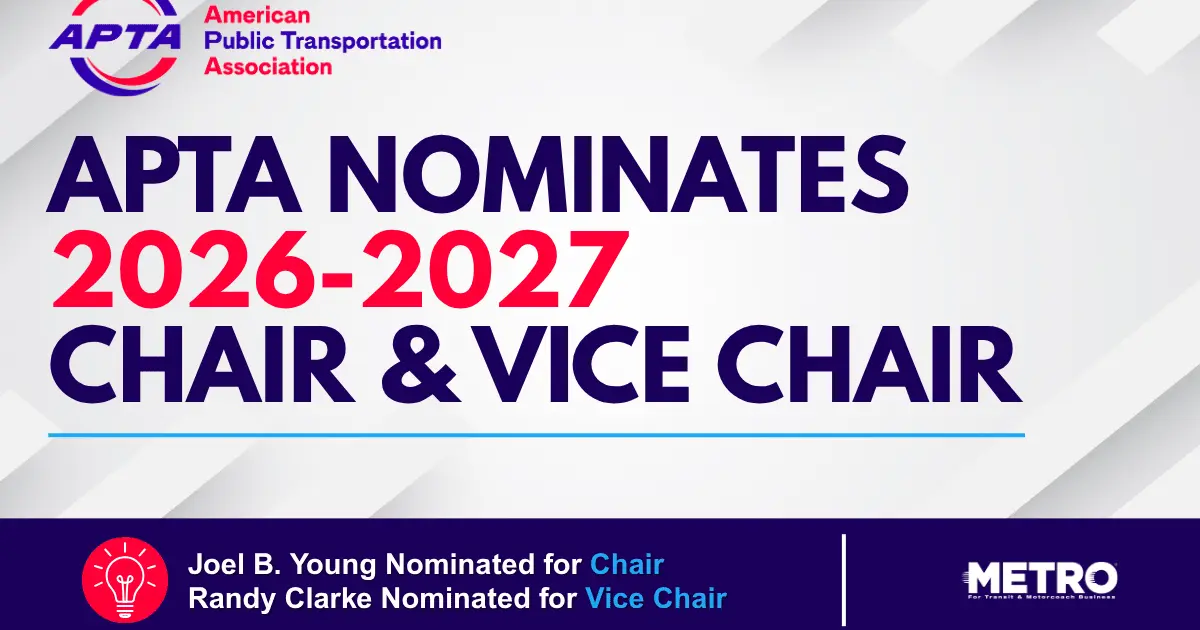
CHICAGO — In a move that signals a strategic alignment between regional transit innovation and capital-region mega-system management, the American Public Transportation Association (APTA) has officially unveiled its high-profile leadership slate for the 2026–2027 term.
Following a rigorous selection process spearheaded by the organization’s dedicated Nominating Committee, transit veterans Joel B. Young and Randy Clarke have been tapped to steer the association through one of the most critical eras in modern public transportation history. Young, a distinguished board member of AC Transit in Oakland, California, has been nominated to serve as APTA Chair. He will be joined by Randy Clarke, the dynamic General Manager and Chief Executive Officer of the Washington Metropolitan Area Transit Authority (WMATA), who has been nominated to serve as Vice Chair.
The announcement, released ahead of the association’s pivotal governance meetings, places a spotlight on leaders who have navigated the turbulent post-pandemic landscape, masterminded equity-driven transit expansions, and grappled with the complex fiscal cliffs facing mass transit networks nationwide.
As the public transportation sector stands at the intersection of technological transformation, climate mandates, and shifting commuter habits, the leadership team chosen in Chicago will carry the torch for an industry that moves millions of Americans daily. The complete leadership slate will be officially presented for a vote by APTA’s broader membership on October 3, during the Annual Meeting of the Members—a cornerstone event held concurrently with the monumental APTA TRANSform Conference & EXPO in Chicago.
Executive Overview: A New Chapter for National Transit Leadership
The leadership appointments of Young and Clarke represent a carefully balanced geographical and operational ticket. By pairing a seasoned Western regional board member deeply attuned to community-centric transit delivery with an East Coast mega-agency chief executive renowned for operational turnarounds and modernization, APTA is positioning itself to effectively lobby and advocate across diverse political and economic landscapes.
Alongside these top-tier nominations, the continuity of institutional knowledge remains a priority for the association. Jannet Walker-Ford, a respected advisory and planning business line executive at WSP USA, will continue her steady stewardship in her 2025–2028 term as Secretary-Treasurer, maintaining vital representation from the private sector consulting and engineering community. Meanwhile, Leanne Redden will transition into the role of Immediate Past Chair, bringing invaluable historical perspective to the incoming executive leadership team as they chart the association’s strategic priorities for the late 2020s.
The stakes for this incoming leadership cohort could not be higher. Public transit systems across the United States and Canada continue to recalibrate following the structural disruptions of the COVID-19 pandemic. While ridership metrics in many urban centers are on a steady upward trajectory, agencies face persistent headwinds, including expiring federal relief funds, shifting hybrid-work commuter patterns, inflationary pressures on capital projects, and heightened expectations for safety, security, and sustainability.
APTA’s role as the unified voice of the industry relies heavily on the ability of its executive leadership to articulate these challenges to federal policymakers, secure vital funding authorizations, and foster collaborative innovation among public agencies and private supply-chain partners alike.
Detailed Chronology: The Path to the Chicago Slate
The road to the 2026–2027 leadership announcement was paved through a deliberate, structured governance process designed to ensure transparency, representation, and organizational stability.
The September 2 Nominating Committee Convening
The foundational step in finalizing the leadership roster occurred on September 2, when APTA’s 2026 Nominating Committee convened in a closed-session meeting. Composed of a diverse cross-section of transit leaders representing varied modes, geographies, and stakeholder groups, the committee was tasked with reviewing candidate applications, conducting interviews, and curating a cohesive slate for the association’s Executive Committee and Board of Directors.
The committee evaluated candidates against stringent criteria, including demonstrated leadership within their home agencies, active engagement with APTA committees and initiatives, a proven track record of advocacy on legislative and regulatory fronts, and a clear vision for the future of public transportation. After rigorous deliberation, the committee finalized the nominations of Young and Clarke, alongside a comprehensive list of candidates designated for three-year terms on the Executive Committee and the Board of Directors, spanning both Transit System Directors and Business Member Directors.
The October 3 Landmark Vote in Chicago
The culmination of this exhaustive selection process will take place on October 3 during the Annual Meeting of the Members. Hosted as a central component of the APTA TRANSform Conference & EXPO in Chicago—widely recognized as public transportation’s largest and most influential gathering in North America—the member vote serves as the formal ratification of the leadership team.
Delegates representing hundreds of public transit systems, state departments of transportation, planning organizations, and private-sector business members will cast their ballots to approve the slate. The venue itself is symbolic; Chicago’s rich transit history and contemporary multi-modal infrastructure provide an ideal backdrop for an association looking aggressively toward the future. Following the confirmation vote, the newly elected officers and committee members will prepare to shadow current leadership before formally assuming their respective offices for the 2026–2027 term.
Supporting Context & Metrics: The State of North American Public Transportation
To fully understand the gravity of the appointments of Joel B. Young and Randy Clarke, one must examine the macroeconomic and operational realities defining the current transit landscape. Public transportation is no longer viewed merely as a municipal utility; it is recognized as the backbone of economic mobility, environmental sustainability, and social equity in urban and suburban centers alike.
Navigating Fiscal Realities and the Post-Pandemic Pivot
According to recent industry data compiled by APTA, public transit systems nationwide have experienced a sustained, multi-year recovery in ridership, closing in on pre-pandemic baselines in many regions. However, this numerical recovery masks a complex fiscal balancing act. The historic influx of federal emergency relief—delivered primarily through the CARES Act, the Coronavirus Response and Relief Supplemental Appropriations Act (CRRSAA), and the American Rescue Plan Act (ARPA)—has largely been drawn down.
As agencies confront the so-called "fiscal cliff," leaders like Clarke and Young find themselves on the front lines of securing sustainable, long-term state and local funding models. Advocacy for increased federal investment, optimized capital program delivery, and innovative value-capture strategies will be paramount during their tenure.
The Technological and Environmental Evolution
Simultaneously, the industry is undergoing the largest fleet electrification transition in its history. Propelled by federal investments from the Infrastructure Investment and Jobs Act (IIJA)—often referred to as the Bipartisan Infrastructure Law—transit agencies are aggressively phasing out diesel buses in favor of zero-emission battery-electric and hydrogen fuel-cell fleets. This operational pivot requires massive infrastructure overhauls, including grid-capacity upgrades, specialized maintenance facility retrofits, and workforce retraining programs.
Furthermore, the integration of emerging technologies—such as mobility-as-a-service (MaaS) platforms, artificial intelligence-driven scheduling, automated transit priority lanes, and enhanced digital fare-payment systems—demands a forward-thinking national association capable of establishing best practices and technical standards. Young’s governance experience at AC Transit—a system widely praised for its early adoption of hydrogen fuel-cell technology—and Clarke’s operational leadership at WMATA—where managing a sprawling heavy-rail and bus network requires constant technological vigilance—position them uniquely to guide APTA members through this technological renaissance.
Official Statements and Leadership Profiles
The designation of the new leadership slate has drawn widespread acclaim from across the transit community, reflecting the high regard in which both Young and Clarke are held by their peers.
Joel B. Young: Community-Centric Governance
As a long-standing board member of AC Transit, Joel B. Young has built a reputation for championing equitable transit access, labor-management collaboration, and sustainable regional planning. AC Transit serves more than a million residents across Alameda and Contra Costa counties in California’s East Bay, operating one of the most innovative and diverse fleets in the nation.
Young’s leadership style emphasizes grassroots engagement and fiscal accountability. In statements accompanying the nomination release, colleagues highlighted his ability to bridge the gap between policy-level decision-making and the day-to-day lived experiences of transit riders. His elevation to APTA Chair underscores the vital role that regional transit district directors play in shaping national policy and ensuring that federal investments translate into tangible community benefits.
Randy Clarke: Mega-System Modernization and Operational Resilience
Randy Clarke brings an immense wealth of executive experience to the role of APTA Vice Chair. Currently serving as the General Manager and CEO of WMATA, Clarke oversees the Metrorail rapid transit system, Metrobus, and MetroAccess paratransit service, operating across the District of Columbia, Maryland, and Virginia.
Before taking the helm at WMATA in 2022, Clarke served as President and CEO of Capital Metro in Austin, Texas, and as Vice President of Operations and Member Services at APTA itself. His deep institutional familiarity with the association, combined with his proven ability to restore public trust, manage complex multi-jurisdictional stakeholders, and drive safety and operational excellence at major agencies, makes him an invaluable asset to the executive team. Under his leadership, WMATA has focused heavily on safety culture reform, service reliability, and financial stabilization—lessons that will undoubtedly inform his contributions at the national level.
Jannet Walker-Ford and Leanne Redden: Continuity of Excellence
The retention of Jannet Walker-Ford as Secretary-Treasurer ensures that the executive committee maintains its strong private-sector partnership alignment. Walker-Ford, a prominent executive at WSP USA, brings extensive expertise in strategic planning, emerging mobility solutions, and public-private partnerships (P3s). Her ongoing leadership reinforces APTA’s commitment to fostering robust collaboration between public transit agencies and the engineering, planning, and technology firms that supply critical infrastructure.
Leanne Redden, transitioning to Immediate Past Chair, completes the leadership triad. Redden’s extensive background in transportation administration—highlighted by her tenure as Executive Director of the Regional Transportation Authority (RTA) in northeastern Illinois—has provided APTA with steady, crisis-tested leadership through some of the most dynamic years in the association’s history.
Future Outlook: The Strategic Horizon for APTA (2026–2027)
As the transit industry looks toward the remainder of the decade, the incoming APTA leadership team will face a series of defining imperatives. The strategic horizon for 2026–2027 will be shaped by several critical focus areas:
- Legislative Advocacy and Reauthorization: With future federal transportation authorization bills on the horizon, APTA must aggressively advocate for sustained, predictable federal funding formulas that reflect the realities of post-pandemic operations and capital maintenance backlogs.
- Workforce Development and Retention: The transit industry continues to grapple with workforce shortages across operations, maintenance, and engineering. Young and Clarke are expected to champion national initiatives focused on workforce training, recruitment, fair labor practices, and the integration of next-generation skill sets required for zero-emission fleets.
- Safety and Security Enhancement: Restoring and maintaining public confidence in the safety and security of transit systems remains a top priority for riders and operators alike. APTA will likely expand its collaborative efforts on sharing best practices for security personnel deployment, mental health crisis response, and environmental design.
- Climate Resilience and Decarbonization: Guiding agencies through the complex, capital-intensive transition to 100% zero-emission fleets while ensuring grid resilience against extreme weather events will be a central pillar of the association’s technical assistance and policy advocacy.
Conclusion
The nomination of Joel B. Young as Chair and Randy Clarke as Vice Chair for the 2026–2027 term marks a pivotal moment for the American Public Transportation Association. Backed by an experienced executive committee and board of directors, and ratified by a membership eager for forward-thinking leadership, APTA is exceptionally well-positioned to navigate the complexities of modern mobility. As the transit community gathers in Chicago for the TRANSform Conference & EXPO, the message is clear: public transportation is not merely recovering—it is transforming, innovating, and leading the way toward a more connected, sustainable, and equitable future.