








Executive Overview
For most children, the journey from childhood to adolescence is marked by milestones like entering middle school, gaining independence, and expanding their horizons. For a 12-year-old cyclist navigating the asphalt labyrinth of New York City, however, that transition carries a stark, existential question: Will I live to see my 13th birthday?
This gripping inquiry forms the emotional and psychological core of urban micromobility debates today. While municipal leaders routinely tout green initiatives, expanded bike lane mileage, and pedestrian-first policies, the reality on the ground—as experienced by our city’s most vulnerable road users—tells a vastly different story. For children, tweens, and teenagers attempting to traverse New York City on two wheels, the infrastructure is not a welcoming network; it is a chaotic, hazardous obstacle course defined by blocked painted lanes, contradictory and confusing legal codes, and the overwhelming dominance of private motor vehicles.
This investigative report examines the daily perils faced by young cyclists in the five boroughs. By synthesizing firsthand accounts from youth riders, analyzing municipal traffic data, scrutinizing contradictory administrative codes, and evaluating systemic policy failures, this feature exposes the glaring disconnect between City Hall’s high-minded rhetoric and the perilous reality of New York’s streets.
Detailed Chronology & Daily Realities: A Ride Through the Urban Jungle
To understand the daily experience of a young New York City cyclist, one must accompany them on a routine trip. For our 12-year-old subject, every journey begins not with the carefree anticipation of youth, but with procedural anxiety.
The Pre-Ride Ritual
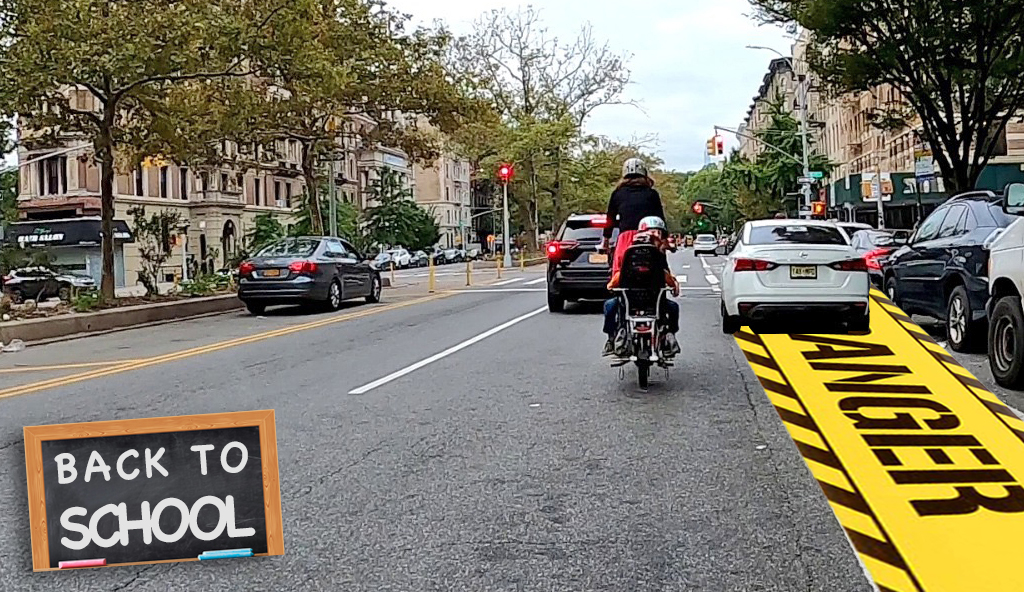
Before a single pedal is pushed, a comprehensive mental checklist must be executed. Hand signals—crucial for communicating intentions to heavy traffic—are mentally reviewed. Deep breaths are taken. Because the cyclist rides alongside their mother on the open road rather than seeking refuge exclusively on the sidewalk, every excursion demands hyper-vigilance.
The Obstacle Course of "Protected" Corridors
Once in motion, the illusion of safe infrastructure vanishes almost immediately. Nine times out of ten, according to local youth accounts, painted bike lanes are obstructed by parked or idling cars and delivery trucks. Commercial trucks present a particularly acute hazard, creating massive blind spots that conceal moving traffic from a child’s line of sight and forcing cyclists to merge precariously into active vehicular lanes.
When confronted with these constant blockades, riders are forced into a difficult tactical choice:

- Execute a dangerous maneuver around the obstruction into fast-moving traffic.
- Abruptly dismount and walk their bicycles around the hazard.
As the young cyclist notes, the latter option fundamentally redefines the activity: "That’s not cycling. That’s walking with a bike between your legs."
This ritual of dismounting transforms a sustainable, efficient mode of independent transportation into an exercise in frustration, robbing children of the very mobility and autonomy that bicycles are meant to provide.
Supporting Context & Metrics: Infrastructure, Policy, and the Law
The dangers facing young cyclists are compounded by a confounding labyrinth of contradictory municipal laws, inadequate infrastructure, and systemic policy blind spots.
The Sidewalk vs. Roadway Legal Quagmire
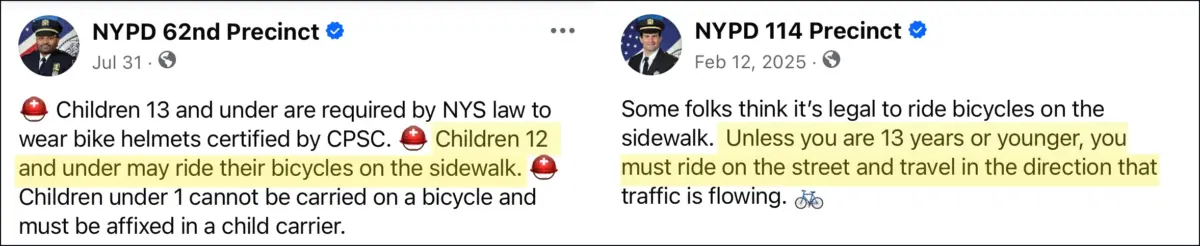
City administrative codes attempt to address the vulnerability of young riders by establishing age-based rules for sidewalk riding. According to specific municipal guidelines, children under the age of 14 are legally permitted to ride their bicycles on New York City sidewalks.
However, this policy collides with another widely cited mechanical rule: cyclists must ride in the roadway if their bicycle wheels measure 26 inches or greater in diameter—a standard size for adult and pre-teen frames alike. This creates a Catch-22 for 12-year-olds who have graduated to adult-sized bicycles.
- The Code Conflict: Legal summaries and municipal codes frequently conflict, leaving enforcement entirely up to the discretion of individual police officers.
- The Bias Factor: This ambiguity introduces the severe risk of police bias, leaving young riders vulnerable to arbitrary stops, fines, or heightened danger depending on which officer they encounter.
The School-Zone Danger Zone
The perils are acutely concentrated around educational institutions. Previous investigations by advocacy outlets like Streetsblog have highlighted that streets directly adjacent to schools are statistically far more dangerous than non-school corridors. The chaotic convergence of school buses, private passenger vehicles, double-parked parents, and rushing pedestrians creates high-tension zones where children commuting to and from class are at maximum risk.
Adult-Centric Traffic Safety Classes
Even educational resources fail to center the actual needs of children. Safety courses designed to teach traffic patterns, signals, and defensive riding are almost exclusively populated by adults. Furthermore, these curricula frequently normalize illegal and dangerous driver behavior, treating aggressive car movements as an immutable law of nature rather than a systemic failure to be corrected.
As the young cyclist poignantly asks: "Who decided that crashes are normal? Other forms of murder certainly aren’t."
Official Statements and Systemic Indifference
Behind the daily hazards faced by young cyclists lies a deeper political disconnect: disenfranchisement.
The Politics of the Unenfranchised
Children under the age of 18 cannot vote. Consequently, they possess no direct electoral leverage to demand accountability from mayors, city council members, or transit commissioners. For six critical developmental years, tweens and teenagers are forced to navigate a transport system that prioritizes the convenience of motor vehicles over human life, without any formal mechanism to punish elected officials who fail to protect them.
Piecemeal Policy and "Sammy’s Law"
Advocacy organizations such as Transportation Alternatives have consistently criticized municipal administrations for implementing safety mandates—such as those enabled by Sammy’s Law—through fragmented, disconnected patches of infrastructure. Stretches of safety modifications sometimes span a mere 100 feet, leaving massive gaps in protection.
[City Hall Policy Debates]
       │
       ├──> Fragmented Implementation (e.g., 100-foot safety zones)
       ├──> Enforcement Discretion & Legal Ambiguity (Sidewalk vs. Roadway)
       └──> Disenfranchisement of Under-18 Residents
             │
             ▼
[Result: Children Face Hostile, Car-Dominated Streets Daily]
Urban planning groups continue to demand comprehensive, neighborhood-wide speed reductions and fully protected, continuous bike networks rather than isolated token gestures. Yet, systemic momentum continues to favor the car, pushing children and active transportation advocates literally and figuratively to the curb.
Future Outlook: Why Kids Keep Riding Despite the Odds
Despite the systemic obstacles, the legal ambiguities, and the daily existential dread of navigating "wheeled boxes of death," a dedicated cohort of young New Yorkers continues to ride.
Resistance, Environment, and Joy
For many tweens, sticking with cycling is an act of quiet rebellion. It is a deliberate choice to spite the automobile-centric culture, to actively defend the urban environment from political inaction, and—above all—because riding a bicycle remains an inherently joyful and liberating experience.
What Must Change
If New York City is serious about achieving its climate goals, reducing traffic fatalities, and fostering genuine urban independence for the next generation, sweeping reforms are non-negotiable:
- Universal Protected Infrastructure: Painted lines must be replaced with hardened, physically protected bike lanes that completely eliminate vehicular intrusion.
- Standardized, Youth-Centric Laws: Legal codes regarding sidewalk riding and wheel size must be clarified and harmonized to protect young riders from contradictory enforcement and police bias.
- School-Zone Pacification: Streets surrounding all city schools must be permanently redesigned as car-free or ultra-low-speed pedestrian and cyclist sanctuaries.
- Child-Inclusive Urban Planning: City planners must actively incorporate the perspectives of children and adolescents—those who cannot vote but are most impacted by street design—into future transit policymaking.
Until these structural transformations take root, New York City’s youngest cyclists will continue to tighten their helmet straps, review their hand signals, take a deep breath, and pedal out into a concrete jungle that views their safety as an afterthought.