










By the Editorial Transit Desk
Published: September 8, 2026
Executive Overview
Public transit agencies stand at a historic operational crossroads. Every single day, modern metropolitan transit networks generate tidal waves of data. From the real-time GPS telemetry of thousands of buses and light rail vehicles (LRVs) to automated fare collection (AFC) systems, scheduling platforms, enterprise resource planning (ERP) systems, and customer service logs, millions of distinct data points are captured continuously. Yet, despite this unprecedented abundance of information, transit directors, program managers, and operations controllers frequently find themselves immobilized by bureaucratic friction when attempting to answer basic operational questions.
Traditionally, if a transit executive needs to investigate a sudden spike in missed connections, evaluate the financial impact of chronic scheduling bottlenecks, or audit operator performance across specific routes, the request must traverse a sluggish gauntlet. It typically starts with an ad-hoc ticket submitted to the IT department. From there, data analysts must manually extract information from disparate, legacy database silos, stitch the incompatible datasets together using custom scripts, and build a static report. By the time this report finally reaches leadership—often days or even weeks later—the operational crisis has long since passed, leaving management to operate in a perpetual state of reactive firefighting rather than proactive stewardship.
The core challenge facing the modern transit industry is no longer a deficit of information; rather, it is the inability to access, correlate, and operationalize that information with the speed demanded by urban mobility.
In this comprehensive feature, we examine how a paradigm shift—combining vendor-neutral open data standards such as the General Transit Feed Specification (GTFS) and GTFS-Realtime (GTFS-RT) with centralized data marts and generative, natural-language conversational artificial intelligence—is poised to rewrite the rules of public transit management. Drawing on insights from industry leaders like Steve Lassey, Chief Executive Officer of Strada 360, this article explores the technical architecture, practical applications, and organizational roadmaps necessary to transition transit agencies from static dashboard reporting to instantaneous, conversational intelligence.
Detailed Chronology: The Evolution of Transit Data Integration
To understand why conversational AI represents such a radical departure from traditional business intelligence (BI), it is vital to trace how transit agencies historically managed, or mismanaged, their digital infrastructure.
Phase 1: The Era of Fragmented Silos (Late 20th Century to Early 2010s)
For decades, public transit systems digitized their operations in isolated functional blocks. The scheduling department used one proprietary software suite to cut runs and block assignments. The maintenance department utilized an entirely separate Computerized Maintenance Management System (CMMS) to track bus engine repairs and parts inventories. Meanwhile, operations controllers relied on Computer-Aided Dispatch and Automatic Vehicle Location (CAD/AVL) systems to monitor vehicle locations on physical map walls or legacy dispatch screens.

Because these software vendors operated under proprietary business models with closed architectures, their databases rarely communicated effectively. A schedule might indicate that a bus is timed to arrive at a major transfer hub at 8:15 AM, while the CAD/AVL tracking system logs the vehicle arriving at 8:22 AM due to street congestion, and the farebox records a surge in boardings. Because these systems lived in separate silos, agency leadership was routinely forced to navigate conflicting "versions of reality," hindering strategic planning and resource allocation.
Phase 2: The Open Data Revolution and GTFS (2010s to Mid-2020s)
The introduction and widespread adoption of the General Transit Feed Specification (GTFS), originally developed by Google and Portland TriMet, marked a watershed moment for the industry. By establishing a standardized format for transit schedules and associated geographic data, GTFS allowed agencies to effortlessly publish their schedules to digital mapping applications like Google Maps and Apple Maps.

The subsequent rollout of GTFS-Realtime (GTFS-RT) expanded this capability, enabling agencies to broadcast live vehicle positions, trip updates, and service alerts in an open, machine-readable format. While GTFS dramatically improved the rider experience by powering third-party trip planners and real-time passenger information displays, its internal utility within agency headquarters remained underleveraged. Most agencies continued to treat GTFS as an external publishing tool rather than the foundational vocabulary for internal enterprise data integration.
Phase 3: The Rise of Conversational Intelligence (Present Day, 2026 and Beyond)
Today, the industry is entering its third major digital evolution. Driven by advances in Large Language Models (LLMs) and Generative AI, transit technology is moving past rigid dashboard interfaces. Instead of requiring data scientists to write complex Structured Query Language (SQL) queries or build static Tableau and Power BI reports, modern architecture allows executives to converse directly with their agency’s unified data repository using plain, natural human language. As Steve Lassey of Strada 360 notes, this transition effectively replaces traditional BI tools with an intelligent, conversational layer that interprets intent, executes underlying data queries, and presents actionable narratives, charts, or tables within seconds.
Supporting Context & Metrics: Breaking Down the Data Bottleneck
The operational friction caused by legacy data silos carries a profound financial and organizational toll. Modern transit agencies juggle immense complexities:
- Multi-Modal Coordination: Large metropolitan agencies often operate bus fleets, light rail networks, heavy commuter rail, and paratransit services simultaneously. Each mode generates distinct telemetry, staffing, and ridership streams.
- The Maintenance-Operations Divide: Unscheduled maintenance events directly trigger missed trips, yet maintenance logs and real-time dispatch logs are frequently stored in incompatible databases.
- The Reporting Lag: Industry surveys indicate that ad-hoc data requests within bureaucratic public agencies can take anywhere from 48 hours to two weeks to fulfill through traditional IT channels.
The Technical Anatomy of a Modern Transit Data Mart
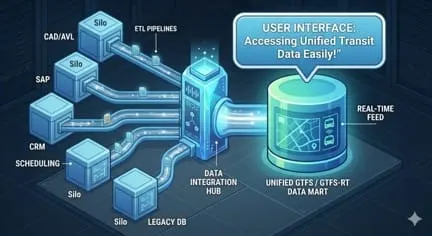
Overcoming these structural hurdles requires dismantling vendor lock-in. According to infrastructure blueprints championed by firms like Strada 360, agencies must establish a centralized Transit Data Mart that functions as a single source of truth.
[Legacy Silos: SAP, CAD/AVL, Scheduling, Farebox]
                       │
                       ▼ (Secure ETL Pipelines & Open Standards)
         [Centralized Transit Data Mart]
                       │
                       ▼ (Natural Language Interface / GenAI)
        [Conversational Intelligence Layer]
                       │
                       ▼
    [Instantaneous Operational Insights for Leadership]
Rather than engineering costly, brittle custom integrations between disparate enterprise software platforms (such as SAP enterprise resource planning systems, bespoke CAD/AVL suites, and specialized scheduling engines), the data mart normalizes all incoming feeds into vendor-neutral relational models anchored by GTFS and GTFS-RT standards.
When operational, financial, maintenance, and workforce data are harmonized into a common schema, the artificial boundaries between bus operations, rail divisions, and administrative finance begin to dissolve. Leadership gains the unprecedented ability to evaluate asset performance, labor utilization, cost-per-passenger-mile, and on-time performance within a unified analytical environment.
Official Perspectives & Industry Insights
Industry leaders emphasize that the deployment of conversational AI is not merely an IT upgrade, but a fundamental cultural shift in how public agencies govern and utilize public resources.
"What if transit leaders could ask any operational question and get a trusted answer in seconds? Conversational AI is transforming how agencies use their data," says Steve Lassey, Chief Executive Officer of Strada 360. "The challenge is not a lack of information. It is the inability to access and connect information quickly. By moving beyond proprietary vendor silos and establishing a unified transit data mart based on open standards, agencies can finally transform raw data into actionable intelligence."
Analysts point out that traditional business intelligence dashboards, while visually appealing, suffer from a structural limitation: they are inherently retrospective and inflexible. A dashboard can only answer questions that a dashboard designer anticipated weeks or months prior. If an executive experiences an unusual operational anomaly—such as an unpredicted spike in dwell times on a specific crosstown bus corridor on rainy Tuesdays—a pre-built dashboard will rarely have the exact slicing parameters required to diagnose the root cause immediately.
Conversational intelligence fundamentally alters this dynamic. By leveraging natural language processing mapped securely to an enterprise-grade data model, an executive can type or voice-command: "Show me the correlation between rain events on Route 42, operator shift changes, and schedule adherence over the past three months." The AI engine instantly parses the semantic intent, queries the relational data mart, calculates the statistical correlation, and generates a comprehensive visual breakdown in seconds.
Practical Applications Across the Enterprise
The integration of conversational AI and unified data marts impacts nearly every department within a modern transit agency:
1. Auditing Operator Performance & Schedule Realism
Transit schedulers often operate under assumptions that do not match street-level realities. Using conversational tools, agency managers can query the system to identify recurring early departures or excessive recovery times, correlating them directly with specific route segments, individual operators, and underlying scheduling parameters. This enables data-driven schedule adjustments that improve reliability without placing undue stress on drivers.
2. Enhancing Multi-Modal Connections
For riders, missed transfers between light rail lines and feeder buses are a primary source of frustration. Conversational AI allows transit planners to instantly evaluate rail arrival performance against connecting bus schedules across historical datasets, isolating recurring transfer failure points and recommending optimized timetables or hold-policies for dispatchers.
3. Streamlining Fleet Reliability and Maintenance Lifecycles
By consolidating maintenance logs from CMMS platforms with real-time operational telemetry, fleet managers can query the data mart to generate complete incident lifecycle reports. The system can proactively flag vehicles with unresolved maintenance defects that are currently scheduled for peak-hour service, preventing unexpected breakdowns on the road.
4. Cross-Departmental Synchronization
- Operations Teams: Can instantly compare employee absenteeism rates against spare-board availability to preemptively address driver shortages.
- Customer Service: Can rapidly cross-reference passenger complaints with live telemetry and operational logs to verify service disruptions and issue precise communications.
- Financial Leaders: Can link service delivery metrics directly to cost allocations and farebox recovery ratios in real time.
Future Outlook: A Pragmatic Roadmap for Agency Modernization
As public transit agencies navigate fiscal tightening, growing urban density, and increasing passenger expectations for seamless mobility, the imperative to modernize data architecture has never been more urgent. However, transitioning toward a conversational AI-driven enterprise requires a disciplined, pragmatic roadmap:
- Mandate Open Standards: Agencies must enforce contractual requirements that all third-party vendors export data in open, documented formats (such as GTFS, GTFS-RT, and SIRI), eliminating proprietary lock-in.
- Build Secure ETL Pipelines: Establish robust, automated extract, transform, load (ETL) pipelines that continuously feed operational databases into a centralized, cloud-ready Transit Data Mart.
- Govern with Strict Security and Privacy: Deploy enterprise-grade AI tools backed by rigorous data governance protocols, ensuring that sensitive personnel and financial records remain secure while empowering authorized leadership.
- Democratize Access: Train executive and operational leadership to embrace natural-language query tools, shifting organizational culture away from reactive report-waiting toward proactive, data-driven stewardship.
The future of public transportation will not be determined by which agency collects the largest volume of raw data. Rather, it will be defined by how effectively agencies empower their leadership to ask complex operational questions and receive immediate, trusted answers. By embracing conversational intelligence, the transit industry is stepping out of the shadows of legacy silos and into an era of unprecedented operational agility.