





Executive Overview
A quiet but profound shift in global energy logistics is unfolding in the waters just outside the Persian Gulf. Faced with an unprecedented maritime blockade and escalating security threats within the Strait of Hormuz, global energy majors and shipping consortia are resorting to highly unusual and technically complex ship-to-ship (STS) transfers of liquefied natural gas (LNG). Recent ship-tracking data from leading maritime intelligence firms Vortexa and Kpler has revealed that at least three major LNG cargoes, loaded in Qatar and the United Arab Emirates (UAE), were transferred between vessels in the Gulf of Oman and off the eastern coast of the UAE. These cargoes were subsequently routed to critical energy hubs in India and Japan.
Historically, ship-to-ship transfers have been a common logistical tool for crude oil and refined petroleum products. However, they remain exceedingly rare, costly, and technically hazardous for LNG. This is due to the extreme cryogenic temperatures (minus 162 degrees Celsius) required to keep the gas liquefied, alongside the specialized equipment and calm sea conditions necessary to prevent catastrophic structural or environmental failures.
The emergence of these STS operations outside the Strait of Hormuz underscores the severe disruption to global energy corridors. Following the outbreak of hostilities between the United States, Israel, and Iran on February 28, the strategic chokepoint of the Strait of Hormuz has been largely closed by Iranian forces. This six-month blockade has choked off vital energy supplies, sent shockwaves through global commodity markets, and forced shipping companies to adopt high-risk logistical maneuvers to deliver contracted cargoes to Asian buyers without exposing damaged or high-risk vessels to further hostile actions.
                       [ PERSION GULF ]
                              |
                     (Ras Laffan / Das Island)
                              |
                     [ STRAIT OF HORMUZ ]  <-- Hostile Zone / Blockade
                              |
            +-----------------+-----------------+
            |                                   |
    (Gulf of Oman)                     (UAE East Coast)
            |                                   |
    [ STS Transfer ]                     [ STS Transfer ]
   - GasLog Shanghai                    - Al Rekayyat
     to GasLog Savannah                   to Tembek
            |                                   |
    [ Destination: Japan ]              [ Destination: India ]
Detailed Chronology of the Transfers
The maritime maneuvers observed over the past several weeks highlight a coordinated effort by state-owned energy giants and international shipping companies to bypass the bottleneck of the Strait of Hormuz. By analyzing satellite transponder data and port records, maritime analysts have reconstructed the timelines of three distinct STS operations.
Case 1: The GasLog Shanghai to GasLog Savannah (Gulf of Oman)
The first notable operation involved two vessels controlled by the prominent Greek shipping firm GasLog.
- The Incident: On July 31, the LNG carrier GasLog Shanghai was exiting the Strait of Hormuz after loading a cargo at Qatar’s massive Ras Laffan export terminal. During its transit through the strait, the vessel was involved in an undisclosed security incident.
- The Maneuver: Rather than proceeding to its final destination with a potentially compromised hull or under heightened threat levels, the GasLog Shanghai anchored in the relatively safer waters off the coast of Oman, outside the Persian Gulf.
- The Transfer: In late August, the GasLog Savannah drew alongside the GasLog Shanghai. Over several days of precision maneuvering, the entire LNG cargo was transferred between the two sister ships.
- Outcome: Following the successful cryogenic transfer, the GasLog Savannah assumed the voyage, while the GasLog Shanghai remained in the region, presumably awaiting safety inspections or repair clearance.
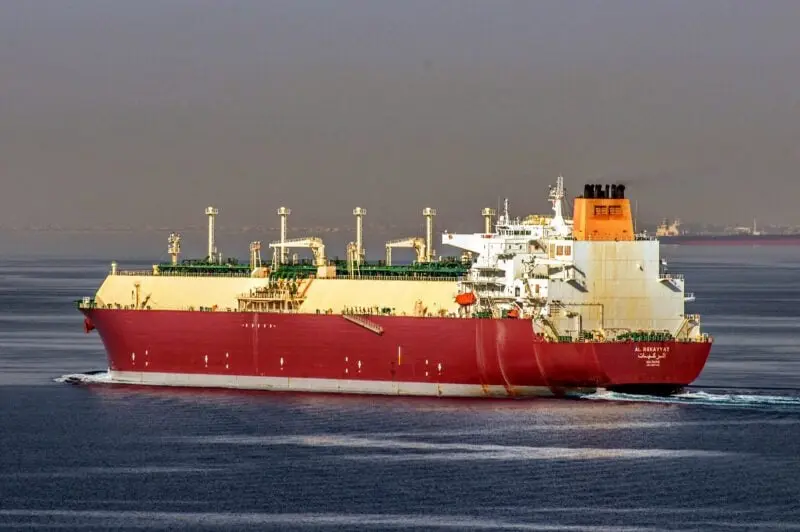
Case 2: The Al Rekayyat to Tembek (UAE East Coast)
The second operation featured Qatari-flagged vessels directly linked to state-backed operations, illustrating the high stakes for the world’s largest LNG exporter.
+-------------------------------------------------------------------------+
| CHRONOLOGY: THE AL REKAYYAT VOYAGE                                      |
+-------------------------------------------------------------------------+
| Early July:     Vessel struck by projectile near Strait of Hormuz.      |
| Mid-August:     STS transfer with "Tembek" off UAE East Coast.          |
| August 31:      "Tembek" delivers cargo to Dahej Terminal, India.       |
+-------------------------------------------------------------------------+- The Incident: In early July, the Al Rekayyat, a specialized LNG tanker controlled by QatarEnergy, was struck by a projectile while navigating near the Strait of Hormuz. The attack caused localized damage, rendering the vessel unfit for long-haul open-ocean transits but leaving its containment systems intact.
- The Maneuver: The damaged vessel was escorted out of the immediate conflict zone to the east coast of the United Arab Emirates, anchoring outside the Persian Gulf.
- The Transfer: In mid-August, the Al Rekayyat conducted an STS transfer with another Qatari LNG carrier, the Tembek.
- Outcome: The Tembek successfully loaded the cargo and departed for South Asia, arriving at India’s Dahej import terminal on August 31 to discharge the gas, mitigating a major supply shortfall for Indian industrial consumers.
Case 3: The Mraweh to LNG Enugu (Gulf of Oman)
The third operation involved assets from the United Arab Emirates and Japanese energy consortia, demonstrating the international footprint of these emergency logistics.

- The Incident: In early August, the Mraweh, an LNG carrier controlled by the Abu Dhabi National Oil Company (ADNOC), successfully loaded a cargo from Das Island inside the Persian Gulf.
- The Maneuver: Due to the extreme risk of navigating the full voyage under an Emirati flag or direct state ownership, the vessel halted its journey immediately after exiting the Strait of Hormuz, anchoring off the Omani coast.
- The Transfer: In mid-August, the Mraweh met the LNG Enugu—a vessel owned through a joint venture between the Japanese trading house Marubeni and the global shipping giant BW Group. The cargo was transferred entirely to the LNG Enugu.
- Outcome: According to vessel-tracking data, the LNG Enugu is currently transiting the Indian Ocean, en route to the Futtsu LNG terminal in Japan, bypassing the need for Japanese-affiliated vessels to enter the highly volatile waters of the inner Gulf.
The Physics and Perils of LNG Ship-to-Ship Transfers
To understand why these maneuvers are generating such concern among maritime insurers and energy analysts, one must look at the immense technical challenges of transferring liquefied natural gas between two moving vessels at sea.
Unlike crude oil, which is liquid at ambient temperatures and can be pumped through standard rubber hoses, LNG must be maintained at minus 162 degrees Celsius (-260 degrees Fahrenheit) to remain in its liquid state. At this temperature, ordinary steel becomes extremely brittle and can fracture upon impact.
+-----------------------------------------------------------------------------+
| KEY CHALLENGES OF LNG SHIP-TO-SHIP (STS) TRANSFERS                          |
+-----------------------------------------------------------------------------+
| Cryogenic Liquids:  Must be kept at -162°C; standard steel becomes brittle. |
| Specialized Hoses:  Requires vacuum-insulated, flexible cryogenic hoses.    |
| Boil-Off Gas (BOG): Pressure management is critical to prevent explosions.  |
| Motion Control:     Vessels must remain perfectly aligned to avoid hose     |
|                     ruptures and catastrophic rapid phase transitions.      |
+-----------------------------------------------------------------------------+
An LNG STS operation requires specialized equipment, highly trained crews, and rigorous environmental controls:
- Cryogenic Hoses: Transfers require flexible, vacuum-insulated cryogenic hoses made of composite materials or stainless-steel bellows. These hoses must be pre-cooled gradually with nitrogen gas before any LNG is introduced to prevent thermal shock.
- Boil-Off Gas (BOG) Management: As LNG is transferred, some of the liquid inevitably vaporizes due to ambient heat leakages. This Boil-Off Gas must be carefully managed. The receiving ship must send vapor back to the donor ship via a dedicated vapor-return line to balance pressures and prevent over-pressurization, which could trigger automatic safety venting or, in worst-case scenarios, explosions.
- Vessel Compatibility and Mooring: The two massive vessels must be moored tightly together using high-performance primary and secondary pneumatic fenders. Even minor swells can cause the ships to roll independently, putting immense shear stress on the cryogenic lines. Emergency Release Couplings (ERCs) are integrated into the system; if the ships drift beyond a calculated safety envelope, these couplings instantly dry-break to prevent a catastrophic spill.
- Rapid Phase Transition (RPT) Risk: If LNG spills onto the water, it does not burn immediately; instead, it heats up rapidly and transitions from a liquid to a gas almost instantly. This can cause a physical, non-chemical explosion known as a Rapid Phase Transition (RPT), which can damage vessel hulls and endanger the lives of crew members.
Because of these compounding risks, LNG STS operations have historically been confined to protected, deep-water ports or specialized offshore terminals. Performing them in open waters, such as the Gulf of Oman, under the shadow of geopolitical conflict, represents an extraordinary operational risk.
Supporting Context & Market Metrics
The sudden reliance on these high-risk operations is a direct consequence of the choking of the Strait of Hormuz, a waterway that typically handles more than one-fifth of the world’s liquefied natural gas trade and some 20 percent of global petroleum liquids.
The Macroeconomic Toll of the Blockade
Since the conflict erupted on February 28, Iran’s partial and sometimes total closure of the strait has severely restricted the outward flow of Qatari and Emirati energy exports. The reduction in available shipping capacity and the physical dangers of transit have caused global energy markets to react violently.
| Metric | Pre-Conflict Levels | Peak Conflict Levels (Current) | Percentage Increase |
|---|---|---|---|
| Asian Spot LNG Price | $10.50 / mmBtu | $23.20 / mmBtu | 120.9% |
| War Risk Insurance Premium | 0.05% of hull value | Up to 2.5% of hull value | 4,900% |
| Daily LNG Tanker Charter Rate | $65,000 / day | $145,000 / day | 123.1% |
| Hormuz LNG Transit Volume | ~14.5 Billion cubic feet/day | ~5.8 Billion cubic feet/day | -60.0% |
The doubling of Asian spot LNG prices to $23.20 per million British thermal units (mmBtu) has reignited inflation fears across major importing economies, particularly in Japan, South Korea, and India, which rely heavily on long-term Qatari contracts.
The Insurance Conundrum
The driving force behind these STS transfers is not merely physical damage to vessels, but the financial realities of maritime insurance. Following the attacks on the Al Rekayyat and the GasLog Shanghai, the Joint War Committee (JWC) of the London insurance market expanded its high-risk listed areas.
Underwriters have raised war risk premiums to prohibitive levels for any vessel entering the Persian Gulf. For many shipowners, their hull and machinery (H&M) and Protection and Indemnity (P&I) clubs simply refuse to cover transits through the Strait of Hormuz. By utilizing a "shuttle" system—where damaged or high-risk vessels load inside the Gulf, run the gauntlet of the strait once, and immediately transfer their cargo to unrestricted, lower-risk international vessels waiting in the Gulf of Oman—shipping companies can significantly lower their overall insurance liabilities and protect their primary fleets from prolonged exposure to war zones.
Official Statements and Corporate Silence
The sensitive nature of these operations, which exist in a legal and security gray area, has led to a wall of silence from the corporate entities involved.
- QatarEnergy: The Qatari state-owned giant, which owns both the Al Rekayyat and the Tembek through its shipping arm Nakilat, declined multiple requests for comment regarding the security of its fleet and the deployment of STS maneuvers.
- ADNOC: The Abu Dhabi National Oil Company, owner of the Mraweh, declined to comment on its shipping strategies or its operational relationship with Japanese buyers under the current blockade conditions.
- GasLog: The Greek shipowner, whose vessels GasLog Shanghai and GasLog Savannah completed the late-August transfer, did not respond to inquiries regarding the nature of the July 31 incident or the safety protocols of their open-sea cryogenic transfer.
- BW Group and Marubeni: Joint owners of the LNG Enugu, both firms remained silent when asked about the charter terms and the potential safety risks of receiving cargo from an Emirati vessel in the Gulf of Oman.
This collective silence is interpreted by industry insiders as an effort to avoid drawing military attention to the specific coordinates of the STS transfer zones, which remain highly vulnerable to drone and missile attacks from non-state actors and regional militaries operating in the area.
Future Outlook
As the conflict shows no signs of immediate resolution, the maritime industry is bracing for a semi-permanent restructuring of Middle Eastern energy exports.
The Rise of Permanent STS Hubs
If the blockade of the Strait of Hormuz persists, maritime analysts predict the formal establishment of offshore LNG transfer hubs in the Arabian Sea and the Indian Ocean. Rather than relying on ad-hoc, emergency ship-to-ship transfers, energy companies may deploy permanently moored Floating Storage and Regasification Units (FSRUs) or specialized Floating Storage Units (FSUs) outside the conflict zone.
These vessels would act as intermediate buffer stations. High-risk shuttle tankers would run back and forth through the dangerous strait to load these storage units, while standard international carriers would load from the FSUs in safe waters, completely insulated from the geopolitical risks of the Persian Gulf.
+-------------------------------------------------------------------------+
| PROPOSED "SHUTTLE-TO-HUB" LOGISTICS MODEL                               |
+-------------------------------------------------------------------------+
|                                                                         |
|  [ Inside Gulf ]  -->  (Shuttle Tanker)  -->  [ Strait of Hormuz ]      |
|                                                     |                   |
|                                            (High-Risk Transit)          |
|                                                     |                   |
|  [ Safe Waters ]  <--  (Int'l Carrier)   <--  [ FSU / Hub (Oman) ]      |
|                                                                         |
+-------------------------------------------------------------------------+
Long-Term Economic and Geopolitical Realignment
The systemic risk of relying on the Strait of Hormuz is accelerating structural changes in global gas procurement. Import-dependent nations like Japan and India are already shifting their investment focus away from Middle Eastern projects, looking instead to accelerate long-term supply agreements with North American exporters (US Gulf Coast), East Africa (Mozambique), and Australia.
In the interim, the successful execution of these three ship-to-ship transfers demonstrates the remarkable adaptability of the global maritime sector. Faced with military blockades, soaring insurance rates, and physical strikes on their vessels, shipping companies have proved willing to push the boundaries of nautical engineering and operational risk to keep the world’s lights on. However, this shadow logistics network comes at a premium—one that global consumers will ultimately pay for in the form of elevated energy bills and persistent inflationary pressures for years to come.