







Executive Overview
The global maritime sector stands at a critical historical juncture. With the International Maritime Organization (IMO) targeting net-zero greenhouse gas (GHG) emissions from international shipping by or around 2050, the industry is racing against a relentless clock. This target is now a mere 24 years away—a timeframe shorter than the typical operational lifespan of a newly built commercial vessel. Consequently, decisions made by shipowners today will directly determine whether the industry meets its climate obligations or faces severe regulatory and financial penalties.
While much of the public discourse centers on "future fuels" such as green ammonia, hydrogen, and methanol, the infrastructure, scalability, and commercial viability of these energy sources remain years, if not decades, away. In the interim, a massive active global fleet of approximately 112,000 vessels continues to operate, collectively pumping roughly 1.05 billion metric tons of carbon dioxide and other greenhouse gases into the atmosphere annually.
To bridge this transitional gap, a pragmatic and immediate solution has emerged: retrofitting existing, conventionally fueled vessels with advanced energy-efficiency technologies. According to David Sakandelidze, Business Manager for Energy and Efficiency at Berg Propulsion, the shipping industry cannot afford to wait for future tonnage to solve its emissions crisis. By optimizing the propulsion systems, hydrodynamic profiles, and control software of the vessels currently on the water, shipowners can achieve immediate, verified fuel savings and emissions reductions.
This investigative report examines the mechanics, metrics, and strategic implications of this retrofit revolution, highlighting how targeted engineering interventions are turning older, less-efficient assets into compliant, modern competitors.
Detailed Chronology: The Retrofitting Acceleration (2022–2026)
The transition from conceptual efficiency designs to widespread shipyard deployment has accelerated rapidly over the last four years. Between 2022 and 2026, Berg Propulsion undertook a concerted campaign to prove the viability of propulsion retrofits across a diverse array of vessel types.
[2022–2024: Early Adoption]
  │  Focus on piloting customized controllable-pitch propeller (CPP) blades
  │  and baseline control system upgrades on early-adopter vessels.
  ▼
[May 2025 – May 2026: Rapid Scaling Phase]
  │  38 vessels retrofitted in a single 12-month window.
  │  Widespread integration of net frequency stabilizers and Dynamic Drive software.
  ▼
[Post-May 2026: Verification & Impact Assessment]
  │  Delivery of 114,000 metric tons of verified annual CO2 emissions savings.
  └  Establishment of standardized retrofit packages for slow-steaming fleets.
2022–2024: Establishing the Proof of Concept
During the initial phase of this initiative, maritime operators faced mounting pressure from the implementation of the IMO’s Energy Efficiency Existing Ship Index (EEXI) and the Carbon Intensity Indicator (CII). Berg Propulsion focused on identifying the most vulnerable segment of the global fleet: high-speed vessels that, due to shifting market dynamics, fuel costs, and supply chain corrections, had been forced to adopt "slow steaming" practices—operating at least 20% slower than their original design speeds.
During these two years, Berg engineered custom hydrodynamic and mechanical retrofits for a baseline group of vessels, proving that modifying existing propulsion systems could yield double-digit fuel savings without requiring expensive engine replacements.
May 2025–May 2026: The Scaling Phase
The momentum culminated in an intensive 12-month period between May 2025 and May 2026, during which Berg Propulsion successfully retrofitted 38 vessels—more than half of the total 70-vessel portfolio completed since 2022. This rapid scaling was driven by a combination of tightening European Union Emissions Trading System (EU ETS) regulations, the looming implementation of FuelEU Maritime, and verified performance data from early adopters.
By the close of this period, the combined 70 retrofitted vessels began delivering a verified annual emissions reduction of 114,000 metric tons of CO2 equivalent, demonstrating that retrofitting is not merely a theoretical stopgap, but a highly scalable industrial solution.
Supporting Context & Metrics: The Mathematics of the 2050 Mandate
To fully appreciate the scale of the challenge facing the maritime industry, one must analyze the mathematical reality of the IMO’s 2050 net-zero trajectory.
| Metric | Value |
|---|---|
| Active Global Fleet | ~112,000 vessels |
| Total Annual Maritime Emissions | ~1.05 billion metric tons of $CO_2$ |
| Time Remaining to Net-Zero Target | 24 years (as of 2026) |
| Required Annual Global Emission Cuts | ~43.75 million metric tons |
| Average Operational Lifespan of a Ship | 25–30 years |
To achieve a linear reduction to zero by 2050, the global fleet must collectively slash its emissions by approximately 43.75 million metric tons every single year. This reduction cannot be achieved solely by waiting for older ships to be decommissioned and replaced by zero-emission newbuilds. Shipyard capacity worldwide is heavily backlogged, and building 112,000 new vessels would take decades, while generating massive scope 3 emissions in the process.
The Physics of the Slow-Steaming Paradox
The economic practice of slow steaming presents a major engineering paradox. While reducing a vessel’s speed inherently lowers its overall fuel consumption due to the cubic relationship between speed and power ($P propto v^3$), it simultaneously exposes severe thermodynamic and mechanical inefficiencies within propulsion plants designed for high-speed operations.
[Vessel Slows Down (Slow Steaming)]
  │
  ├─► [Engine operates far below its optimal thermal efficiency point]
  │
  ├─► [Controllable-Pitch Propeller (CPP) pitch is reduced to slow the ship]
  │     │
  │     └─► [Constant high RPM maintained to keep shaft generator active]
  │           │
  │           └─► [Massive hydrodynamic "churning" losses at the propeller]
  │
  └─► [Result: High fuel consumption per mile relative to actual work done]
In a conventional setup utilizing a Controllable-Pitch Propeller (CPP), the system controls thrust and vessel speed by adjusting the angle (pitch) of the propeller blades while maintaining a constant engine rotation speed (RPM). This constant RPM is vital because it drives the shaft generator, which produces stable electrical power for the ship’s onboard systems.
However, when a ship designed for 20 knots slow-steams at 14 knots, the propeller blades must be pitched at a highly inefficient angle to prevent the ship from accelerating, while the engine continues to spin at full speed. This results in massive hydrodynamic "churning" losses, high fuel consumption per nautical mile relative to the work being done, and sub-optimal engine load profiles that increase wear, carbon deposits, and NOx emissions.
Technical Deep-Dive: Engineering the Modern Retrofit
To resolve the slow-steaming paradox, Berg Propulsion developed a multi-layered retrofit strategy combining hydrodynamic optimization, mechanical adjustments, electrical engineering, and intelligent software control systems.
                    ┌──────────────────────────────────────┐
                    │      Berg Retrofit Architecture      │
                    └──────────────────┬───────────────────┘
                                       │
         ┌─────────────────────────────┼─────────────────────────────┐
         ▼                             ▼                             ▼
┌─────────────────┐           ┌─────────────────┐           ┌─────────────────┐
│  Hydrodynamic   │           │   Electrical    │           │ Digital Control │
│   Optimizations │           │  Modifications  │           │    & Software   │
├─────────────────┤           ├─────────────────┤           ├─────────────────┤
│• New CPP Blades │           │• Frequency      │           │• Combinatory    │
│• Reduced RPM    │           │  Stabilizers    │           │  Control Mode   │
│• Hub Cones      │           │• Battery Packs  │           │• Dynamic Drive  │
│• Propeller      │           │  (Peak Shaving) │           │• Engine Power   │
│  Nozzles        │           │                 │           │  Limiter (EPL)  │
└─────────────────┘           └─────────────────┘           └─────────────────┘
Hydrodynamic and Blade Redesign
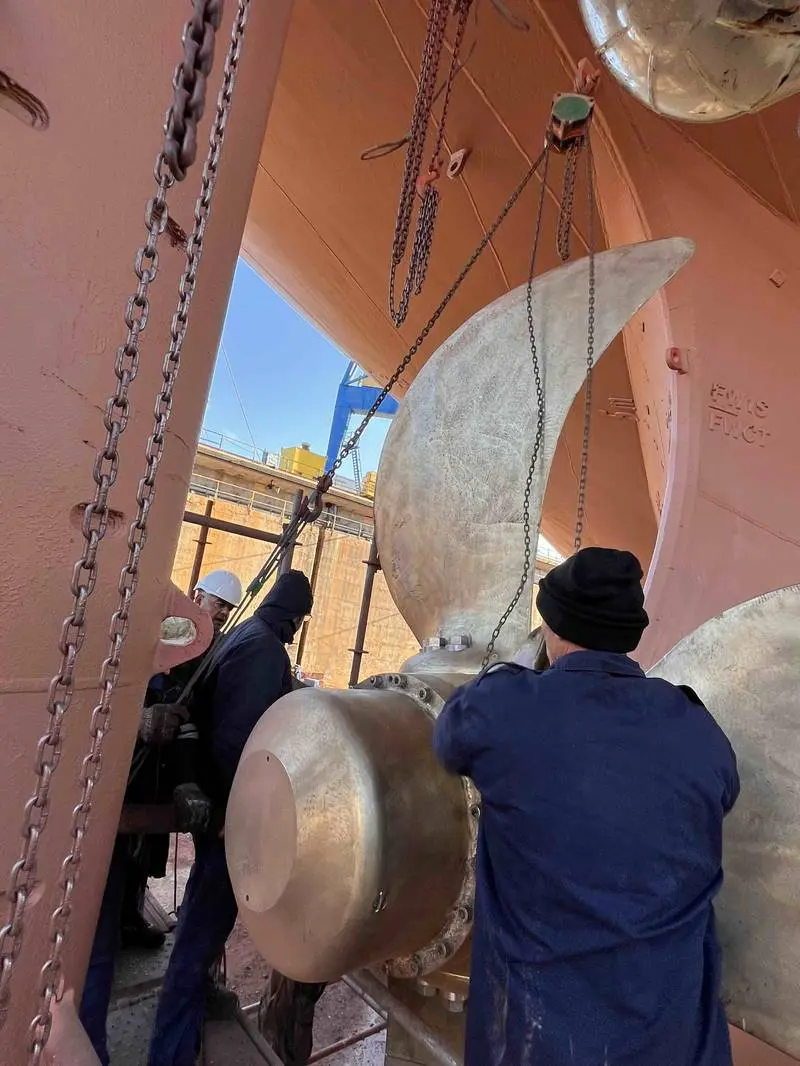
The cornerstone of Berg’s retrofit methodology is the redesign of the CPP blades themselves. By manufacturing new blades optimized specifically for the lower, actual operating speeds of the vessel, engineers can restore the propeller’s open-water efficiency.
To maximize these gains, Berg couples the blade redesign with a 10% to 15% reduction in engine RPM. Running the engine and shaft slower directly reduces frictional and rotational energy losses.
To complement this, owners can install additional hydrodynamic hardware:
- Hub Fairing Cones: Attached to the propeller hub to smooth out the water flow behind the propeller, reducing turbulence, drag, and hub vortex losses.
- Propeller Nozzles: Duct structures fitted around the propeller to redirect water flow, dramatically increasing thrust and efficiency at lower speeds.
Overcoming the Electrical Challenge: Net Frequency Stabilizers
When engine RPM is reduced by 10% to 15% to save fuel, the shaft speed drops proportionally. In a standard electrical setup, this drop in input speed would cause the shaft generator’s output frequency to fall below the safe threshold required by the ship’s electrical grid (typically 50Hz or 60Hz), rendering the generator useless and forcing the crew to run auxiliary diesel generators instead.
To bypass this issue, Berg installs a net frequency stabilizer (an active front-end frequency converter). This power electronics system takes the variable-frequency AC power produced by the slower-spinning shaft generator, converts it to DC, and then inverts it back into a highly stable, grid-compliant AC frequency. This allows the vessel to reap the fuel-saving benefits of lower engine RPM while keeping the shaft generator fully online to supply clean, stable electrical power to the ship’s hotel load and auxiliary systems.
Hybridization and Battery Integration
In more comprehensive retrofit configurations, Berg integrates battery energy storage systems (BESS). These battery packs serve two primary functions:
- Peak Shaving: The battery absorbs sudden load fluctuations on the ship’s grid or propulsion line, allowing the main engine to run at a steady, optimized load point without burning extra fuel to handle transient spikes.
- Shore-Based Charging: Allowing the vessel to shut down its auxiliary engines entirely while in port, eliminating localized emissions in coastal communities.
Intelligent Control Systems and Software
A hardware retrofit is only as effective as the software managing it. Berg Propulsion utilizes advanced control system upgrades to maximize the synergy between the engine and the propeller:
- Combinatory Mode: Rather than running the engine at a fixed RPM and adjusting only the propeller pitch, combinatory mode uses intelligent algorithms to automatically adjust both engine RPM and propeller pitch in tandem along an optimized curve, finding the absolute lowest fuel-consumption point for any desired vessel speed.
- Dynamic Drive: This fuel-optimization software package continuously calculates real-time variables—such as wind, draft, and sea state—to adjust engine and propeller parameters dynamically, preventing fuel wastage.
- Engine Power Limiter (EPL): A system that electronically caps the maximum power output of the engine to ensure compliance with EEXI regulations, while preserving the necessary power reserve for safe navigation in adverse weather.
Official Statements: Perspectives from Berg Propulsion
The Industry Shift
In discussing the philosophy behind Berg Propulsion’s engineering push, David Sakandelidze, Business Manager for Energy and Efficiency, emphasizes that waiting for the perfect green ship is a luxury the planet—and shipowners—cannot afford.
"Rather than pinning its decarbonization hopes on future tonnage, shipping can pursue its goals today by retrofitting available technology to existing, conventionally fueled vessels."
Sakandelidze points out that the financial risk of inaction is growing rapidly. Shipowners who delay optimization face the prospect of stranded assets—ships that are structurally sound but commercially unviable because they cannot meet tightening CII ratings or because they face heavy carbon taxes under regimes like the EU ETS.
Target-Driven Engineering
Sakandelidze highlights that the most effective way to make a meaningful impact on global emissions is to target the specific operational realities of the existing fleet, rather than relying on one-size-fits-all solutions.
"To support and meaningfully contribute to our common goal, Berg Propulsion defined its own shipping segment to achieve fuel savings. This segment consists of ships built for high speed but, due to market demand, are operating at least 20% slower than design speed."
Addressing the technical trade-offs of slow steaming, Sakandelidze notes:
"Such operating, while offering economical and environmental benefits in the form of reduced fuel consumption, exposes inefficiencies of the propulsion power plant system which were designed for a different optimal operation point. The trade-off lies in reduced engine and propulsion efficiency, in turn causing a ship’s shaft generator to lose its ability to produce stable electrical power."
By identifying this specific mechanical friction point and engineering a tailored suite of hydrodynamic, electrical, and digital solutions, Berg has turned an operational compromise into a source of verified environmental and economic performance.
Future Outlook: Scaling Retrofits for a Global Fleet
As the maritime industry looks toward the crucial 2030 milestone—by which time the IMO aims for a 20% to 30% reduction in total emissions compared to 2008 levels—the scale of the retrofitting market is set to expand exponentially.
The success of Berg Propulsion’s 70-vessel campaign serves as a blueprint for the wider industry. If a modest deployment of retrofitted systems can prevent 114,000 metric tons of CO2 from entering the atmosphere annually, scaling these technologies across even 20% of the eligible global slow-steaming fleet would yield tens of millions of tons of annual carbon reductions. This is precisely the scale of reduction required to meet the IMO’s annual target of 43.75 million tons.
Financial and Regulatory Drivers
The business case for retrofitting is becoming self-evident. With the inclusion of maritime transport in the EU ETS and the introduction of FuelEU Maritime, carbon is no longer a free externality; it is a direct operational cost. At a carbon price of €80 to €100 per ton, a vessel saving 2,000 tons of CO2 per year through a Berg retrofit saves not only on fuel costs but also nets up to €200,000 in avoided carbon taxes annually.
Furthermore, financial institutions are increasingly aligning their lending portfolios with the Poseidon Principles, which index shipping loans against decarbonization trajectories. Older, un-optimized ships will find it increasingly difficult to secure financing or insurance, making retrofits a necessity for asset preservation.
The Path to 2050
Ultimately, the transition to zero-emission fuels like ammonia or hydrogen is a long-term destination, but retrofitting is the vehicle that will carry the industry through the next two critical decades. By utilizing highly efficient, versatile propulsion systems that perform well across a wide range of speeds, existing ships can significantly lower their fuel consumption per nautical mile and reduce their CO2, NOx, and particulate emissions today.
By optimizing the ships we already have, the maritime industry can achieve immediate, deep decarbonization, proving that the path to a zero-emission future does not lie in waiting for tomorrow’s technology, but in re-engineering the assets of today.