






Executive Overview
Nestled within the picturesque Qu’Appelle Valley of Saskatchewan, Canada, lies the quaint and historically rich village of Lebret. Positioned along the tranquil shores of Mission Lake, this tight-knit community serves as a stunning testament to the enduring interplay between natural splendor and deep-rooted cultural heritage. Saskatchewan, widely celebrated as Canada’s sunniest province—boasting upwards of 2,000 hours of annual sunshine—provides an inviting backdrop for a destination where the past remains palpably alive.
Founded initially as a Catholic mission in the 1860s, Lebret has evolved from its ecclesiastical origins into a unique cultural haven. Today, it captures the imagination of travelers seeking an escape from urban centers like Regina, located just 50 miles to the southwest. From its landmark hilltop Stations of the Cross and the architectural grandeur of the Sacred Heart Roman Catholic Church to vibrant local Indigenous enterprises like the Lebret Cafe, the village bridges historical preservation with contemporary rural charm. This comprehensive journalistic report explores Lebret’s historical roots, its recreational landscape, its cultural focal points, and its growing significance as a premier regional tourism destination.
Detailed Chronology of a Prairie Sanctuary
To truly understand the unique cultural tapestry of Lebret, one must examine the chronological milestones that transformed a remote valley settlement into a landmark of Saskatchewan’s heritage.

[1860s] Foundation of the original Catholic Mission in the Qu'Appelle Valley
   │
[1871] Erection of the historic cross on the northern hill overlooking Mission Lake
   │
[early 20th century] Construction of the stone Sacred Heart Roman Catholic Church
   │
[1929] Establishment of the red-and-white Memorial Chapel and finalization of the hillside path
   │
[Modern Era] Emergence of the seasonal Lebret Museum and the community-driven Lebret Cafe
The 1860s–1870s: Missionary Beginnings and the Sacred Landscape
The written history of Lebret begins in the tumultuous and transformative decade of the 1860s. Established originally as a Catholic mission to serve the local Indigenous populations and incoming settlers, the site was chosen for its strategic and spiritual centrality within the Qu’Appelle Valley. Mission Lake provided vital sustenance, while the surrounding fertile hillsides offered agricultural potential.
In 1871, a symbolic milestone was achieved with the erection of a grand cross on the northern hill overlooking the valley. This cross marked the spiritual anchor of the community—a feature that continues to dominate the skyline today. Although the original mission buildings from the 1870s have long since vanished, the physical topography of the village remains permanently altered and blessed by this early period of spiritual exploration.
The Turn of the Century: Architectural Permanence
As the 19th century gave way to the 20th, the transient wooden structures of the early mission gave way to permanent, enduring architecture. The cornerstone of this era is the Sacred Heart Roman Catholic Church. Constructed from locally sourced stone, the church features a soaring spire and a bell tower that have stood as silent sentinels over the village for well over a century.
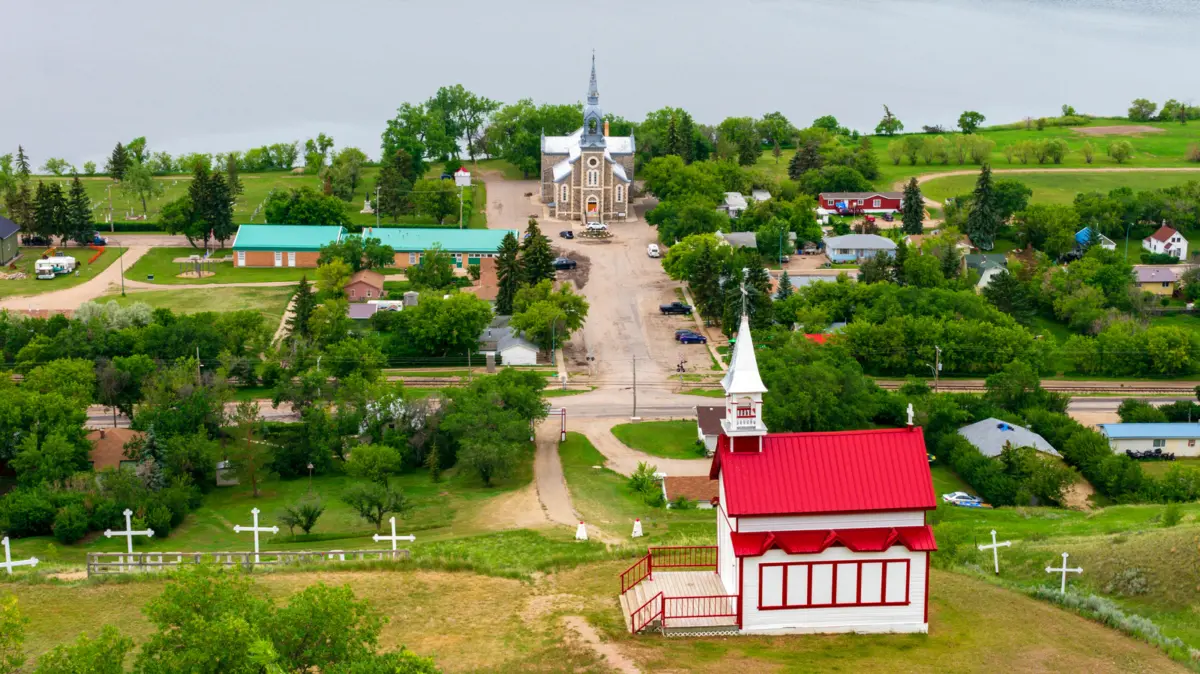
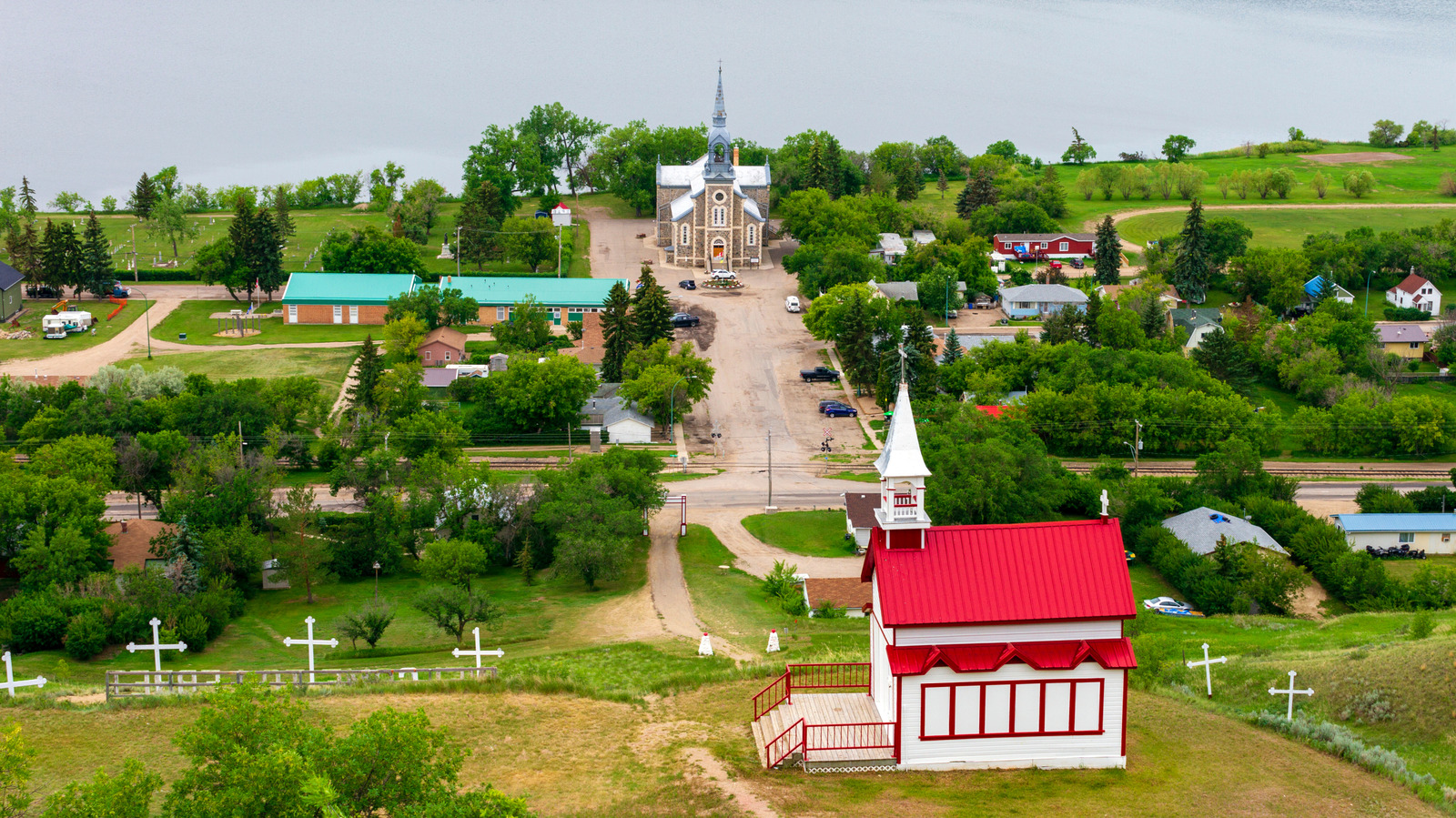
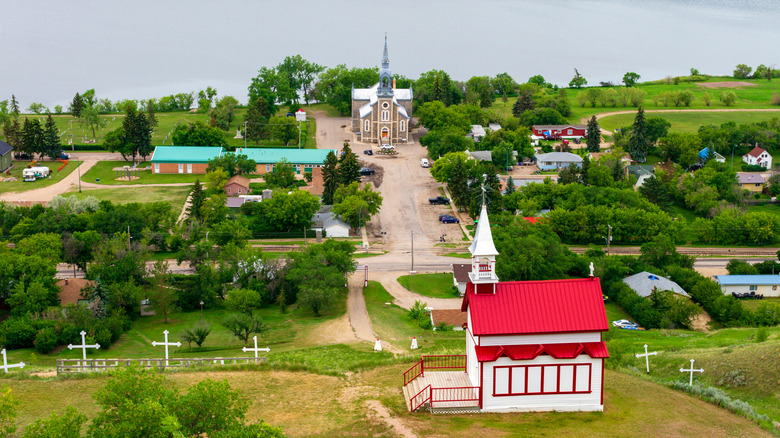
Complementing the church was the development of the sacred walking path known as the Stations of the Cross. Winding upward from the front doors of the Sacred Heart church along the steep slopes of the northern hill, this path culminated in 1929 with the construction of the iconic red-and-white Memorial Chapel. This period cemented Lebret’s reputation not merely as a utilitarian frontier settlement, but as a place of profound aesthetic and spiritual reflection.

The Modern Era: Cultural Revitalization
As the agricultural and religious demographics of Saskatchewan shifted through the latter half of the 20th century, villages like Lebret faced the economic challenges common to rural prairie communities. However, rather than fading into obscurity, the village leveraged its historical assets and natural endowments to foster a sustainable tourism economy.
The establishment of the seasonal Lebret Museum provided a formalized space for preserving settler homewares and Indigenous Métis beadwork. More recently, the opening of enterprises such as the indigenous-owned Lebret Cafe has injected new economic and cultural vitality into the community, turning historical preservation into an active, participatory experience for modern travelers.
Supporting Context & Geographic Metrics
Understanding Lebret requires a detailed examination of its geographic environment, accessibility, and recreational infrastructure. The village functions as an ideal gateway for ecotourists, historians, and outdoor enthusiasts alike.
Geographic and Climatic Profile
- Province: Saskatchewan, Canada
- Annual Sunshine: Exceeding 2,000 hours annually, making it one of the sunniest regions in the country.
- Primary Water Body: Mission Lake, part of the interconnected chain of lakes within the Qu’Appelle Valley.
- Elevation & Topography: Characterized by steep, forested hillsides dropping down into low-lying lake basins, creating dramatic vertical vistas unusual for the flat plains typically associated with the Canadian prairies.
Accessibility and Regional Proximity
Lebret’s relative isolation is balanced by its proximity to major transportation hubs, making it an accessible weekend getaway:
- From Regina: Approximately 50 miles (a convenient 1-hour drive east). Regina International Airport (YQR) provides frequent flights connecting major Canadian and U.S. cities.
- From Saskatoon: Approximately a 3.5-hour drive south via major provincial highways, allowing travelers to experience the acclaimed Saskatoon John G. Diefenbaker International Airport (YXE).
- Local Amenities: While Lebret itself maintains a quiet, village atmosphere devoid of commercial hotels, visitors can find comprehensive lodging options directly within Regina or just 10 minutes away in the neighboring town of Fort Qu’Appelle.
Outdoor Recreation Metrics
The surrounding landscape offers a robust slate of activities for outdoor enthusiasts:
- Fishing Diversity: Mission Lake is renowned among regional anglers for supporting a diverse fishery, including walleye, northern pike, carp, yellow perch, burbot, and lake whitefish.
- Trail Networks: Beyond the village’s internal hilltop treks, the nearby Echo Valley Provincial Park (located just 20 minutes away) features specialized trail systems:
- Coyote Trail: Navigates through vibrant, wildlife-rich marshlands.
- Eagle Trail: Rewards hikers with panoramic vistas of the valley floor.
- Raccoon Trail: Provides a leisurely path frequented by local white-tailed deer.
Cultural Landmarks and Local Enterprises
The soul of Lebret resides in its active preservation of local heritage and the contemporary entrepreneurial spirit of its residents.
The Sacred Heart Church and Hillside Stations
The architectural centerpiece of the village is undeniably the Sacred Heart Roman Catholic Church. Visitors walking its grounds are immediately struck by the meticulous stonework and towering spire. The journey does not end at the church doors; the path of the Stations of the Cross leads pilgrims and hikers alike up the steep incline of the northern hill. Passing each station offers a moment of contemplative pause before reaching the summit, where the 1929 red-and-white Memorial Chapel stands alongside the iconic "Welcome to Lebret" sign. The panoramic view from this elevation encompasses the entirety of the village, the glittering expanse of Mission Lake, and the sprawling contours of the Qu’Appelle Valley.
The Lebret Museum
Located directly opposite the Sacred Heart Roman Catholic Church, the Lebret Museum serves as the historical archive of the community. Operating seasonally from mid-May through August (Friday through Sunday afternoons), the museum curates exhibits detailing the harsh realities and triumphs of early homesteaders. Of particular note are collections of intricate beadwork crafted by First Nations and Métis artisans. Online visitor logs and reviews frequently highlight unique artifacts, such as a historic book rescued from a devastating early church fire—a tangible symbol of the village’s resilience.
The Lebret Cafe: A Hub of Métis Art and Cuisine
No contemporary visit to Lebret is complete without stopping at the local cafe, easily identifiable by its vibrant lavender-painted facade along Highway 56. Owned and operated by three Métis women, the cafe functions simultaneously as a culinary destination and a cultural gallery.
The establishment showcases works of art, traditional music, books, and handmade goods by local artisans. The menu features a rotating selection of sweet and savory baked goods, including traditional treats like apple fritters, raisin pie, coconut biscuits, and freshly baked cheese buns. Furthermore, the cafe hosts specialized workshops centered on traditional Métis meditative art practices, providing visitors with an immersive cultural education.
Future Outlook and Tourism Sustainability
As rural tourism across western Canada undergoes a renaissance, villages like Lebret are positioned at an important crossroads. The challenge moving forward lies in balancing the influx of weekend visitors from Regina and beyond with the preservation of the delicate ecological balance of Mission Lake and the quiet dignity of the historic community.
Local tourism boards, in collaboration with provincial authorities, are increasingly focusing on sustainable infrastructure development. Efforts to maintain the structural integrity of historical sites—such as the stone masonry of the Sacred Heart Church and the preservation of the hillside walking paths—remain a top priority. Simultaneously, the success of indigenous-led enterprises like the Lebret Cafe demonstrates a scalable model for economic development that honors cultural heritage rather than commercializing it.
For travelers looking beyond standard resort vacations, Lebret offers an authentic slice of Canadian prairie history combined with accessible outdoor recreation. Whether casting a line into the calm waters of Mission Lake, hiking the historic Stations of the Cross at sunset, or sharing a cup of tea with local artisans, visitors to Lebret step into a living narrative that has endured for well over a century—and one that is well-prepared to welcome generations to come.