





Executive Overview
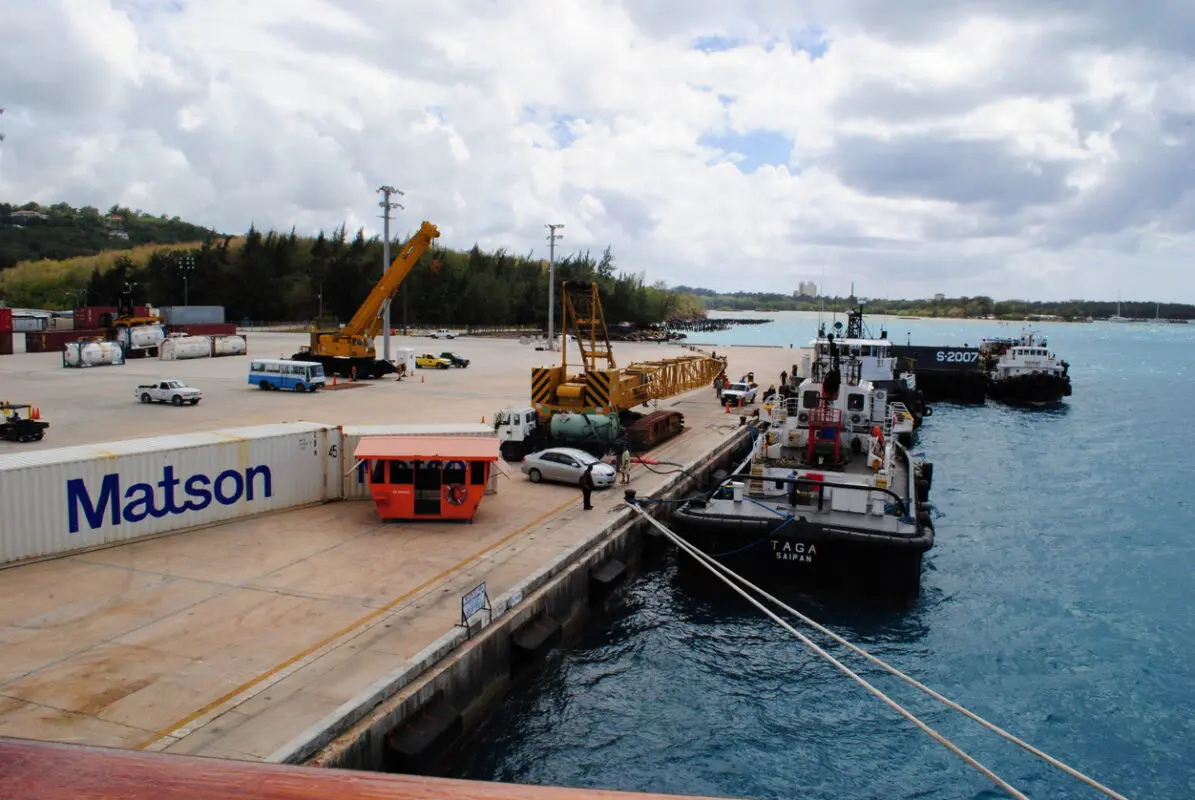
In response to the shifting weather patterns trailing the passage of Tropical Storm Saudel, the U.S. Coast Guard Captain of the Port (COTP) for Forces Micronesia/Sector Guam has officially set Port Heavy Weather Condition (PHWC) WHISKEY for the Port of Saipan and the Port of Tinian.
Although Tropical Storm Saudel no longer poses a direct, immediate threat to the Commonwealth of the Northern Mariana Islands (CNMI), the activation of PHWC WHISKEY marks a critical precautionary phase in regional maritime governance. Commercial traffic and cargo operations at both ports remain fully open and operational. However, maritime authorities have issued strict advisories for vessel masters, pilots, and terminal operators to exercise heightened caution during transits, particularly due to the persistent risks of channel shifting and underwater shoaling caused by heavy wave action and storm surges.
PHWC WHISKEY serves as the initial tier in the U.S. Coast Guard’s standardized heavy weather preparedness framework. It functions as an early warning indicator, signaling that sustained gale-force winds are a possibility within a 72-hour window, or that a significant tropical system has recently exited the local operating area.
While commercial activity continues unabated under WHISKEY, the declaration compels maritime stakeholders to shift from routine operations to proactive preparedness. Vessel masters, facility managers, and logistics coordinators are now mandated to review their heavy weather response plans, secure unsecured shoreside equipment, verify and reinforce mooring arrangements, and monitor continuous meteorological updates issued by the Joint Typhoon Warning Center (JTWC) and the National Weather Service (NWS).
This latest maritime directive underscores the delicate logistical balance maintained across the Western Pacific, where regional island economies rely heavily on uninterrupted maritime supply chains. At the same time, authorities must remain vigilant against the compounding hazards of post-storm navigational impediments.
Detailed Chronology: The Evolution and Aftermath of Tropical Storm Saudel
The Genesis and Track of Tropical Storm Saudel
Tropical Storm Saudel developed out of a persistent area of disturbed weather within the monsoon trough of the Western Pacific basin—a meteorological nursery known for generating some of the most powerful tropical cyclones on Earth. As the system organized, centralized convection deepened, prompting meteorological agencies to monitor its westward trajectory toward the island chains of Micronesia.
Operating within an environment characterized by warm sea surface temperatures and favorable upper-level outflow, the storm intensified into a tropical storm before making its closest approach to the Commonwealth of the Northern Mariana Islands. While the storm’s core track spared Saipan and Tinian from catastrophic direct landfalls, its expansive wind field and associated convective rainbands generated heavy squalls, rough seas, and dangerous swells across local waters.
Post-Storm Assessment and the Decision for PHWC WHISKEY
As Tropical Storm Saudel tracked further away into the Philippine Sea, neutralizing its direct wind threat to the immediate CNMI coastline, attention shifted from wind mitigation to underwater hazard assessment and post-storm recovery.
Maritime authorities and port engineers recognized that while the visible surface weather was improving, hidden dangers remained beneath the surface. The immense hydraulic energy of passing tropical systems frequently shifts sandy seabeds, alters channel configurations, and displaces navigational aids.
Consequently, the U.S. Coast Guard Captain of the Port for Forces Micronesia/Sector Guam exercised statutory authority under the Maritime Transportation Security Act (MTSA) and the Ports and Waterways Safety Act to establish PHWC WHISKEY. This transition acknowledges that the maritime threat has not completely vanished, but rather evolved into navigational and environmental hazards that require careful management by all mariners transiting the Saipan and Tinian commercial channels.
Supporting Context & Metrics: Navigating the Western Pacific Typhoon Season
The Operational Realities of the Western Pacific Basin
The Western Pacific is globally recognized as the most active and intense tropical cyclone basin on the planet. Operating within this region requires maritime operators, port authorities, and government agencies to maintain an elevated year-round state of readiness.
For island territories such as Guam, Saipan, and Tinian, geographic isolation means that virtually all essential commodities—including food, medical supplies, fuel, and construction materials—arrive via container ships, fuel tankers, and inter-island barge services. Any disruption to port operations can rapidly cascade through local supply chains, threatening energy security and retail inventories.
Understanding the U.S. Coast Guard Port Heavy Weather Tier System
To mitigate the risks posed by seasonal typhoons and tropical storms, the U.S. Coast Guard employs a tiered framework of Port Heavy Weather Conditions. These conditions allow port captains to systematically scale operational restrictions upward or downward as meteorological threats evolve.
[PHWC WHISKEY] ---> [PHWC X-RAY] ---> [PHWC YANKEE] ---> [PHWC ZULU]
(72-Hour Warning) (48-Hour Warning) (24-Hour Warning) (Port Closed)- PHWC WHISKEY (Set):
- Trigger: Gale-force winds possible within 72 hours, or a storm has recently passed.
- Status: Ports remain open. Commercial traffic and cargo operations continue normally.
- Action Required: Review heavy weather plans, monitor weather bulletins, and secure loose gear.
- PHWC X-RAY:
- Trigger: Gale-force winds possible within 48 hours.
- Status: Ports remain open, but vessels intending to remain in port must prepare to take specific precautions.
- Action Required: Ocean-going commercial vessels over 500 gross tons must prepare to depart or submit formal requests to remain in port with comprehensive heavy-weather mooring plans.
- PHWC YANKEE:
- Trigger: Gale-force winds expected within 24 hours.
- Status: Port is closed to inbound commercial traffic. All cargo operations must cease unless explicitly authorized by the Captain of the Port.
- Action Required: Vessels remaining in port must execute final safety protocols, disconnect shoreside transfers if necessary, and double up mooring lines.
- PHWC ZULU:
- Trigger: Gale-force winds expected within 12 hours, or storm conditions are imminent.
- Status: Port is completely closed to all vessel traffic and cargo operations. Waterside facilities are locked down.
- Action Required: Emergency personnel shelter in place; all non-essential maritime activity is strictly prohibited.
Navigational Hazards: The Threat of Shoaling and Aids to Navigation (ATON) Discrepancies
Beyond winds and storm surges, post-storm maritime environments present insidious navigational hazards that can jeopardize deep-draft commercial vessels and agile tug-and-barge units alike.
Shoaling occurs when wave action and storm-driven currents deposit vast quantities of sand, silt, and debris into previously dredged navigation channels. This reduces under-keel clearance (UKC), drastically increasing the risk of a commercial vessel grounding—an event that can block an entire port facility for days or weeks.
Furthermore, floating and fixed Aids to Navigation (ATON)—such as channel buoys, daybeacons, and range lights—are frequently dragged off station, submerged, or rendered inoperable by heavy seas. The U.S. Coast Guard has explicitly reminded all mariners operating in the waters around Saipan and Tinian to maintain rigorous visual and radar lookouts and to report any perceived discrepancies in ATON positioning immediately to the Sector Guam Command Center via VHF-FM channel 16 or 22A.
Official Statements and Regulatory Guidance
Directives from U.S. Coast Guard Forces Micronesia/Sector Guam
In official notices distributed to the regional maritime community, leadership at Sector Guam emphasized that while the immediate meteorological crisis of Tropical Storm Saudel has passed, complacency remains the greatest enemy of maritime safety.
"The establishment of Port Heavy Weather Condition WHISKEY is not a measure to disrupt commerce, but a crucial reminder that our operational environment remains dynamic and potentially hazardous in the wake of tropical weather systems," stated officials representing the Captain of the Port. "Mariners must respect the shifting bathymetry of our channels and maintain constant vigilance regarding underwater shoaling and displaced aids to navigation."
Responsibilities of Vessel Masters and Terminal Operators
Under the regulatory framework of PHWC WHISKEY, legal and operational accountability is shared between the federal maritime regulator, vessel masters, and shoreside facility operators.
- Vessel Masters are required to continuously evaluate their ship’s stability, propulsion readiness, and mooring configurations. For ships currently berthed in Saipan or Tinian, crews must ensure that gangways are monitored, mooring lines are tended to account for tidal and surge variations, and auxiliary systems are maintained in a state of immediate readiness.
- Terminal Operators must inspect their waterfront facilities for unsecured cargo containers, rolling stock, cranes, and loose industrial equipment. High winds and localized squalls associated with trailing rainbands can easily transform un-ballasted containers or construction materials into dangerous wind-borne projectiles, threatening port infrastructure and personnel.
Future Outlook: Regional Resilience and Long-Term Preparedness
Anticipating Future Weather Events in the Western Pacific Basin
As the Western Pacific typhoon season progresses, maritime authorities across the Commonwealth of the Northern Mariana Islands and Guam expect additional tropical disturbances to form and track through the region. Climate patterns governing sea surface temperatures and atmospheric pressure gradients indicate that the frequency of rapid intensification events remains a persistent challenge for meteorological forecasters.
For the Ports of Saipan and Tinian, this means that the transition from PHWC WHISKEY back to normal operating conditions—and potentially forward into more restrictive conditions during the next storm cycle—will require ongoing agility from local supply chain managers.
Technological Advancements in Port Risk Management
To enhance safety and reduce costly supply chain interruptions, regional maritime stakeholders are increasingly turning to advanced port management technologies. These include:
- Real-time Under-Keel Clearance Systems (UKCS): Utilizing precise bathymetric sonar data combined with real-time tide and current sensors to calculate exact vessel clearances.
- Automated Meteorological Sensor Arrays: Providing port captains and vessel pilots with hyper-local wind speed, wave height, and current telemetry directly from the channel entrance.
- Digitized Heavy Weather Port Coordination Platforms: Streamlining communication between the U.S. Coast Guard, commercial steamship agents, terminal operators, and harbor pilots to expedite decision-making when storm conditions escalate.
Conclusion
The setting of Port Heavy Weather Condition WHISKEY for Saipan and Tinian following Tropical Storm Saudel serves as a textbook example of proactive maritime risk management. By maintaining open commercial channels while enforcing strict situational awareness and preparedness protocols, the U.S. Coast Guard Captain of the Port Forces Micronesia/Sector Guam ensures that economic vitality and environmental safety are successfully balanced across the Marianas. As mariners navigate the post-storm channels with heightened caution, the resilience of the region’s maritime infrastructure continues to prove itself against the formidable forces of the Western Pacific.