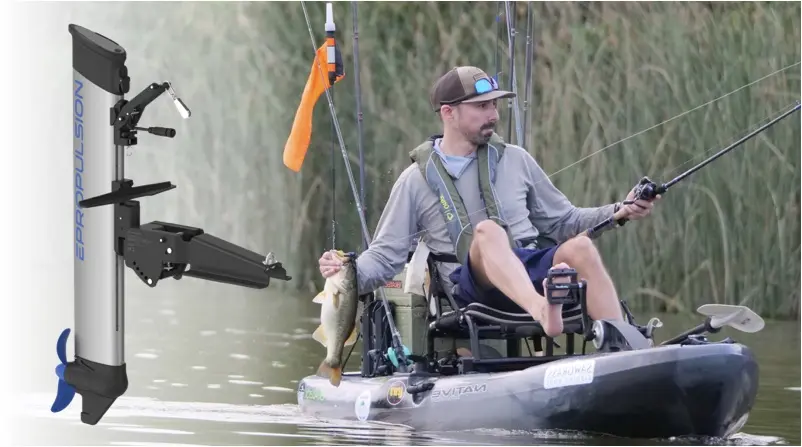
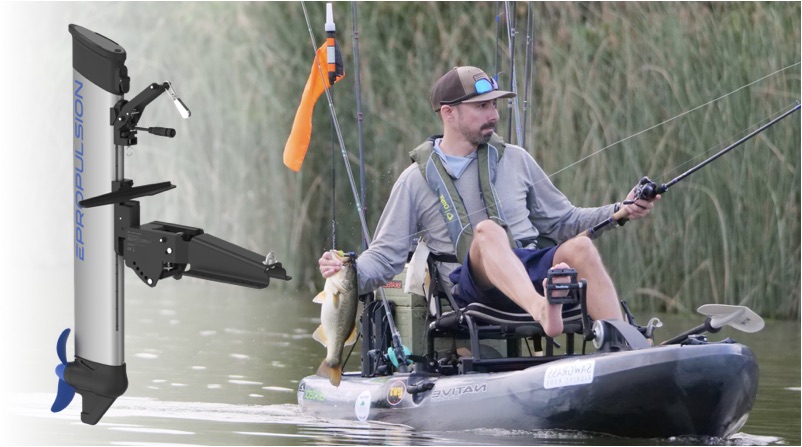
The intersection of recreational angling and sustainable marine technology has reached a compelling new milestone. ePropulsion—a recognized global leader in zero-emission marine mobility—has officially expanded its footprint in the outdoor recreation sector with the introduction of the kLite 750. Engineered specifically to meet the rigorous demands of kayak anglers, this innovative "rudder-style" electric outboard blends silent, clean, and precise mechanical operation with featherlight design. Weighing in at under 15 pounds (6.8 kilograms) complete with its integrated 378-watt-hour lithium power source, the kLite 750 eliminates the cumbersome battery boxes, chaotic wiring harnesses, and heavy transoms that have historically plagued small-craft electrification.
Designed to serve one of the fastest-growing niches in recreational boating, the kLite 750 arrives at a time of profound transformation within the sportfishing industry. According to data compiled by the American Sportfishing Association, over 2.5 million enthusiasts in the United States alone regularly fish from kayaks, driving a multi-hundred-million-dollar marketplace. Market intelligence estimates suggest that specialized electric propulsion systems tailored for paddlecraft and kayaks account for a lucrative $50 million to $70 million slice of this economic pie annually.
By scaling down its award-winning eLite technology into an intelligent, purpose-built package for kayak fishers, ePropulsion is not merely introducing another gadget to the marketplace; they are validating a paradigm shift. The kLite 750 offers a multi-mode performance profile, including a dedicated "Fish Mode" for delicate low-end maneuvering, a continuous "Go Mode" for cruising, and a punchy "Sport Burst" feature to combat challenging currents. As environmental pressures mount and modern anglers demand stealth, efficiency, and ergonomic simplicity, the kLite 750 stands poised to redefine how humanity interacts with our inland waterways and coastal fisheries.
Detailed Chronology: The Evolution of ePropulsion and the Birth of the kLite
To fully comprehend the engineering sophistication behind the kLite 750, one must trace the corporate trajectory and technological evolution of ePropulsion over the past decade. The company’s origins are firmly rooted in academic excellence and forward-thinking innovation.
2012–2014: Foundation and the Brushless Revolution
ePropulsion was founded in 2012 by current CEO Danny Tao, alongside a multidisciplinary collective of students, graduates, faculty members, and advisors from the prestigious Hong Kong University of Science and Technology (HKUST). United by a shared vision to rid the marine sector of combustion-engine noise, fuel spills, and noxious exhaust fumes, the founding team dedicated years to research and development.
Their breakthrough moment arrived at the prestigious METStrade marine industry trade show in 2014. There, ePropulsion publicly debuted their maiden product: the Spirit 1.0 electric outboard. Utilizing a proprietary brushless, direct-drive motor technology—a first for the commercial market at that scale—the Spirit 1.0 immediately captured the attention of marine experts and recreational boaters alike, establishing the foundational reputation for quality, efficiency, and value that the brand maintains today.
Expanding the Spectrum: Low-Power Outboards to High-Voltage Inboards
Following the success of the Spirit series (operating generally in the 1 to 6 kilowatt range, roughly equivalent to 3 to 10 horsepower), ePropulsion systematically diversified its catalog. They introduced the Navy outboards and specialized pod drives, gradually building a robust ecosystem of clean-energy propulsion solutions designed for everything from inflatable dinghies and tender boats to sailing catamarans and 12-meter (40-foot) commercial ferries.
By 2022, the company set its sights on heavy commercial applications and larger pleasure craft. The introduction of the H-Series inboards marked a monumental step forward, catering specifically to professional boatbuilders and commercial operators. Delivering between 60kW and 250kW (approximately 80 to 350 horsepower), these high-voltage, zero-emission systems empowered vessels ranging from 60 to 100 feet (18 to 30 meters) to abandon fossil fuels entirely.
Momentum continued unabated with the subsequent rollouts of the I-Series and X-Series:
The I-Series (Introduced for mid-sized vessels): Ranging from 10kW to 40kW (15 to 55 horsepower), these inboard solutions were meticulously designed for sailboats, day boats, narrowboats, and canal craft.
The X-Series (Introduced in 2023): Bringing equivalent power classes (12, 20, and 40 kW) into the outboard sector, offering high performance for speedier day-cruisers and family runabouts.
2024–Present: The eLite Innovation and the Arrival of the kLite
In 2024, ePropulsion altered the small-craft landscape once more with the launch of the eLite—a rudder-style outboard that earned widespread acclaim for its elegance and utility on tenders and small watercraft. Recognizing an unserved niche among technical anglers, the company took the core DNA of the eLite and re-engineered it into the kLite 750.
Previewed as a prototype at ICAST (the world’s largest sportfishing trade show), the reaction from industry insiders and professional anglers was immediate and overwhelming. The kLite 750 represents the culmination of twelve years of relentless miniaturization, software refinement, and battery chemistry optimization.
Supporting Context & Metrics: The Economics and Engineering of Kayak Fishing
The launch of the kLite 750 does not occur in a vacuum; it is strategically positioned at the nexus of booming outdoor recreation trends and advanced electrical engineering.
The Kayak Fishing Economy
Recreational fishing has long been a multi-billion-dollar global pastime, but the segment encompassing kayak angling has experienced explosive, exponential growth over the past decade. Traditional motorized vessels—while effective—are often prohibitively expensive, difficult to transport, noisy, and incapable of navigating shallow, stump-strewn flats, narrow creeks, or rocky river bends where trophy fish frequently hide.
According to comprehensive figures released by the American Sportfishing Association:
Participation: Over 2.5 million individuals in the United States regularly practice sportfishing from a kayak.
Market Valuation: The overall kayak fishing equipment and vessel market is valued between $500 million and $600 million (€440 million to €525 million).
Propulsion Sector: Market intelligence firms, such as Ken Research, indicate that specialized electric propulsion systems designed explicitly for kayaks command roughly 10% of this overall market share, generating between $50 million and $70 million in annual retail sales.
As urban centers grow and anglers seek more intimate, accessible ways to connect with nature without the financial and logistical burdens of trailering a traditional powerboat, the demand for lightweight, high-performance electric propulsion will only intensify.
Mechanical Architecture and Specifications of the kLite 750
The engineering brilliance of the kLite 750 lies in its radical consolidation of components. Traditional electric trolling motors often require a separate heavy deep-cycle marine battery stored in the hull of the kayak, connected via long, vulnerable cables to a bow-mounted or stern-mounted motor, alongside a separate hand-tiller or foot-steering system.
The kLite 750 completely reimagines this layout through a unified "rudder-style" configuration:
Integrated Power Storage: The wide, hydrodynamically tapered shaft that houses the motor mechanism also neatly encloses the high-density 378-watt-hour lithium power source. There is no external battery box to lug around, no loose wiring, and zero wasted deck space.
Featherlight Ergonomics: The entire fully integrated unit weighs in at less than 15 pounds (6.8 kg). This ensures that the trim, stability, and weight distribution of even lightweight fishing kayaks remain entirely uncompromised.
Tailored Performance Modes: Recognizing that kayak anglers operate under vastly different water conditions—from lazy backwaters to roaring rapids—the kLite 750 features three distinct operational profiles accessible via a simple tactile switch:
Go Mode: Delivers 500 watts of continuous power (roughly 0.75 horsepower), optimized for general cruising and efficiently traversing open water to reach distant fishing grounds.
Sport Burst: Delivers a maximum output of 750 watts (1 horsepower) for up to 60 seconds. This burst mode provides crucial high-end thrust when an angler needs to punch through aggressive tidal rips, navigate heavy winds, or safely shoot fast-moving rapids.
Fish Mode: Designed specifically for the moment the angler reaches their target destination. It offers ultra-precise, whisper-quiet low-end control, allowing subtle adjustments to position the kayak perfectly against structure or current without spooking wary fish.
Battery and System Architecture
Underpinning the kLite 750 is ePropulsion’s broader expertise in energy storage. The company’s wider product ecosystem relies on advanced lithium iron phosphate (LiFePO4 or LFP) battery lines—namely their E-Series and G-Series—which provide exceptional energy density, extended operational cycle life, and paramount thermal and chemical safety. Furthermore, through the implementation of eSSA (ePropulsion Smart System Architecture), all components communicate seamlessly within a modular, protected network, drastically reducing technical complexity while maximizing reliability in harsh marine environments.
Official Statements and Industry Perspectives
The reception of the kLite 750 among industry leaders underscores its potential to disrupt and elevate the kayak fishing experience.
Tom Watson, President of ePropulsion Americas, shared insights into the product’s journey from concept to reality following its initial public preview:
"When we showed our original prototype at ICAST, the world’s largest sportfishing trade show, the interest was substantial," stated Watson. "The eLite has already been revolutionary for tenders and small craft, and we are confident that the kLite is going to take kayak anglers to new and exciting places."
Watson’s optimism is echoed by outfitters, guides, and independent tackle retailers who note a definitive shift in consumer behavior. Modern anglers are increasingly prioritizing mobility, lightweight transportability, and environmental stewardship. Traditional combustion engines are entirely impractical for kayaks, and even older generations of lead-acid or bulky lithium trolling setups have long demanded compromises in cargo capacity and ease of rigging. By integrating the power source, steering mechanics, and propulsion into a single, sub-15-pound rudder assembly, ePropulsion has effectively removed the logistical friction that previously deterred casual paddlers from adopting electric propulsion.
Future Outlook: The Ongoing Electric Transition in Recreational and Commercial Boating
The introduction of the kLite 750 is emblematic of a much larger, irreversible global transition toward sustainable maritime mobility. As regulatory bodies tighten emissions standards on inland lakes and coastal marine sanctuaries, and as consumers become increasingly conscious of their ecological footprint, the demand for clean marine propulsion continues to surge across every classification of vessel.
ePropulsion has successfully positioned itself at the vanguard of this movement. By maintaining a diversified product portfolio—ranging from 750-watt kayak outboards and portable tenders to robust 250kW commercial inboard systems—the company has built an authoritative brand synonymous with engineering integrity, reliability, and user-centric design.
Looking ahead, the roadmap for electric boating points toward greater system intelligence, faster charging infrastructure, enhanced energy densities, and tighter ecosystem integration. For the everyday kayak angler, innovations like the kLite 750 signal a future where accessing remote, untouched fisheries is no longer limited by physical endurance or noisy, polluting machinery. Instead, the modern angler can glide silently across mirror-flat backwaters, empowered by clean electricity, fully focused on the singular pursuit of the catch.
As ePropulsion continues to scale its global distribution network and expand its dealer partnerships—making products readily accessible through specialized platforms like the Plugboats Marketplace—the dream of a fully electrified, zero-emission recreational waterways sector draws ever closer to reality. The kLite 750 is not merely a tool for catching fish; it is a testament to how thoughtful engineering can harmonize human recreation with the preservation of the natural world.