











By Global Maritime Security & Shipping Correspondent
Published by Maritime Investigations Desk
Executive Overview
In a comprehensive report released today, maritime safety investigators have laid bare the tragic circumstances surrounding a fatal accident involving a crew member aboard the Bermuda-flagged cruise vessel Arvia. The incident occurred on October 26, 2025, while the massive passenger liner was navigating international waters on passage from Southampton, England, to Santa Cruz de Tenerife in the Canary Islands, Spain.
The investigation was spearheaded by the United Kingdom’s Marine Accident Investigation Branch (MAIB). Although the Arvia flies the flag of Bermuda—a British Red Ensign Group (REG) category 1 Red Ensign register—the MAIB conducted the inquiry on behalf of the Bermuda Ship Registry. This cooperative framework operates under a formal Memorandum of Understanding (MoU) established between the MAIB and various member administrations of the Red Ensign Group, designed to pool specialized investigative resources for complex maritime accidents.
While the preliminary summaries merely touch upon the bare facts of the event, the full report provides a deeply analytical look into the systemic operational factors, onboard procedures, and human elements that contributed to the fatality. As the global cruise industry continues to scale up post-pandemic operations with increasingly massive vessels, incidents of this nature bring rigorous scrutiny to maritime labor safety standards, emergency response protocols, and the physical hazards routinely faced by shipboard personnel.
Detailed Chronology of the Voyage and Incident
Departure from Southampton: Setting the Stage
The Arvia, one of the jewels of modern cruise engineering, departed the Port of Southampton on what was expected to be a routine transatlantic-bound journey toward the warm waters of the Canary Islands. As is standard practice for mega-cruise vessels embarking on extended itineraries, the ship’s crew was engaged in a complex matrix of guest services, routine engineering maintenance, and navigational duties.
With thousands of passengers on board enjoying the initial phases of their vacation, the shipboard hierarchy operated under strict schedules. Behind the scenes, however, auxiliary departments—including deck, engine, and hotel operations teams—were managing concurrent maintenance routines designed to keep the vessel in pristine condition.
The Transiting Phase and the Critical Window
On October 26, 2025, while the Arvia was several hundred miles off the coast of mainland Europe traversing the Bay of Biscay and heading south toward the Iberian Peninsula, the operational tempo shifted.

According to the MAIB chronology, the fatal accident took place during standard daytime operational hours. While precise details regarding the exact location of the crew member vary within operational zones of the ship, the sequence of events unraveled rapidly when a routine task devolved into a critical safety failure.
- Phase 1: Preparation and Briefing: The crew member, an experienced worker assigned to shipboard operations, was tasked with specific maintenance duties. Preliminary findings from the report highlight the potential gaps in the initial Job Safety Analysis (JSA) conducted prior to the commencement of the task.
- Phase 2: The Incident Execution: At a critical juncture in the operation, an unforeseen mechanical or structural shift occurred. The crew member became trapped and sustained catastrophic injuries before safety interlocks or emergency stops could be effectively engaged by nearby personnel.
- Phase 3: Immediate Onboard Response: Colleagues in the immediate vicinity initiated a code-level emergency alert. The ship’s medical team, comprising specialized emergency physicians and nurses housed within the ship’s onboard hospital facility, responded to the scene within minutes.
- Phase 4: Medical Intervention and Time of Death: Despite immediate advanced life support measures administered by the medical staff, the severity of the trauma meant that resuscitation efforts were ultimately unsuccessful. The crew member was pronounced dead aboard the vessel as the ship continued its southward trajectory.
Diversion Protocols and Port Coordination
Following the confirmation of the fatality, the ship’s master initiated communication protocols with maritime rescue coordination centers (MRCC) and the Bermuda Ship Registry. Due to the ship’s mid-ocean positioning and the nature of the transit, the master maintained the course toward Santa Cruz de Tenerife, where local authorities, forensic investigators, and consular representatives were standing by to board the vessel upon arrival.
Supporting Context & Metrics: The Arvia and Modern Cruise Safety
Vessel Profile: The Scale of Arvia
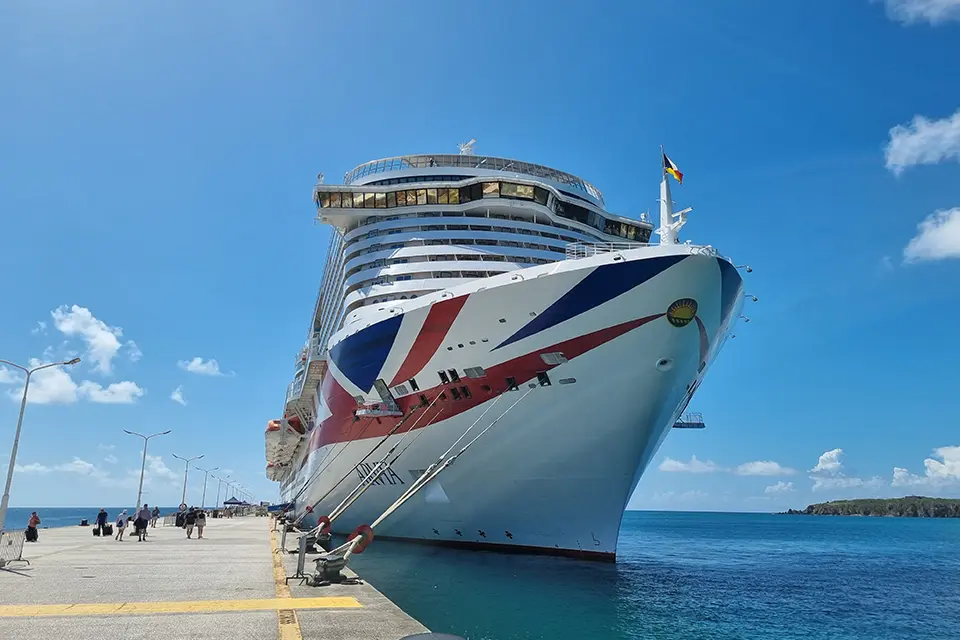
Understanding the operational environment of the Arvia is critical to understanding the complexities of managing crew safety on modern mega-ships. Delivered in late 2022, the Arvia is an Excel-class LNG-powered cruise ship operated by P&O Cruises (a brand under the Carnival Corporation umbrella).
- Gross Tonnage: Approximately 185,000 GT
- Passenger Capacity: Up to 5,200 guests (double occupancy)
- Crew Complement: Approximately 1,800 international crew members
- Length: 344.5 meters
Operating a vessel of this magnitude is akin to managing a floating, self-sustaining city. The sheer scale creates vast logistical challenges, particularly regarding the coordination of thousands of concurrent safety-critical operations happening across multiple departments simultaneously.
The Broader Safety Landscape in Cruise Shipping
Maritime safety metrics compiled by international bodies such as the International Maritime Organization (IMO) and the International Labour Organization (ILO) indicate that while passenger safety at sea remains statistically high, occupational safety for crew members continues to present significant challenges.
+------------------------------------------------------------------------+
|                   CRUISE CREW OCCUPATIONAL HAZARDS                   |
+--------------------------+---------------------------------------------+
| Primary Risk Factors     | - Working at height                         |
|                          | - Enclosed space entry                      |
|                          | - Heavy machinery maintenance               |
|                          | - Fatigue due to rapid turnaround schedules |
+--------------------------+---------------------------------------------+
| Contributing Elements    | - Cultural/language barriers in teams       |
|                          | - Time pressure during passenger turnarounds|
|                          | - Complex multi-layered subcontracting      |
+--------------------------+---------------------------------------------+
Statistics from the MAIB and parallel European agencies (such as the European Maritime Safety Agency – EMSA) consistently highlight that slips, trips, falls, and accidents involving machinery or lifting equipment account for the majority of severe crew injuries and fatalities. Unlike passengers who are restricted to public recreational zones, crew members operate in heavy industrial zones beneath and beyond the guest-facing areas of the ship.

Official Statements and Regulatory Analysis
MAIB’s Role and Investigative Methodology
The Marine Accident Investigation Branch operates under a strict mandate: its purpose is to determine the circumstances and causes of marine accidents with the sole objective of improving safety at sea, rather than apportioning blame or liability.
In its official release regarding the Arvia incident, the lead investigator emphasized the rigorous nature of the multi-jurisdictional cooperation. Because the vessel is registered in Bermuda, the statutory obligation to investigate sits with the Bermuda Ship Registry. However, through the established Memorandum of Understanding (MoU) with the Red Ensign Group, the UK’s MAIB possesses the technical expertise, independence, and forensic bandwidth to execute the investigation to the highest international standards.
A spokesperson for the MAIB stated:
"Our investigation into the fatal accident aboard the Arvia has been exhaustive, focusing not merely on the immediate physical moments of the tragedy, but on the management systems, safety cultures, and procedural frameworks that allowed the hazard to materialize. We extend our deepest condolences to the family, friends, and colleagues of the deceased crew member."
Bermuda Ship Registry and Red Ensign Group Response
As the flag administration, the Bermuda Ship Registry carries the ultimate responsibility for ensuring that vessels flying its flag comply with international conventions, including the Maritime Labour Convention (MLC, 2006) and the International Safety Management (ISM) Code.
Representatives from the Red Ensign Group noted that the findings of the Arvia report will be distributed across all member registries (including the UK, Cayman Islands, Gibraltar, and others) to serve as an industry-wide safety bulletin. This ensures that lessons learned from the tragedy are rapidly translated into mandatory guidance for other large passenger vessels operating globally.
Corporate Statement from P&O Cruises / Carnival Corporation
In the wake of the report’s publication, P&O Cruises issued an official corporate statement acknowledging the findings and reiterating its commitment to crew welfare:
"We are deeply saddened by the loss of our colleague on board the Arvia on October 26, 2025. The safety, health, and well-being of every single crew member and guest remains our absolute highest priority. We have fully cooperated with the MAIB and the Bermuda Ship Registry throughout this rigorous investigation. We are carefully reviewing all recommendations contained within the report to ensure our safety protocols, training modules, and operational oversight mechanisms are continually strengthened across our entire fleet."
Future Outlook: Safety Recommendations and Industry Implications
Key Recommendations from the MAIB Report
While the full report details specific technical breakdowns, the overarching recommendations issued by the MAIB focus heavily on three core areas:
- Enhancement of Permit-to-Work (PTW) Systems: The report highlights potential vulnerabilities in how high-risk tasks are authorized and monitored. Recommendations mandate stricter pre-work verifications and mandatory stop-work authority empowerment for all crew levels.
- Human Factors and Fatigue Management: Recognizing the intense operational tempo inherent in transatlantic repositioning voyages and tight seasonal schedules, the report calls for a re-evaluation of rest hour verifications and workload allocations for maintenance personnel.
- Safety Communication and Supervisory Oversight: Addressing the multinational demographic of cruise ship crews, the report emphasizes the necessity of clear, unambiguous communication protocols during complex mechanical operations where language barriers can introduce catastrophic risks.
Long-term Impact on the Global Cruise Industry
The release of this report arrives at a critical juncture for the global cruise industry. As operators order larger, more complex vessels powered by alternative fuels (such as Liquified Natural Gas, methanol, and fuel cells), the technical demands placed on engineering and deck crews are multiplying exponentially.
Industry analysts suggest that the findings from the Arvia investigation will trigger widespread internal audits across major cruise conglomerates. Key areas of anticipated reform include:
- Digitalization of Safety Logs: Transitioning from paper-based Permit-to-Work systems to automated, real-time digital monitoring platforms that track hazardous operations directly from the bridge.
- Enhanced Practical Training: Moving away from generic compliance-based e-learning modules toward hands-on, scenario-based safety simulations conducted regularly during onboard musters.
- Empowering the Safety Culture: Cultivating an open environment where junior crew members feel explicitly protected and encouraged to halt operations if they perceive safety deviations, without fear of professional reprisal.
Conclusion
The tragic death aboard the Arvia on October 26, 2025, serves as a sobering reminder of the inherent dangers lurking beneath the polished surface of the modern cruise experience. While ships like the Arvia represent marvels of maritime architecture and passenger luxury, they remain heavy industrial workplaces.
Through the diligent investigative work of the MAIB and the cooperative framework of the Red Ensign Group, the maritime community now possesses a clear roadmap of actionable insights. Implementing these lessons is not merely a regulatory obligation; it is a moral imperative to ensure that those who labor in the engine rooms, corridors, and decks of the world’s cruise fleets return safely to their homes and families at the end of every voyage.


