EXECUTIVE OVERVIEW
A critical medical emergency at sea has once again disrupted operations for Royal Caribbean International’s mega-ship Oasis of the Seas, creating a ripple effect that delayed thousands of vacationers across two consecutive sailings. The massive vessel, capable of accommodating over 5,600 guests, arrived significantly behind schedule at its homeport of Cape Liberty, New Jersey, on Saturday, October 11, 2026.
The unexpected delay—prompted by the urgent need to debark a critically ill passenger—compelled cruise line executives to recalibrate not only the conclusion of a 7-night voyage but also the entire embarkation window and initial port stop for the ship’s subsequent cruise. While passenger safety and timely medical interventions remain the undisputed priority for modern cruise lines, recurring schedule disruptions underscore the complex logistical challenges of managing floating cities with populations exceeding those of small towns.
Royal Caribbean moved swiftly to mitigate traveler frustration, issuing financial protections for disrupted flights and automating refunds for impacted shore excursions. However, the incident highlights a growing operational trend for the Oasis-class vessel: this marks the second time in less than a month that emergency medical debarkations have forced significant itinerary shifts on this specific ship. This comprehensive report examines the timeline of events, the cascading operational impacts, traveler compensation policies, and the broader context of at-sea medical logistics within the contemporary cruise industry.
Detailed Chronology: How the Medical Emergency Unfolded
The sequence of events began during the final stretch of a 7-night cruise that departed Cape Liberty on October 4, 2026. While navigating regional waters, a passenger aboard the Oasis of the Seas experienced a severe medical crisis requiring specialized intervention beyond the capabilities of the ship’s advanced onboard medical facility.
According to passenger accounts shared within cruising communities—specifically corroborated by traveler logs on social media platforms—the ship routed toward Nassau, Bahamas, to facilitate an emergency medical debarkation. Royal Caribbean has maintained privacy regarding the exact nature of the medical condition and the precise geographical coordinates or timing of the port stop, citing medical confidentiality. However, the diversion and subsequent transfer of the patient to shore-based medical professionals consumed vital operating hours.
As the vessel pushed northward along the U.S. Eastern Seaboard toward its homeport in Bayonne, New Jersey, it became mathematically impossible to meet the scheduled 6:00 a.m. arrival time on October 11.

- 6:00 AM (Scheduled): Original arrival time for the conclusion of the October 4 sailing at Cape Liberty.
- 9:30 AM (Actual): Revised arrival time of the Oasis of the Seas, representing a delay of three and a half hours.
- 1:00 PM: Estimated completion time for the full debarkation of all passengers from the previous cruise, delaying terminal readiness for incoming guests.
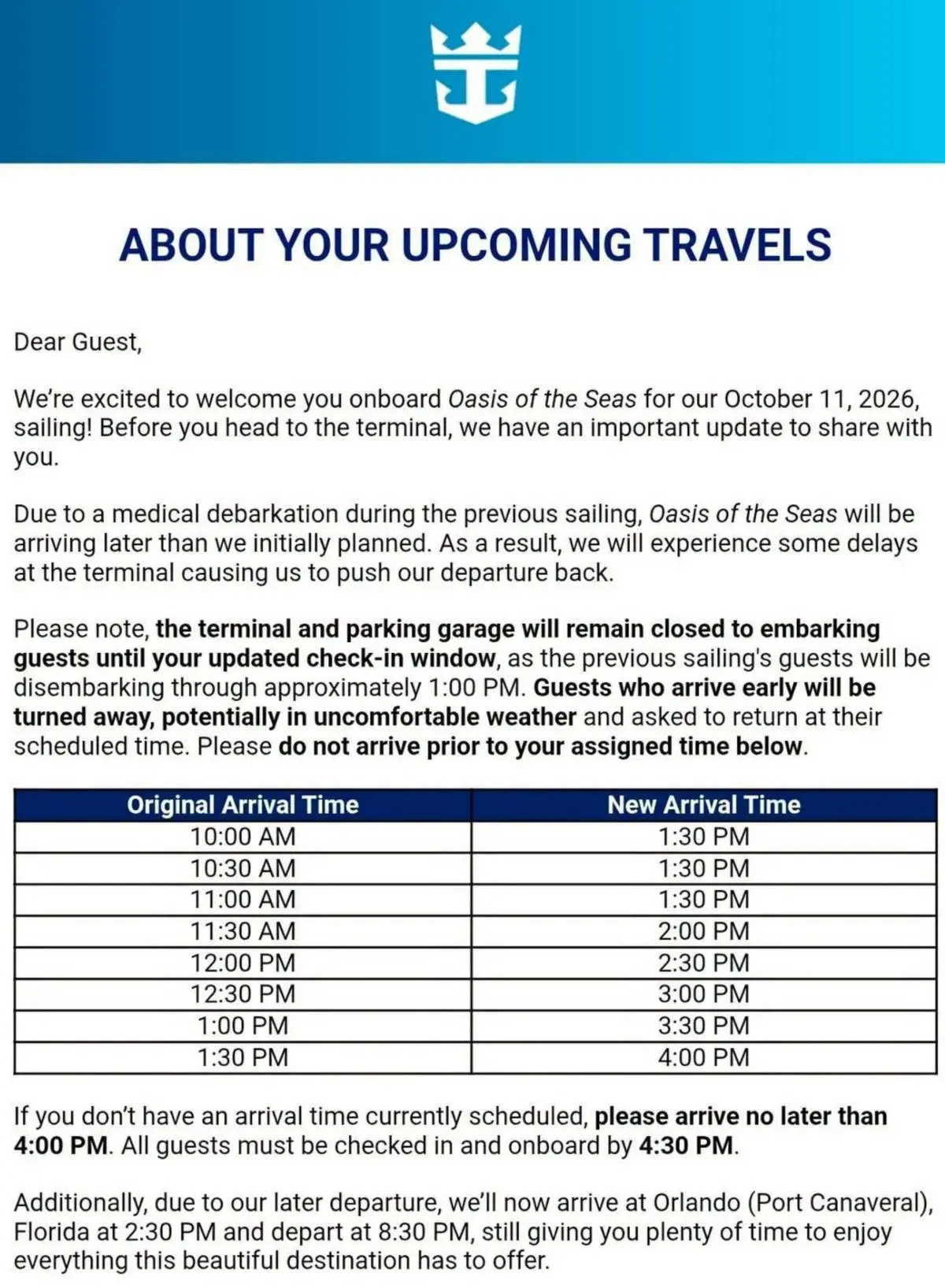
- 1:30 PM: The newly established earliest arrival and check-in time for guests embarking on the October 11 sailing.
- 2:30 PM (Next Itinerary): Revised arrival time at the first scheduled port of call, Port Canaveral, Florida, marking a two-hour reduction in port time.
Supporting Context & Metrics: The Ripple Effect on Passengers and Ports
The logistical machinery required to turn around a ship the size of the Oasis of the Seas is immense. When an arrival is delayed by three and a half hours, terminal operations are compressed into a fraction of their normal timeframe, risking severe congestion, passenger anxiety, and regulatory bottlenecks.
Impact on Embarking Guests
For the thousands of travelers arriving at the Cape Liberty Cruise Port for the October 11 departure, the morning was marked by uncertainty. Royal Caribbean issued proactive digital alerts warning guests not to arrive early at the terminal or parking garage. The cruise line explicitly stated that security and terminal staff would turn away vehicles arriving prior to their updated check-in windows, as outgoing guests were still processing through customs and immigration.
The revised schedule pushed the earliest check-in time from 10:00 a.m. to 1:30 p.m., with rolling arrival slots extended through 4:00 p.m. Despite the compressed window, the ship managed an expedited safety briefing and boarding process, though departure times from New Jersey were similarly deferred.
Port Canaveral Visit Compromised
The downstream effects extended all the way to Florida. The subsequent sailing featured an initial stop at Port Canaveral, Florida, before heading toward the Bahamas. Due to the delayed departure from Cape Liberty, the ship’s arrival at Port Canaveral was postponed from 12:30 p.m. to 2:30 p.m.—a net loss of two hours of shore time for guests eager to visit central Florida attractions or explore the port area. Fortunately, Royal Caribbean preserved the evening departure window, maintaining the scheduled 8:30 p.m. sail-away time.
A Concerning Trend: The September Precedent
This event is not an isolated incident for the vessel. Less than a month prior, Cruise Hive reported a strikingly similar occurrence aboard the Oasis of the Seas. On September 20, 2026, the 5,602-guest ship arrived at Cape Liberty approximately eight hours behind schedule following two emergency medical evacuations in Nassau. That incident resulted in cancelled port calls and extended delays for the following cruise, proving that medical emergencies at sea can profoundly test the elasticity of mega-ship schedules.

Official Statements and Guest Compensation
Faced with mounting traveler inconvenience, Royal Caribbean deployed a structured communications strategy aimed at balancing operational transparency with consumer goodwill.
The Onboard Letter
In a formal letter distributed to guests on the October 4 sailing, management emphasized the ethical imperative underlying the schedule change:
"We successfully debarked our guest so they could receive additional medical care. As a result, we’ll now be delayed in our return to Cape Liberty," the notice read. "We’re sorry for the inconvenience caused by this change, and we appreciate your understanding, knowing we’d do the same for you or a loved one in a similar situation."
Financial Protections and Reimbursements
Recognizing that travel delays frequently cascade into missed flights, altered train schedules, and unexpected hotel expenses, Royal Caribbean instituted a comprehensive reimbursement framework for the impacted passengers:
- Flights by Royal: Guests who booked their air travel through the cruise line’s proprietary air program had their itineraries automatically adjusted and monitored by travel specialists at no additional cost.
- Independent Travelers: Guests who booked independent air or land transportation are eligible for financial compensation covering verified change fees. The cruise line established caps of $200 per person for domestic travel and $400 per person for international travel.
Excursion Adjustments
For the guests boarding on October 11, the shortened port call in Port Canaveral necessitated immediate adjustments to shore excursions. Royal Caribbean announced that all official excursions booked through the line would be automatically rescheduled where feasible. For tours that could not be accommodated within the truncated timeframe, the cruise line canceled the bookings and issued full refunds in the form of onboard credit. Any remaining refundable balances are slated to be credited back to the guest’s card on file within 14 business days following final disembarkation.
Future Outlook: Managing the Unpredictable Nature of At-Sea Health
As modern cruise ships grow larger—carrying passenger and crew populations that regularly surpass 7,000 individuals—medical emergencies at sea represent an unavoidable statistical reality. While cruise lines invest heavily in state-of-the-art onboard medical centers equipped with intensive care units, telemedicine links, and specialized physicians and nurses, certain critical interventions simply cannot be performed onboard.
The Logistics of Emergency Medical Evacuations
Evacuating a passenger from a moving vessel involves complex coordination between the ship’s captain, corporate operations, maritime rescue coordination centers (MRCC), and local port authorities. Depending on the vessel’s location, evacuations may require:
- Diverting the ship to the nearest port with advanced trauma facilities (such as Nassau in the Bahamas).
- Deploying local harbor pilots and tugs to expedite berth allocation.
- Coordinating helicopter airlifts in extreme open-ocean scenarios, weather permitting.
Each of these steps consumes precious hours. When factored against rigid maritime itineraries governed by port slot availability, pilotage schedules, and fuel economics, a single medical diversion can easily disrupt a multi-day schedule.
Industry Implications and Passenger Expectations
For travelers, incidents like the Oasis of the Seas delays serve as a reminder of the unique vulnerabilities inherent in cruise travel. Unlike land-based vacations where medical events impact only the individual, a cruise ship operates as an interdependent micro-society.
Cruise lines are increasingly refining their contingency planning, utilizing predictive analytics to buffer sea days and negotiate flexible port agreements that allow ships to recover lost time without compromising safety. Nevertheless, consumer education remains vital. Industry analysts note that as the demographic profile of cruisers skews older, the incidence of acute cardiac, respiratory, and neurological events at sea is likely to persist, making robust insurance policies, comprehensive airline reimbursement programs, and flexible passenger mindsets essential components of the modern cruising experience.
As the Oasis of the Seas continues its autumn deployment—subsequently visiting Royal Caribbean’s private island destination, Perfect Day at CocoCay, and Nassau before its scheduled return to Cape Liberty on October 18, 2026—passengers and crew alike will hope for a smooth remainder of the season, free from further unforeseen medical deviations.