BRUSSELS / TALLINN / RIGA / VILNIUS — In a coordinated diplomatic offensive that highlights the deepening economic decoupling between Eastern Europe and the Russian Federation, the Baltic nations of Estonia, Latvia, and Lithuania have formally requested the European Union to implement a bloc-wide embargo on the transit and import of Russian grain.
In a joint letter dispatched on October 9, 2026, addressed to European Council President Antonio Costa and European Commission President Ursula von der Leyen, the leaders of the three Baltic states demanded swift, decisive legislative action. The initiative marks a significant escalation in the regional effort to close what Baltic officials characterize as a glaring moral and economic loophole in the Western sanctions regime—one that Moscow has increasingly exploited to bypass maritime bottlenecks in the Black Sea.
Executive Overview: The Geopolitical and Logistical Pivot
The joint Baltic appeal represents a critical juncture in the European Union’s ongoing trade war with Moscow. While the EU has levied historically unprecedented sanctions against Russian oil, gas, coal, and technology since the escalation of the war in Ukraine in 2022, agricultural products and fertilizers have largely remained exempt. This carve-out was originally designed to safeguard global food security, particularly in import-dependent nations across the Global South.

However, the Baltic states argue that the geopolitical landscape has shifted dramatically. Following sustained and highly effective Ukrainian maritime drone and missile strikes against Russian naval assets and commercial port infrastructure in the Black Sea, Moscow’s traditional southern agricultural export corridors have faced severe operational disruptions. In response, Russian state-backed agricultural conglomerates have redirected massive volumes of grain overland via Belarus and into Baltic rail networks, utilizing the deep-water ports of Lithuania, Latvia, and Estonia to reach international markets.
By calling for an EU-wide ban, the Baltic coalition aims to dismantle this northern logistical safety valve. The move is designed to accomplish three primary objectives:
- Deprive the Kremlin of Vital Foreign Exchange: While grain prices have fluctuated, the scale of Russian agricultural exports remains a multi-billion-dollar revenue generator for the state budget.
- Eliminate Domestic Complicity: Baltic ports, rail operators, and logistics firms would no longer be forced or incentivized to handle cargo originating from an aggressor state.
- Prevent "Port-Shopping": A unilateral ban by a single nation (such as Estonia’s recent domestic restrictions) simply diverts cargo to neighboring Baltic ports. Only a harmonized, EU-wide mandate can successfully seal the Eastern border.
Detailed Chronology: From Black Sea Conflict to Baltic Bottleneck
To understand the urgency of the Baltic states’ October 2026 petition, it is necessary to trace the shifting geography of the global grain trade over the preceding twenty-four months.
[2024-2025: Black Sea Escalation]
       │
       ▼
[Ukrainian maritime strikes disrupt Russian southern ports (Novorossiysk)]
       │
       ▼
[Russia redirects agricultural logistics northward via Belarusian rail]
       │
       ▼
[Surge of Russian grain transit through Baltic ports (Riga, Ventspils, Klaipėda)]
       │
       ▼
[October 2026: Estonia enacts unilateral ban; Baltic states petition EU for bloc-wide embargo]
The Black Sea Attrition Campaign (2024–2025)
Historically, the vast majority of Russian grain exports departed from southern ports such as Novorossiysk, Taman, and Tuapse, transiting through the Bosporus Strait to destinations in the Middle East, North Africa, and Asia. However, throughout 2024 and 2025, Ukraine’s deployment of advanced, domestically produced uncrewed surface vessels (USVs) and long-range cruise missiles systematically eroded Russian naval dominance in the Black Sea.

Commercial shipping in the region faced soaring insurance premiums, war-risk surcharges, and frequent operational halts. Although Russian grain vessels were rarely targeted directly, the collateral risks of operating in a highly contested military theater forced international shipowners and underwriters to demand steep premiums, severely impacting the economic efficiency of the Black Sea route.
The Northern Diversion (Late 2025–Mid 2026)
Faced with rising costs and logistical bottlenecks in the south, Russian state grain exporters, working in tandem with Belarusian state railways, began utilizing the Soviet-gauge rail infrastructure that still links Russia and Belarus to the Baltic states.
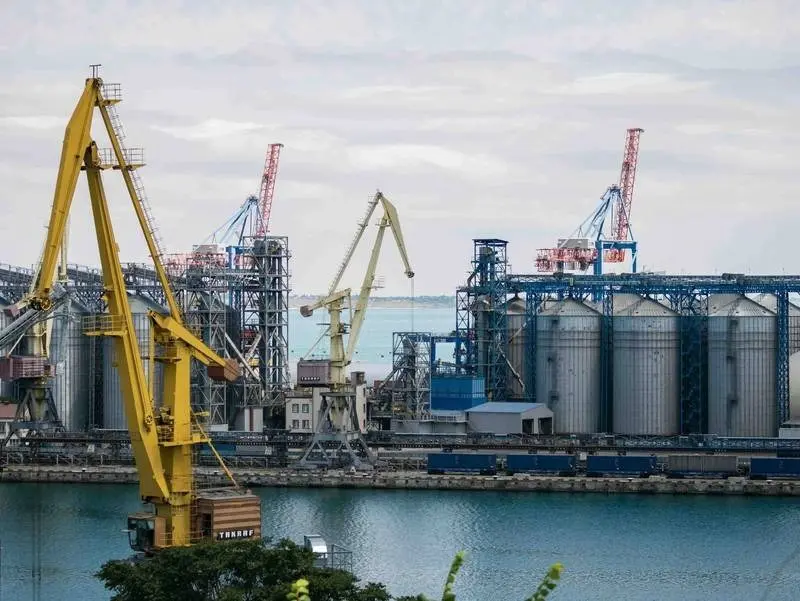
Throughout the first half of 2026, regional observers noted an unprecedented surge in bulk grain trains crossing the borders into Latvia and Lithuania. Ports such as Riga, Ventspils, Liepāja, and Klaipėda—which had spent the last several years attempting to diversify away from Russian transit cargo—found themselves once again handling millions of metric tons of Russian agricultural products.
Estonia’s Unilateral Precedent (Early October 2026)
Recognizing the political and security risks of facilitating Russian trade, the Estonian government took the bold step of announcing a unilateral ban on the import and transit of Russian agricultural goods through its territory and ports. However, Tallinn quickly realized the limitations of unilateral action. Without a unified regional or continental policy, Russian exporters simply rerouted their rail cars south toward Latvian and Lithuanian terminals, rendering the Estonian ban highly symbolic but economically ineffective in halting the broader flow.
This realization culminated in the October 9, 2026, joint letter, where the three Baltic prime ministers united to demand a comprehensive European Union mandate that would legally bind all member states and eliminate the possibility of regulatory arbitrage.
Supporting Context & Metrics: The Logistics of Grain Warfare
The economic dimensions of the Baltic grain transit highlight the complex scale of the issue. According to maritime intelligence and customs data compiled during the 2025–2026 fiscal years, Russian agricultural transit through the Baltic corridor had reached volumes that rivaled pre-war levels, albeit under highly altered logistical conditions.

Estimated Grain Transit Volumes through Baltic Ports (2024–2026)
| Year | Transit Volume via Baltic States (Metric Tons) | Primary Commodity | Destination Markets |
|---|---|---|---|
| 2024 | 2,100,000 | Wheat, Barley, Meslin | Southern Europe, East Africa |
| 2025 | 3,800,000 | Wheat, Corn, Oilseeds | Middle East, North Africa |
| 2026 (Est.) | 5,400,000 | Wheat, Rye, Fertilizers | Global South, Select EU Ports |
The "Stolen Grain" Conundrum
A primary driver behind the Baltic nations’ urgency is the verified concern over the origin of the grain. Independent investigative journalism, satellite imagery, and maritime tracking have repeatedly demonstrated that a significant portion of the agricultural products exported by Russia under domestic labels is actually harvested from occupied territories in Ukraine, including the Zaporizhzhia, Kherson, and Donetsk oblasts.
By allowing these shipments to pass through EU infrastructure, Baltic officials argue that European ports are inadvertently laundering looted Ukrainian resources, directly undermining the billions of euros in financial and military aid that the EU has provided to Kyiv.
Furthermore, the domestic economic impact on Baltic farmers has been severe. The influx of cheaper Russian grain—often subsidized by the state or produced under lower regulatory standards—has depressed local agricultural prices in Eastern Europe, leading to widespread protests by domestic farming syndicates who demand protectionist measures against what they term "agricultural dumping."
Official Statements and Political Alignment
The joint letter addressed to European Council President Antonio Costa and European Commission President Ursula von der Leyen utilizes stark, uncompromising language, framing the grain transit not merely as a commercial issue, but as a critical national security threat to the European Union’s eastern flank.
Excerpts and Diplomatic Rhetoric
In the joint communication, the Baltic leadership stated:
"The continued transit of Russian agricultural products through the European Union is a geopolitical anomaly that directly funds the Russian war machine. While our nations have made immense sacrifices to decouple our energy and industrial sectors from Moscow, our transport infrastructure remains a conduit for Russian state-directed trade. We urge the European Commission and the European Council to act collectively to close our borders to these goods, ensuring that the European Union does not serve as a logistical facilitator for Russian economic aggression."
Institutional Reactions in Brussels
The reception of the Baltic proposal in Brussels highlights the complex balance of interests within the 27-member bloc.
- The European Commission (Ursula von der Leyen): Historically supportive of tightening sanctions, the Commission has expressed sympathy for the Baltic position. However, officials within the Directorate-General for Trade (DG TRADE) have cautioned that any bloc-wide ban must be carefully structured to avoid violating World Trade Organization (WTO) rules or triggering accusations of exacerbating food insecurity in developing nations.
- The European Council (Antonio Costa): As the newly installed President of the European Council, Costa faces the formidable task of building consensus among member states. While Poland, Finland, and the Nordic nations are expected to support the Baltic initiative, southern European nations with significant maritime shipping sectors—such as Greece, Cyprus, and Malta—as well as landlocked countries with historically complex relationships with Moscow, such as Hungary, may present significant diplomatic obstacles.
Future Outlook: Geopolitical and Market Implications
As the European Union begins internal deliberations on the Baltic proposal, the global agricultural and maritime shipping sectors are preparing for potential disruptions.
                    [EU Debates Baltic Grain Ban]
                                  │
         ┌────────────────────────┴────────────────────────┐
         ▼                                                 ▼
[Option A: Full Embargo Enacted]                  [Option B: Proposal Rejected/Stalled]
 ├─ Russia forced to use Arctic/Far East routes    ├─ Baltic states face domestic political pressure
 ├─ Global grain transport costs increase          ├─ Unilateral border controls likely to increase
 └─ Baltic ports undergo painful structural shift   └─ Continued friction within EU sanctions framework
Potential Market Impacts
If the European Union accedes to the Baltic states’ demands and implements a total ban on the import and transit of Russian grain, the immediate impact on global grain markets will likely manifest in localized price volatility.
While Russia would eventually find alternative routes—such as expanding its Arctic ports (Murmansk) or shipping overland to China and Central Asia—these routes are significantly more expensive and logistically constrained than the highly efficient rail-to-port connections offered by the Baltic states. Consequently, the cost of Russian grain on the global market would rise, potentially impacting importing nations in Africa and the Middle East.
The Port Decoupling Challenge
For the Baltic ports themselves, a total ban would mark the end of an era. For over a century, cities like Riga and Klaipėda have functioned as the primary maritime gateways for the vast Eurasian hinterland. Eliminating Russian bulk cargo entirely will require these ports to undergo a painful and costly structural transformation, shifting their focus toward containerized Western trade, green energy logistics (such as offshore wind support), and domestic industrial manufacturing zones.
Conclusion
The Baltic nations’ push for an EU-wide ban on Russian grain exports represents more than a trade dispute; it is a fundamental test of the European Union’s strategic autonomy and moral consistency. As the letter sits on the desks of Costa and von der Leyen in Brussels, the decisions made in the coming weeks will determine whether the EU is willing to absorb the economic costs of a complete logistical decoupling, or whether the pragmatic necessities of global food supply chains will allow Russian grain to continue its quiet journey through the heart of Europe.