











Executive Overview
In a landmark development for American transportation infrastructure, the U.S. Department of Transportation’s Federal Railroad Administration (FRA), alongside the Florida Department of Transportation (FDOT), has officially celebrated a massive $516 million combined financial commitment to revolutionize rail transit across the Sunshine State. This sweeping capital infusion is anchored by $416 million in direct federal funding, which is further bolstered by a substantial $100 million state-level match. The initiative is designed to address two critical imperatives of modern civil infrastructure: drastically enhancing rail safety across more than 900 grade crossings and constructing a state-of-the-art multimodal transit station in the city of Cocoa.
This multi-faceted project arrives at a crucial juncture for Florida, a state experiencing unprecedented demographic growth, booming tourism, and surging industrial expansion, particularly along its dynamic Space Coast. As passenger rail usage reaches historic highs—driven by initiatives like Brightline and commuter rail expansions—the necessity for comprehensive infrastructure hardening has never been more urgent. The federal allocation is a centerpiece of Transportation Secretary Sean P. Duffy’s visionary "Golden Age of Rail" package, initially unveiled in August. By prioritizing high-impact corridors, the federal government and state partners are seeking to eliminate longstanding vulnerabilities at intersections where trains, motorists, and pedestrians converge.
Beyond immediate safety dividends, the investment is projected to serve as a powerful economic catalyst. Local and state leaders estimate that the new multimodal station in Cocoa alone will generate up to an astonishing $350 million in annual economic impact while supporting approximately 3,500 jobs during its development and operational phases. By weaving together advanced rail safety technology, regional connectivity, and job-creating infrastructure projects, this funding package sets a new benchmark for how state and federal agencies can collaboratively modernize the nation’s transit arteries for the twenty-first century.
Detailed Chronology of the Initiative
The realization of this half-billion-dollar transportation milestone is the result of years of meticulous planning, strategic lobbying, regional coordination, and federal policy shifts. To understand the magnitude of the recent announcements in Florida, it is essential to trace the chronological evolution of the initiatives leading up to this point.
The Foundation: Identifying Vulnerabilities and Regional Needs
For over a decade, Florida’s explosive population growth—adding hundreds of new residents daily—has placed unprecedented strain on its transportation networks. The introduction and subsequent expansion of high-speed passenger rail services along the Florida East Coast (FEC) corridor dramatically increased train frequencies, speeds, and passenger volumes. While these private and public rail investments modernized travel between South Florida and Orlando, they simultaneously highlighted the urgent need to upgrade aging infrastructure at hundreds of highway-rail grade crossings.
Local municipalities, county commissioners, and state legislators spent years documenting safety concerns, lobbying for federal grants, and coordinating with freight and passenger rail operators. Central Florida—encompassing Brevard, Orange, Osceola, Seminole, and Volusia counties—became a primary focal point for these discussions. The sheer volume of vehicular traffic intersecting with rail lines created a persistent public safety challenge, prompting transportation planners to seek comprehensive, systemic solutions rather than piecemeal fixes.
The August Policy Shift: Unveiling the "Golden Age of Rail"
The trajectory of Florida’s rail modernization efforts accelerated dramatically in August, when Transportation Secretary Sean P. Duffy announced the comprehensive federal framework known as the "Golden Age of Rail" package. This national strategy was crafted to channel billions of dollars into high-priority rail corridors, emphasizing structural safety, technological integration, and network efficiency.
Under Secretary Duffy’s leadership, the FRA was tasked with identifying shovel-ready projects that could immediately absorb federal dollars to yield maximum safety and economic returns. Florida’s meticulously cataloged pipeline of crossing upgrade projects—spanning more than 900 distinct locations—matched the federal criteria precisely. The state’s application demonstrated a rare synergy between high-speed corridor protection and localized economic development, paving the way for the historic $416 million federal grant award.
The Official Celebration and State Match Commitment
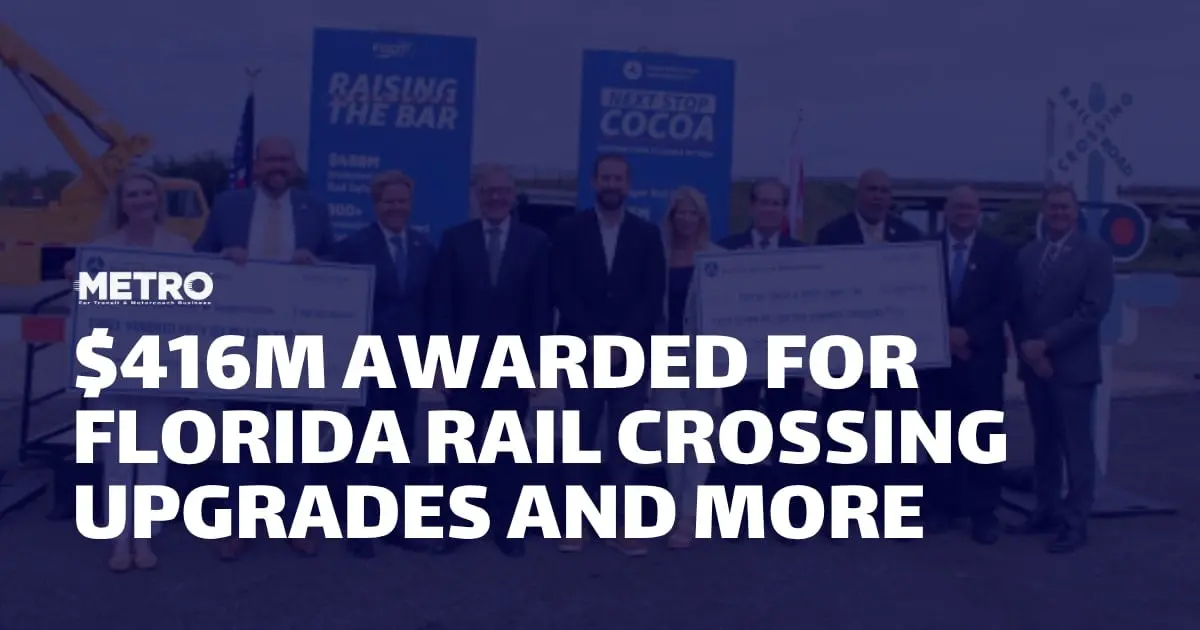
The formal rollout of the funding materialized through a joint celebration hosted by federal and state transportation officials. During the event, leadership from the FRA and FDOT detailed how the $416 million federal allocation would be deployed across the state. Crucially, the announcement was accompanied by a robust commitment from the state of Florida, which added $100 million in matching funds to ensure the comprehensive scope of the projects could be fully realized without budgetary shortfalls.
This joint announcement also marked the official greenlighting of the Cocoa multimodal station project. By combining federal grant mechanisms with state transportation trust funds, the project transitioned from a long-term planning concept into an active development phase, complete with designated timelines for engineering, procurement, and construction.
Supporting Context & Metrics: Analyzing the $516 Million Package
To fully appreciate the scope of this infrastructure initiative, it is necessary to examine the specific metrics, geographical distribution, and technological upgrades that comprise the $516 million investment.
The Financial Breakdown
The funding structure is intentionally balanced between widespread safety enhancements and concentrated economic development infrastructure:
- Total Combined Investment: $516 million
- Federal Allocation (FRA): $416 million
- State Matching Funds (FDOT): $100 million
- Dedicated Crossing Safety Sub-Allocation: $356 million of the federal package
- Projected Economic Impact (Cocoa Station): Up to $350 million annually
- Job Creation: Approximately 3,500 sustainable and construction jobs supported
Geographic Distribution: Focusing on Central Florida
While the safety upgrades impact rail corridors statewide, a significant emphasis has been placed on Central Florida due to its dense population centers and high traffic volumes. Of the more than 900 railroad crossings slated for enhancement across the state, nearly 25 percent are concentrated within the Central Florida region.
This regional focus encompasses five key counties:
- Brevard County: Home to the Space Coast and the site of the new Cocoa multimodal station, serving as a vital nexus for regional connectivity.
- Orange County: Encompassing the greater Orlando metropolitan area, a massive tourism hub with heavy commuter and visitor transit patterns.
- Osceola County: A rapidly expanding residential and commercial corridor experiencing surging demands for reliable public transit.
- Seminole County: Characterized by dense suburban communities intersected by major freight and passenger rail lines.
- Volusia County: Bridging Central Florida to the northeast coast, requiring robust corridor protections to handle multi-jurisdictional traffic flows.
Advanced Safety Features and Technological Integration
Modernizing over 900 railway crossings requires much more than basic signage maintenance. The funding will underwrite the installation of cutting-edge safety technologies designed to significantly reduce human error and prevent unauthorized track intrusions.
The engineering plans outline the implementation of several advanced safety mechanisms:
- Quad-Gate Systems: Installing four-quadrant gate arms that completely block all lanes of traffic when a train is approaching, preventing motorists from driving around lowered gates.
- Advanced Obstruction Detection (AOD): Deploying radar and optical sensors at critical crossings to detect stalled vehicles or pedestrians on the tracks and automatically alert oncoming train engineers.
- Synchronized Traffic Signal Preemption: Interconnecting crossing warning systems with local municipal traffic lights to clear queuing vehicles off the tracks and prevent gridlock during peak hours.
- Enhanced Illumination and High-Visibility Markings: Upgrading lighting arrays and applying high-durability thermoplastic pavement markings to ensure crossings are exceptionally visible during nighttime hours and adverse weather conditions.
- Continuous Monitoring and Diagnostic Systems: Integrating all upgraded crossings into centralized digital monitoring networks, allowing maintenance teams to detect equipment malfunctions in real-time before they pose a safety hazard.
Official Statements and Leadership Perspectives
The convergence of federal and state resources has drawn high praise from political leaders, transportation administrators, and community stakeholders, all of whom emphasize the transformative nature of the investment.
U.S. Congressman Mike Haridopolos, representing the Space Coast region, highlighted the profound local impact of the Cocoa multimodal station. "Here on the Space Coast, we continue to build for the future," Congressman Haridopolos stated. "This new station will make it easier for people to travel to and from the Space Coast while supporting our growing community. It is expected to have up to a $350 million annual economic impact and support 3,500 jobs, bringing even more opportunity to our region." His remarks underscore the dual purpose of the initiative: safeguarding citizens while simultaneously driving regional economic prosperity.
At the federal level, FRA Administrator David Fink emphasized the alignment between national policy and local execution. "By investing these dollars where they matter most, President Trump and Secretary Duffy are ushering in a Golden Age of Rail that will make Florida’s rail corridors safe, modern, and more efficient," Administrator Fink noted. This sentiment reflects the broader federal agenda to reposition rail transport as a premier, high-speed, and secure alternative to highway travel, capable of supporting America’s economic competitiveness in the twenty-first century.
State transportation officials similarly lauded the partnership, noting that the $100 million state match demonstrates Florida’s proactive posture toward infrastructure development. By working in seamless coordination with the FRA, FDOT has ensured that state priorities—particularly the protection of vulnerable road users and the expansion of integrated transit hubs—are fully realized through this massive capital injection.
Future Outlook: The Next Era of Florida’s Rail Network
As engineering teams mobilize and construction schedules are finalized, the completion of these projects promises to reshape the transportation landscape of Florida for decades to come. The integration of advanced grade-crossing technologies will drastically lower incident rates, saving countless lives and reducing the economic costs associated with rail-related accidents and transit delays.
Furthermore, the establishment of the Cocoa multimodal station serves as a blueprint for future regional transit developments. By creating a seamless interchange where rail passengers can connect with local bus networks, ridesharing services, and active transportation corridors, the station will alleviate highway congestion and reduce carbon emissions along the Space Coast.
In the broader context of Transportation Secretary Duffy’s "Golden Age of Rail," Florida’s successful acquisition and deployment of this $516 million package position the state as a national leader in modern rail infrastructure. As these projects move from the drawing board to reality, the Sunshine State is demonstrating that strategic, well-funded investments in public safety and transit connectivity are foundational to sustaining long-term economic vitality, community resilience, and a superior quality of life for its residents and visitors alike.


