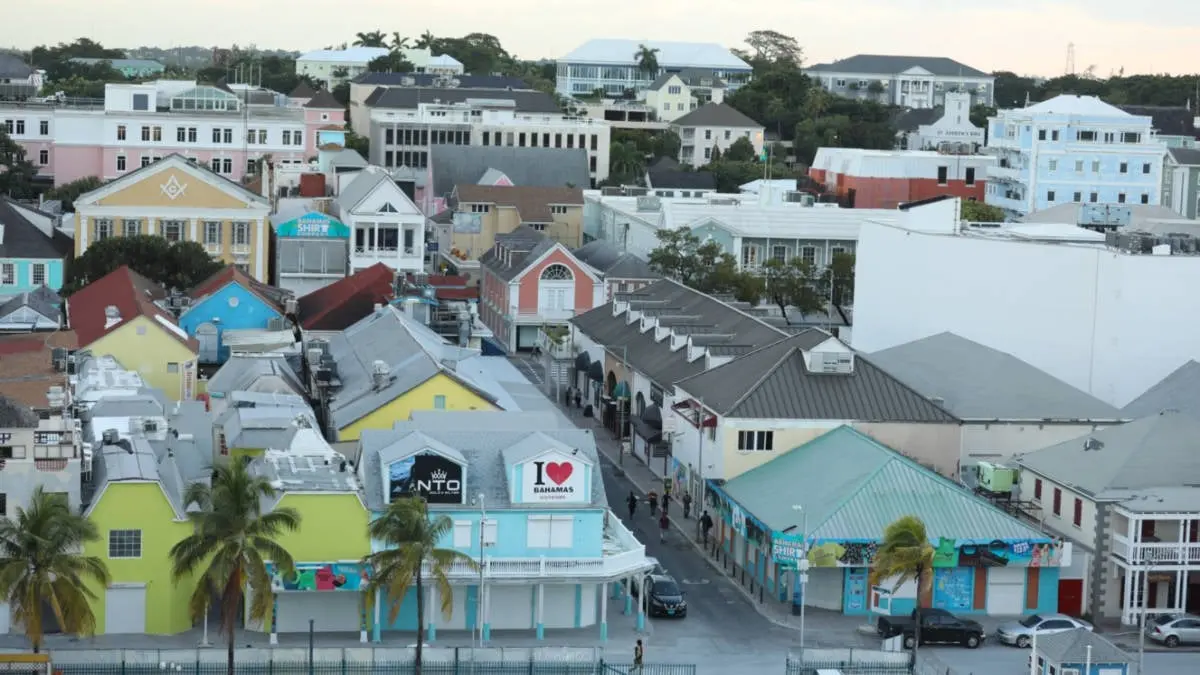
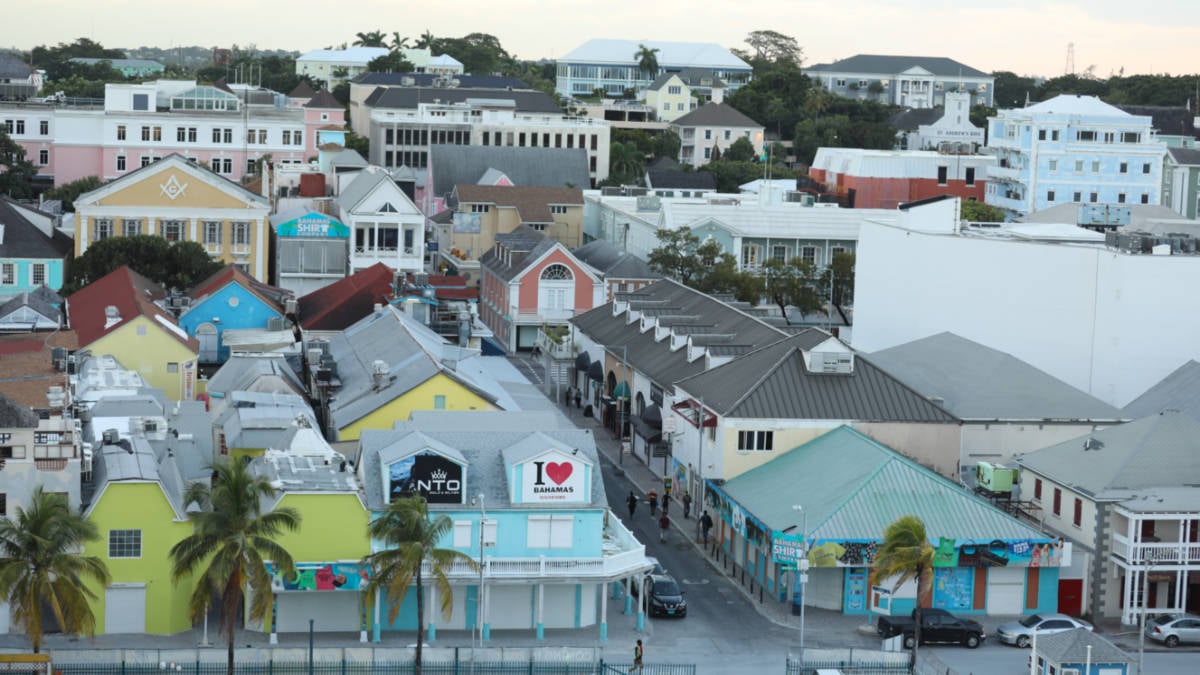
A routine day in the bustling downtown core of Nassau, Bahamas, took a chaotic and expensive turn when an unauthorized US cruise ship passenger decided to play traffic cop. What began as a misguided attempt to direct vehicles and clear a path for an ATV convoy quickly escalated into aggressive confrontation, property destruction, and a humiliating trip to a local police station.
According to local reports highlighted by The Tribune and captured on widely circulated social media footage, the unnamed cruise visitor took it upon himself to halt traffic on West Bay Street—one of the capital’s busiest arteries. Standing directly in the middle of the thoroughfare, the tourist placed his hands on the hood of an oncoming vehicle, barking orders and attempting to force the driver to yield so a group of all-terrain vehicles could merge.
When the motorist slowly inched forward to bypass the obstruction, the frustrated tourist lashed out, punching the driver’s side window and shattering the glass. A retired police officer witnessing the altercation promptly intervened, leading to the immediate arrest of the American visitor.
Rather than facing severe criminal charges that could have resulted in a prolonged stay in the Bahamian legal system, the tourist was given an alternative: pay $1,100 in cash to cover the property damage. Lacking the funds on hand, the traveler was reduced to a humiliating exercise in public crowdfunding, reportedly begging fellow cruise ship passengers for donations to secure his freedom.
The incident highlights a persistent challenge for Caribbean port destinations: the friction between unruly tourists acting with a sense of vacation impunity and local authorities tasked with maintaining public order. As cruise tourism surges back to record highs, this episode serves as a stark reminder that vacationers remain strictly bound by the laws of their host nations—a reality underscored by a string of high-profile, costly legal incidents involving cruise passengers in Nassau throughout 2026.
Detailed Chronology of the Incident
The confrontation unfolded against the backdrop of Nassau’s heavily congested downtown traffic, specifically at the high-traffic intersection of West Bay Street and Dorchester Street. Located roughly a half-mile from the sprawling Nassau Cruise Port and directly across the street from the luxury Margaritaville Beach Resort, the area is a perpetual hub of activity, teeming with tour groups, shoppers, local commuters, and resident businesses.
The Buildup and Traffic Interruption
While the exact date of the incident was not formally disclosed in initial police logs, local media brought the story to light on Monday, October 5, 2026. Video footage of the event reveals a male cruise passenger stepping aggressively into the flow of traffic on West Bay Street. Without any legal authority, reflective gear, or official designation, the man began waving his arms to halt oncoming traffic.
His objective appeared to be clearing a pathway for a convoy of ATVs to enter the main thoroughfare. Popular among visitors looking for a high-octane sightseeing experience, ATV tours are a staple of the Nassau excursion market. However, whether this specific ATV group was affiliated with an official cruise line shore excursion, an independent local vendor, or simply a group of independent travelers remains unconfirmed. Furthermore, it is unclear whether the aggressive tourist was personally acquainted with the ATV riders or simply seized upon a misplaced sense of vigilantism to assist them.
As the tourist stood in the middle of the road, shouting aggressively, a local driver approached the blockage. Rather than stopping indefinitely for an unauthorized civilian, the motorist slowly inched the vehicle forward to navigate past the obstruction. Infuriated by the driver’s refusal to yield to his commands, the tourist stepped up to the vehicle as it passed and delivered a powerful punch directly to the driver’s side window, completely shattering the glass.
Intervention and Arrest
Fortunately, a retired police officer was in the immediate vicinity and witnessed the unprovoked act of vandalism. Acting quickly, the former law enforcement official detained the tourist and summoned active-duty police officers to the scene.
The suspect—identified strictly as a US tourist and cruise ship passenger—was placed under arrest and transported from the tourist-heavy zone.
Faced with potential criminal charges for destruction of property and disorderly conduct, the passenger was offered a settlement by local authorities: pay the vehicle owner $1,100 in restitution to cover the cost of the broken window, and the matter would be resolved outside of formal court proceedings.
The Crowdfunding Scramble
While the tourist agreed to pay the restitution to avoid a protracted legal battle, a logistical hurdle quickly emerged: he did not have $1,100 in cash or immediate liquidity on his person.
Desperate to return to his ship before all-aboard time, the man resorted to begging fellow cruise passengers and bystanders for donations to raise the required cash. Witnesses reported seeing the distressed tourist approaching strangers and fellow travelers, explaining his predicament and collecting contributions dollar by dollar until he hit the $1,100 threshold.
It remains unclear who ultimately contributed to the makeshift bail fund, whether they were family members, friends traveling in his party, or sympathetic strangers who simply wanted to clear the bottleneck before their ship sailed.
The driver of the damaged vehicle, who chose to remain anonymous in media reports, expressed sheer disbelief at the tourist’s audacious behavior. In an interview following the incident, the motorist delivered a scathing rebuke of foreign entitlement:
"I told the guy that if I had done what he did in his country, I probably would have got shot."
To fully understand the gravity of the incident, one must examine the staggering volume of maritime tourism flowing through Nassau on any given day. On the date of the altercation, the port was operating at near-maximum capacity. Major vessels docked in the area included Royal Caribbean International’s Freedom of the Seas and Harmony of the Seas, alongside MSC Cruises’ massive MSC Seashore.
These ships alone bring thousands of transient visitors into a relatively compact downtown footprint. Over the preceding weekend, vessels from Carnival Cruise Line, Disney Cruise Line, and Norwegian Cruise Line had also cycled through the port. With multiple mega-ships in town, pedestrian and vehicular congestion along West Bay Street reaches critical mass daily, creating a tinderbox of frayed tempers between locals trying to navigate their home city and tourists experiencing vacation brain fog.
A Pattern of Misbehavior: The June 2026 Police Station Brawl
Unfortunately, this street-level altercation is not an isolated incident, but rather part of an escalating trend of unruly behavior by cruise passengers visiting Nassau in 2026.
Just a few months prior, on June 8, 2026, Nassau law enforcement was forced to deal with an explosive incident involving cruise visitors. What began as a violent brawl among six cruise passengers at the cruise terminal escalated rather than subsided; the combatants continued their violent altercation inside a local police station.
The incident resulted in extensive property damage to the precinct and physical injuries to responding police officers. The legal fallout was swift and devastatingly expensive. The passengers involved were ultimately forced to pay a combined total of more than $52,000 in fines and restitution—a stark financial penalty that sent shockwaves through the cruising community and served as a warning regarding local law enforcement tolerance.
Economic and Social Tensions
The strain between the Bahamian populace and transient cruise tourists has become a growing point of discussion. While tourism is the lifeblood of the Bahamian economy—accounting for the vast majority of the nation’s GDP and employment—local residents have grown increasingly intolerant of foreign visitors who flout local laws, litter, harass street vendors, or, in extreme cases, attempt to police local traffic and vandalize property.
Local officials have continually stressed that while tourists are warmly welcomed, the capital of the Bahamas is a sovereign nation with strict legal codes, not an amusement park governed by vacation rules.
Official Statements and Corporate Policies
As of the reporting of this incident, neither the Royal Caribbean Group, MSC Cruises, nor any other major cruise line operating out of Nassau has released an official statement regarding the tourist’s identity or the specific ship involved. Cruise lines generally maintain a strict policy of privacy regarding individual guest legal matters unless compelled by international maritime law or court subpoena.
However, corporate legal departments are quick to distance themselves from passengers who violate local laws while ashore. A review of major cruise line contracts and guest conduct policies reveals a uniform, unwavering stance: guests are individually and entirely responsible for their actions in foreign ports.
Royal Caribbean International Guest Conduct Policy
Royal Caribbean’s comprehensive Guest Health, Safety, and Conduct Policy explicitly outlines passenger obligations while visiting international destinations:
"Guests are required to comply with all applicable laws of the various countries that they visit."
Failure to adhere to these local statutes not only exposes the passenger to immediate criminal prosecution by local authorities—as demonstrated by the Nassau police intervention—but also triggers severe corporate penalties. Cruise lines routinely reserve the right to confiscate cruise cards, confine passengers to their cabins, disembark disruptive individuals in foreign ports at their own expense without a refund, and issue lifetime bans from future sailings.
MSC Cruises Guest Conduct Policy
Similarly, MSC Cruises’ Guest Conduct Policy sets a strict behavioral baseline for all travelers stepping off its vessels:
"Guests are also expected to comply with applicable laws of the various countries their cruise visits."
Cruise contracts explicitly state that when a passenger steps off the gangway into a port of call, they cease to be protected by the internal security bubble of the cruise ship and fall entirely under the jurisdiction of local police, courts, and penal systems.
Future Outlook: What This Means for Cruise Travelers
The Nassau street altercation offers several crucial takeaways for the wider cruising community as the industry moves forward:
Zero Tolerance for Vigilantism: Vacationers must remember that they possess zero legal authority in foreign countries. Attempting to direct traffic, intervene in local disputes, or enforce civil order outside of one’s home jurisdiction is not only dangerous but illegal.
The High Cost of Lawlessness: The days of tourists escaping foreign misdemeanors with a slap on the wrist are effectively over. Ports like Nassau are tightening enforcement, utilizing high-definition security cameras, social media evidence, and rapid judicial processing to hold foreign visitors financially and criminally accountable. As seen in both the $52,000 police station brawl and this $1,100 window-smashing incident, bad behavior abroad carries an immediate, punishing price tag.
The Limits of Cruise Line Protection: Many passengers operate under the false assumption that their cruise line will intervene or bail them out if they are arrested in a port of call. In reality, cruise lines will leave detained passengers behind to face local authorities alone if they violate port laws, requiring travelers to fend for themselves—or, in this case, beg strangers for cash on a Bahamian street corner.
Ultimately, the unnamed cruise passenger learned an expensive lesson on West Bay Street: a vacation in paradise does not exempt anyone from the rule of law. As cruise ports continue to grapple with massive visitor influxes, local authorities have made it abundantly clear that disruptive foreign travelers will pay dearly for treating island infrastructure as their personal playground.