






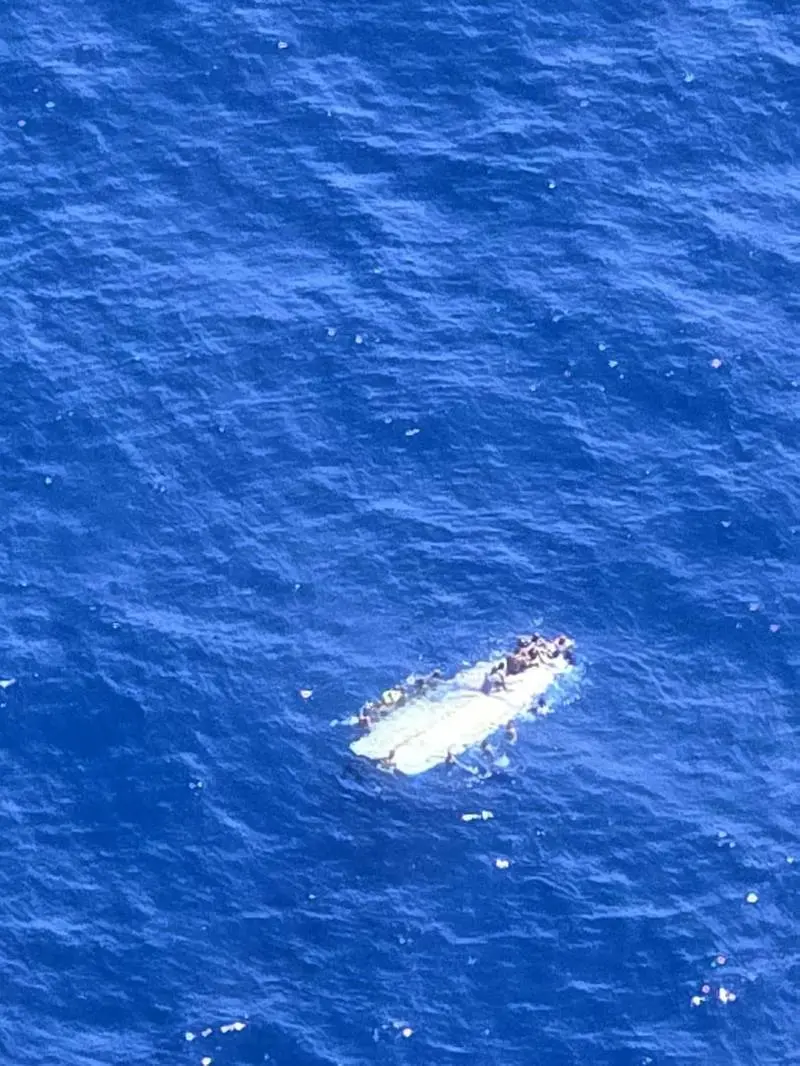
SAN JUAN, Puerto Rico — A harrowing maritime disaster unfolded in the treacherous waters of the Mona Passage on Monday, September 28, 2026, resulting in a massive search-and-rescue operation by the United States Coast Guard (USCG) and partner agencies. At least 40 survivors have been pulled from the ocean, and two bodies have been recovered after an overloaded, makeshift migrant vessel capsized approximately 10 miles off the coast of Mona Island.
The disaster, which occurred late Sunday night, was precipitated not only by severe environmental conditions but also by a sudden outbreak of extreme violence on board. Survivors reported that a physical altercation involving a machete erupted among the passengers, causing mass panic, severe injuries, and a sudden shift in weight that ultimately rolled the unstable vessel. With an estimated 60 people originally on board, emergency crews continue to scour the deep, high-current waters for approximately 18 individuals who remain missing.
Executive Overview
On the morning of September 28, 2026, Coast Guard Sector San Juan watchstanders received a critical distress report from a commercial vessel operating in the Mona Passage—the volatile strait separating Puerto Rico from the island of Hispaniola. The crew of the motor vessel Tripiti reported spotting and rescuing four individuals drifting in the open ocean.

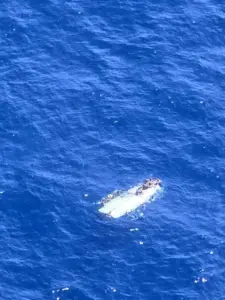
According to initial debriefings of the survivors, their makeshift wooden vessel—commonly referred to in the region as a yola—had capsized at approximately 11:00 p.m. on Sunday, September 27. The survivors described a scene of terror: mid-transit, a violent dispute broke out among the passengers, culminating in a machete fight that left several individuals severely wounded. In a desperate bid to escape the violence, multiple passengers leaped into the dark, churning waters to attempt a swim toward the sheer limestone cliffs of Mona Island. The chaotic movement of the remaining passengers destabilized the severely overloaded, flat-bottomed craft, causing it to capsize and pitch the remaining occupants into the sea.
Compounding the tragedy, none of the passengers were equipped with life jackets or personal flotation devices.
The U.S. Coast Guard, in coordination with local and federal law enforcement partners, immediately initiated a comprehensive search-and-rescue (SAR) operation. By Monday afternoon, rescue crews had successfully pulled 40 survivors from the water, while recovering two deceased victims. A multi-agency search remains active over a wide grid of the Caribbean Sea as authorities race against time, ocean currents, and dehydration to locate the remaining missing passengers.
Detailed Chronology of the Incident
The timeline of the disaster highlights the rapid escalation of a routine illegal maritime voyage into a deadly humanitarian crisis.
+-----------------------------------------------------------------------------+
|                                  TIMELINE                                   |
+-----------------------------------------------------------------------------+
| Sept 27, 11:00 PM | Violent fight breaks out on makeshift vessel; multiple  |
|                   | passengers jump overboard; vessel capsizes 10 miles     |
|                   | off Mona Island.                                        |
+-------------------+---------------------------------------------------------+
| Sept 28, 12:00 PM | MV Tripiti spots and rescues 4 survivors; alerts        |
|                   | USCG Sector San Juan.                                   |
+-------------------+---------------------------------------------------------+
| Sept 28, Afternoon| USCG launches cutters, helicopters, and fixed-wing      |
|                   | aircraft. 36 additional survivors rescued; 2 bodies     |
|                   | recovered. Active search continues for ~18 missing.     |
+-----------------------------------------------------------------------------+
The Voyage and the Outbreak of Violence
While the exact point of origin remains under investigation, federal authorities suspect the vessel departed from the eastern coast of the Dominican Republic, a common staging ground for human smuggling operations bound for the U.S. territory of Puerto Rico.
At approximately 11:00 p.m. on Sunday, while transiting about 10 miles off Mona Island, an argument erupted among those on board. The tension quickly escalated into physical violence. According to survivor testimonies, at least one individual wielded a machete, inflicting severe, debilitating injuries on several passengers.
The ensuing panic proved fatal. To escape the blade, numerous passengers crowded to one side of the un-decked, low-freeboard vessel or jumped directly into the water, hoping to swim toward the distant silhouette of Mona Island. The sudden, drastic shift in the vessel’s center of gravity caused the waterlogged craft to capsize instantly, trapping some underneath and leaving the rest fighting to stay afloat in pitch-black conditions without life-saving equipment.
The Good Samaritan Discovery
For thirteen hours, the survivors drifted in the open ocean, pushed by the strong westerly currents of the Mona Passage. At approximately 12:00 p.m. on Monday, the crew of the merchant vessel Tripiti observed debris and movement in the water.
Upon closer inspection, the crew discovered four exhausted survivors clinging to remnants of the capsized craft or floating nearby. The crew of the Tripiti immediately brought the four individuals on board, provided basic medical aid, and contacted Coast Guard Sector San Juan watchstanders to report the incident. The survivors informed their rescuers that they were part of a larger group of approximately 60 people.
The Mobilization of Search and Rescue (SAR)
Upon receiving the distress call, Coast Guard Sector San Juan immediately assumed the role of Search and Rescue Mission Coordinator (SMC) and launched a massive, coordinated response. Search patterns were generated using the Search and Rescue Optimal Planning System (SAROPS), factoring in wind speed, sea state, and the prevailing currents of the Mona Passage.
The response fleet quickly expanded to include:
- USCG Sector San Juan Watchstanders: Coordinating communications and logistics.
- USCG Cutter Crews: Dispatched to conduct surface searches and recover survivors.
- USCG MH-60T Jayhawk Helicopters: Dispatched from Air Station Borinquen to provide rapid aerial scanning and hoist capabilities.
- USCG HC-144 Ocean Sentry Aircraft: Providing long-range, high-endurance aerial surveillance and search-pattern coordination.
- Partner Agencies: Puerto Rico Police Joint Forces of Rapid Action (FURA) and U.S. Customs and Border Protection (CBP) Air and Marine Operations (AMO) assets.
By late Monday afternoon, the combined efforts of the USCG and assisting vessels resulted in the rescue of 36 additional survivors, bringing the total number of rescued individuals to 40. Search crews also located and recovered the bodies of two deceased passengers.
Supporting Context & Metrics
The tragedy off Mona Island is a stark reminder of the extreme dangers associated with irregular maritime migration across the Caribbean, particularly through the Mona Passage.

The Geography and Perils of the Mona Passage
The Mona Passage is a 130-kilometer (80-mile) wide strait that connects the Atlantic Ocean to the Caribbean Sea. It is widely regarded by maritime experts as one of the most difficult and unpredictable stretches of water in the Caribbean.
                    ATLANTIC OCEAN
                         |
         +---------------+---------------+
         |                               |
  [Dominican                      [Puerto Rico]
  Republic]       MONA PASSAGE           |
         |               o               |
         |          Mona Island          |
         |         (Uninhabited)         |
         +---------------+---------------+
                         |
                   CARIBBEAN SEA
Several oceanographic factors contribute to its danger:
- Conflicting Currents: The collision of tidal currents from the Atlantic and the Caribbean creates violent rip tides, heavy swells, and unpredictable wave patterns.
- Shallow Reefs and Limestone Cliffs: Mona Island itself offers no easy refuge. It is a biological reserve characterized by sheer, vertical limestone cliffs rising up to 200 feet, surrounded by sharp coral reefs. Landing a vessel safely without professional navigation is nearly impossible, especially in high seas.
- Distance and Exposure: The 10-mile distance from Mona Island where the vessel capsized is deceptive. Strong currents in this area sweep objects westward, away from the island and out into the open, deeper waters of the Caribbean Sea, making swimming to shore an unrealistic feat for even the strongest swimmers.
The Anatomy of a "Yola"
Smuggling networks operating in the Caribbean routinely utilize makeshift vessels known as yolas. These boats are built quickly in hidden coastal workshops, utilizing cheap plywood, minimal framing, and single or dual outboard engines.
| Feature | Standard Commercial Vessel | Makeshift Migrant Yola |
|---|---|---|
| Material | Reinforced fiberglass/steel | Cheap plywood and basic timber |
| Stability | Engineered ballast and hull design | Flat-bottomed, highly prone to rolling |
| Safety Gear | Life jackets, flares, life rafts, EPIRBs | Typically zero safety equipment |
| Capacity | Strictly regulated and certified | Overloaded by 300% to 500% of safe capacity |
| Navigation | GPS, radar, VHF marine radios | None or consumer-grade smartphones |
Because these vessels lack internal structural support or ballast, any sudden movement of passengers—such as the panic caused by the reported machete fight—instantly shifts the center of gravity, leading to immediate capsizing or swamping.
Official Statements and Coast Guard Response
The U.S. Coast Guard and federal law enforcement partners have expressed deep concern over both the loss of life and the unprecedented level of violence reported on board the vessel.
The Complexity of the Search and Rescue Operation
Coast Guard officials emphasized that searching for survivors in the Mona Passage is an operational race against time.
"Our primary focus remains the preservation of life," said a spokesperson for Coast Guard Sector San Juan. "We are utilizing every available asset to search the waters off Mona Island. The reports of violence on board prior to the capsizing add a deeply troubling dimension to this tragedy, and we are working closely with federal law enforcement partners to investigate these claims as we continue our search."
The Coast Guard reiterated the extreme danger of these illegal voyages, noting that smugglers routinely mislead migrants about the safety of the crossing and the seaworthiness of the vessels.
"Sm smugglers do not care about human life; they care about profit," the Coast Guard statement continued. "They cram dozens of people onto vessels that are completely unfit for the open ocean, with no life jackets, no navigation equipment, and no means of calling for help. When panic or violence breaks out in such confined, unstable conditions, disaster is the inevitable result."
Investigation into Onboard Violence
The involvement of a machete and the subsequent outbreak of violence have drawn the attention of Homeland Security Investigations (HSI) and the U.S. Attorney’s Office for the District of Puerto Rico. Survivors who were rescued are being processed, provided medical treatment, and interviewed by federal agents to determine the sequence of events that led to the altercation.
Key areas of the federal investigation include:
- Identification of the Smugglers: Determining if the instigator of the violence was a smuggler or an associate attempting to maintain control of the vessel.
- Origin of the Weapon: Investigating how a machete was brought on board and the motive behind the attack.
- Criminal Charges: Potential federal charges for alien smuggling resulting in death, as well as assault and murder on the high seas, which carry severe penalties under U.S. maritime law.
Future Outlook
This latest maritime tragedy underscores the ongoing challenges faced by border enforcement and humanitarian organizations in the Caribbean. Despite continuous warnings, public awareness campaigns, and increased patrols, the volume of irregular migration through the Mona Passage remains high, driven by economic instability, political unrest, and security crises in neighboring nations.
Strengthening Regional Maritime Security
In response to persistent migration flows, the Caribbean Border Interagency Group (CBIG)—which includes the USCG, CBP, Immigration and Customs Enforcement (ICE), and the Puerto Rico Police Department—has continuously adapted its patrol strategies. However, the vastness of the maritime border makes total interdiction difficult.
The future outlook for regional maritime security will likely involve:
- Increased Aerial Surveillance: Leveraging unmanned aerial systems (UAS) and advanced radar capabilities to detect low-profile yolas before they enter deep waters.
- Enhanced International Cooperation: Strengthening intelligence-sharing and joint operations between the United States, the Dominican Republic, and Haitian authorities to dismantle smuggling syndicates at their points of origin on land.
- Prosecution as a Deterrent: The federal government is expected to aggressively prosecute individuals involved in organizing this fatal voyage, particularly given the violent circumstances. Publicizing these prosecutions serves as a critical tool to deter future smuggling attempts.
As the search for the remaining missing passengers continues off the coast of Mona Island, the maritime community is once again left to mourn a preventable loss of life. The incident stands as a somber testament to the lethal combination of desperate voyages, unstable vessels, and the volatile environment of the open sea.