







Executive Overview
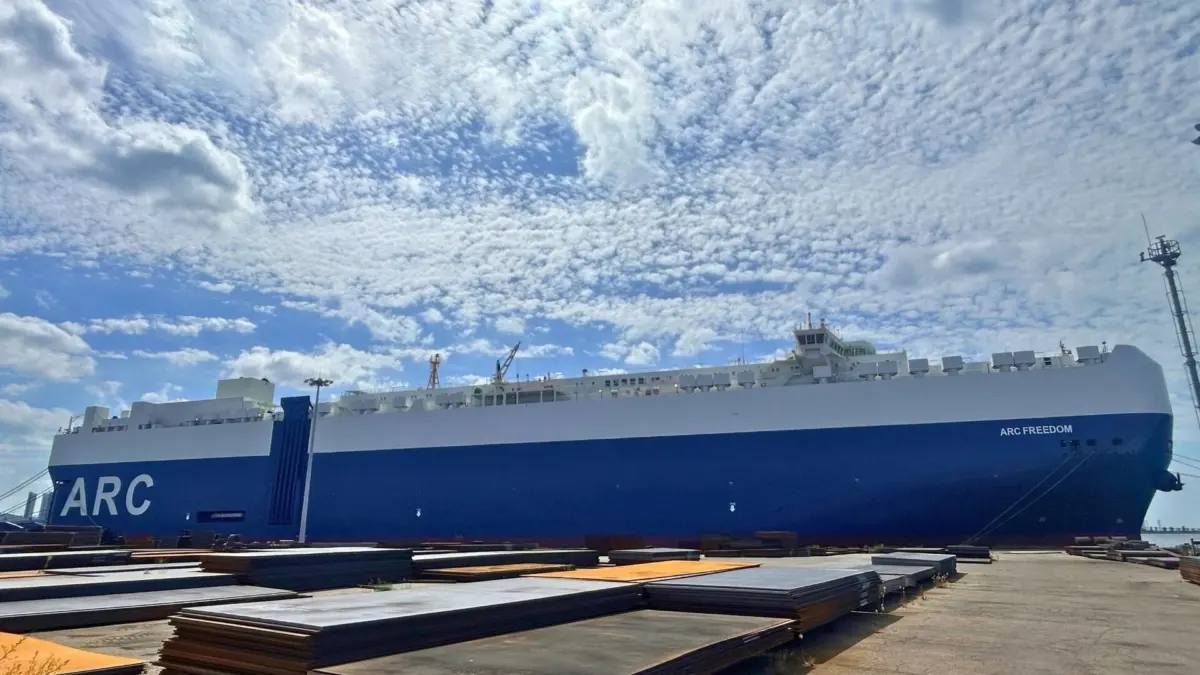
In an era defined by intensifying geopolitical rivalries and fractured global supply chains, the strength of the United States’ commercial sealift capability has once again emerged as a cornerstone of national security. In a major move to modernize this critical logistical backbone, the American Roll-On/Roll-Off Carrier (ARC) Group has officially integrated the ARC Freedom into the U.S.-flag fleet. Operating under the Maritime Security Program (MSP), this newly reflagged vessel represents a significant technological and structural upgrade for the U.S. Maritime Administration (MARAD) as it seeks to recapitalize its strategic fleet with younger, highly capable, and militarily versatile tonnage.
Formerly operating as the Figaro under the Wallenius Wilhelmsen banner, the 2011-built ARC Freedom (IMO 9505041) is a massive Large Car and Truck Carrier (LCTC). Boasting a carrying capacity of nearly 8,000 car-equivalent units (CEUs) distributed across 13 vehicle decks, the vessel offers the exact kind of heavy-lift, high-volume capacity required to transport complex military hardware across transoceanic distances.
The transition of the ARC Freedom to the U.S. registry does not expand the statutory 60-ship limit of the MSP. Instead, it replaces older, less efficient vessels, reflecting a deliberate strategy by both MARAD and private defense contractors to aggressively recapitalize the fleet. As the U.S. military prepares for potential high-intensity conflicts in the Indo-Pacific and European theaters—where long-range logistics will dictate the outcome of any engagement—the addition of the ARC Freedom provides a vital boost to the nation’s rapid-response sealift capacity.
+-----------------------------------------------------------------------------+
|                          ARC FREEDOM AT A GLANCE                            |
+-----------------------------------------------------------------------------+
|  Vessel Name: ARC Freedom (Ex-Figaro)    |  IMO Number: 9505041             |
|  Year Built: 2011                        |  Length Overall: ~231 Meters     |
|  Capacity: ~8,000 CEUs                   |  Vehicle Decks: 13 (5 Hoistable) |
|  Stern Ramp Capacity: 320 Metric Tons    |  Main Deck Height: 6.5 Meters    |
+-----------------------------------------------------------------------------+
Detailed Chronology
The arrival of the ARC Freedom under the U.S. flag is the latest milestone in a highly coordinated, multi-year fleet renewal initiative spearheaded by the ARC Group. This systematic modernization effort has been designed to align commercial operations with the evolving logistical demands of the U.S. Department of Defense (DoD).
February 2024: The Reflagging of ARC Honor
The current cycle of fleet modernization gained significant momentum in February 2024 when ARC successfully reflagged the ARC Honor, another large car and truck carrier. Previously operating under a foreign registry, the vessel was brought under the U.S. flag and integrated into the MSP. This transition served as a proof-of-concept for the rapid reflagging of modern, high-capacity roll-on/roll-off (Ro-Ro) vessels to meet immediate strategic needs.
December 2024: The Arrival of ARC Endeavor
Building on the success of the ARC Honor, ARC executed another major fleet upgrade in December 2024 with the introduction of the ARC Endeavor. This vessel was officially brought into the MSP to replace the aging Endurance. Crucially, rather than selling or scrapping the older vessel, ARC retained the Endurance under the U.S. flag, thereby preserving overall American tonnage while ensuring that the active, subsidized MSP slot was occupied by a far more modern and capable ship.
Early 2025: The Integration of ARC Freedom
Following these precursor transitions, U.S. Coast Guard records in early 2025 confirmed the official registry of the ARC Freedom under the U.S. flag. The vessel, measuring approximately 231 meters in length and originally delivered as the Figaro in 2011, underwent a rigorous reflagging process. This included extensive inspections to ensure compliance with stringent U.S. Coast Guard safety and operational standards, as well as the transition of the vessel’s crew to licensed U.S. merchant mariners. The ARC Freedom now stands fully operational, ready to be deployed in both commercial trade routes and military mobilization exercises.
Supporting Context & Metrics
To understand the strategic significance of the ARC Freedom, one must examine both the technical specifications of the vessel and the broader landscape of the U.S. merchant marine.
+--------------------------------------------------------------------+
|                    U.S. MERCHANT FLEET PROFILE                     |
|            (Oceangoing self-propelled vessels >= 1,000 GT)         |
+--------------------------------------------------------------------+
|  Total Active U.S.-Flag Fleet: ~190 Vessels                        |
|  ===============================> [190]                            |
|                                                                    |
|  Maritime Security Program (MSP) Sub-Fleet: 60 Vessels             |
|  =========> [60]                                                   |
+--------------------------------------------------------------------+
Technical Capability and Military Utility
The ARC Freedom is uniquely suited for the dual-use requirements of the MSP. Unlike standard car carriers designed solely for light passenger vehicles, the ARC Freedom features a heavy-duty structural design:
- Decks & Configuration: Out of its 13 vehicle decks, five are fully hoistable. This configuration allows crew members to adjust deck heights dynamically, transforming the ship’s interior from a standard car carrier into a heavy-cargo transport capable of housing oversized industrial and military equipment.
- Clearance & Ramp Strength: The vessel boasts a 6.5-meter-high main deck and door clearance, complemented by a stern ramp rated for rolling loads of up to 320 metric tons.
- Military Cargo Compatibility: This high-capacity ramp and clearance profile enable the ARC Freedom to easily load, transport, and discharge heavy military hardware. This includes M1A2 Abrams main battle tanks, heavy tactical trucks, and large military aircraft such as V-22 Osprey tiltrotor aircraft and CH-47 Chinook heavy-lift helicopters.
The Mechanics of the Maritime Security Program (MSP)
Established under the Maritime Security Act of 1996 and administered by MARAD, the MSP maintains a fleet of 60 commercially viable, militarily useful, U.S.-flagged merchant vessels.
In exchange for a yearly retainer payment, participating commercial operators agree to make their ships, global intermodal logistics networks, and terminal facilities available to the DoD during times of war or national emergency. This public-private partnership is highly cost-effective; it provides the military with immediate access to a global logistics network that would cost billions of dollars to build, maintain, and operate solely within the military budget.
The State of the U.S. Flag Fleet
The introduction of the ARC Freedom comes at a time when the domestic maritime sector faces critical capacity challenges. As of August 2024, MARAD documented only 190 U.S.-flagged, self-propelled oceangoing merchant vessels of 1,000 gross tons or more. Of these, the 60 vessels enrolled in the MSP form the core of America’s international commercial sealift capability.
The scarcity of U.S.-flagged ships is compounded by a severe shortage of qualified merchant mariners. By keeping modern vessels like the ARC Freedom active in commercial trade under the U.S. flag, the MSP helps sustain the employment of American mariners, ensuring a pool of credentialed personnel is available to man military reserve fleets during a prolonged conflict.
Official Statements
The successful integration of the ARC Freedom has been widely praised by both military planners and industry executives, who view the vessel as a critical addition to national defense readiness.
Maritime Administrator Capt. Stephen M. Carmel emphasized the vital role the vessel will play in global power projection:
"Adding the ARC Freedom to the U.S.-flag fleet is a major win for America’s national security. As a member of the Maritime Security Program, this vessel will deliver the rapid response our military depends on to keep America safe."
For ARC, the addition of the vessel represents both a commercial milestone and a renewal of its corporate commitment to supporting the nation’s strategic goals. Eric Ebeling, President and CEO of ARC, connected the vessel’s entry to a broader historical context:
"Freedom has always been inseparable from America’s identity. As America marks 250 years of independence, ARC Freedom is a fitting name for a vessel that will carry the U.S. flag around the world, serving our customers in peacetime and standing ready to serve our nation when called."
These statements underscore the unique nature of the MSP, where commercial profitability and national defense objectives are seamlessly aligned.
Future Outlook
Looking ahead, the recapitalization of the U.S.-flag merchant fleet will remain an urgent priority for national security strategists. The ongoing conflicts in Europe and the Middle East, coupled with rising tensions in the South China Sea, have highlighted the vulnerability of global supply chains and the absolute necessity of secure, sovereign sealift capacity.
Addressing the Ready Reserve Force (RRF) Crisis
While the MSP provides commercially active vessels, the U.S. also relies on the Ready Reserve Force (RRF)—a fleet of government-owned, laid-up vessels kept in reduced operating status. However, the RRF is rapidly aging, with many vessels exceeding 40 years of service.
Modern commercial vessels like the ARC Freedom represent the future of sealift, offering superior fuel efficiency, advanced navigation systems, and compliance with modern environmental regulations. The continuous injection of newer tonnage into the MSP by operators like ARC provides a model for how the U.S. can systematically modernize its overall maritime readiness without relying solely on taxpayer-funded government shipbuilding programs.
Sustaining the Voluntary Intermodal Sealift Agreement (VISA)
As the largest operator of U.S.-flag Ro-Ro vessels in international trade, ARC’s participation extends beyond the MSP. The company is also a key player in MARAD’s Voluntary Intermodal Sealift Agreement (VISA).
This program integrates commercial intermodal systems—including rail, trucking, port terminals, and logistics management systems—into the military’s mobilization planning. The addition of the ARC Freedom expands the physical capacity of this integrated network, ensuring that when the military calls on the merchant marine, it receives not just a ship, but a complete, highly efficient logistical pipeline capable of moving material from domestic factories to the front lines of any global theater.
Ultimately, the successful reflagging and deployment of the ARC Freedom serves as a powerful reminder of the enduring importance of the merchant marine. As long as global stability is contested on the high seas, the ability of the United States to project power will depend on the strength, modernity, and readiness of its commercial fleet.