










Executive Summary: The traditional consumer journey in travel—once a straightforward, step-by-step progression from dreaming to planning to booking—is officially obsolete. According to groundbreaking new research unveiled at the Skift Global Forum through a seventh annual collaboration between Skift and McKinsey & Company, the modern travel booking journey has mutated from a predictable line into a chaotic, continuous "orbit."
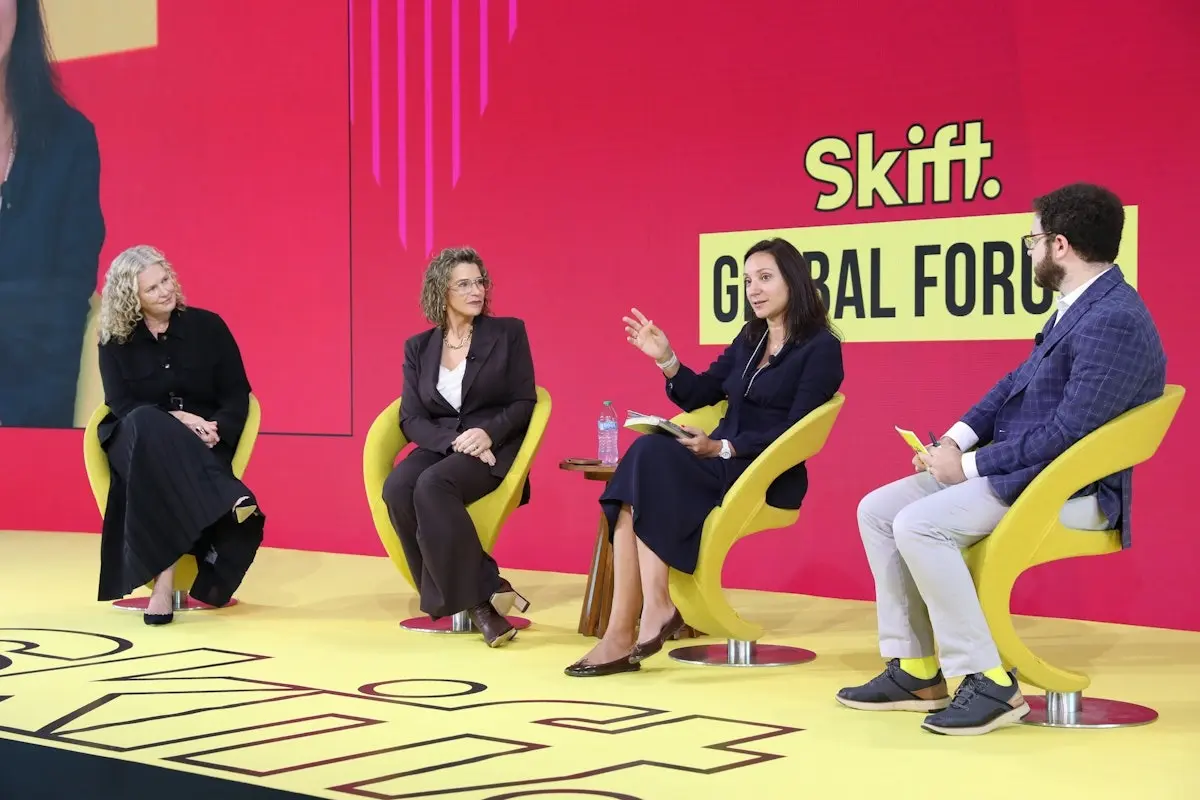
Based on comprehensive studies of 1,000 consumers and detailed traveler diaries, industry leaders—including Priceline Chief Commercial Officer Traci Mercer, IHG Chief Commercial & Marketing Officer Heather Balsley, and McKinsey Partner Margaux Constantin, moderated by Skift’s Seth Borko—revealed that travel brands clinging to outdated, linear marketing funnels are burning capital on models that no longer reflect consumer reality.
Today’s travelers are trapped in an endless loop of research, hesitation, and post-booking pivots. With touchpoints ballooning from roughly 45 in 2018 to an estimated 65 today, one-third of which actively push travelers further away from a final decision, travel operators must completely overhaul how they approach customer acquisition, loyalty, and distribution.
Executive Overview
For decades, digital marketing across the travel, hospitality, and OTA (Online Travel Agency) sectors operated on a fundamental premise: capture attention, nurture intent, secure the booking, and retain for the next cycle. This linear construct allowed marketing executives at major hotel chains and booking platforms to map their advertising spend directly to predictable conversion phases.
That playbook is now defunct.
During a high-stakes panel discussion at the Skift Global Forum, travel distribution executives and management consultants pulled back the curtain on a profound shift in consumer psychology and digital behavior. The modern travel booking funnel does not end at checkout; in many cases, it barely pauses there.
More than 50% of contemporary travelers change their minds and rebook or significantly alter their itineraries after making their initial reservation. This staggering metric exposes a massive vulnerability in how hospitality giants and travel distribution platforms allocate their billions in marketing dollars. As consumer touchpoints expand exponentially, companies are realizing that visibility alone is no longer enough. Winning the modern traveler requires maintaining relevance throughout an expansive, unpredictable, and endlessly looping digital journey.
Detailed Chronology: The Evolution of the Consumer Decision Journey
To understand how the travel industry arrived at this crossroads, one must examine the rapid acceleration of digital touchpoints over the past decade.
The 2018 Baseline: A Predictable Path
Reflecting on historical data, McKinsey & Company established that the average consumer navigated approximately 45 distinct touchpoints—ranging from inspiration via social media to checking review sites and comparing airline ticket prices—before committing to a booking. While complex, this path still maintained a discernible beginning, middle, and end. Consumers gathered information, narrowed down their choices, transacted, and packed their bags.
The Pandemic Acceleration and Digital Saturation
The post-pandemic travel boom dramatically accelerated digital fragmentation. Armed with accumulated savings, flexible work policies, and an insatiable appetite for experiences, consumers began utilizing an unprecedented array of platforms to curate their trips. Meta-search engines, short-form video platforms like TikTok and Instagram Reels, hyper-personalized AI assistants, user-generated review communities, and traditional OTAs flooded the consumer consciousness with endless options.
The Modern "Orbit" (Present Day)
Today, that 2018 baseline of 45 touchpoints has surged to an estimated 65 per trip. However, McKinsey Partner Margaux Constantin was quick to contextualize this metric during the panel discussion, noting that the figure is "slightly arbitrary" because it has become "very difficult to pinpoint when that journey really starts and when it ends."
The journey is no longer a path; it is an orbit. Consumers are continuously pulled in and out of the decision-making ecosystem. The data shows that one in every three steps a traveler takes during this process actually pushes them further away from making a final choice. Instead of converging on a decision, the modern consumer experiences decision fatigue, prompting them to reset their research, pivot to new destinations, or scrap their plans entirely and start over.
Supporting Context & Metrics: Decoding the New Traveler Psychology
The empirical data presented by Skift and McKinsey paints a vivid picture of a volatile, highly discerning consumer base. Travel companies can no longer rely on brand inertia or standard loyalty programs to capture repeat business.
1. The 65-Touchpoint Reality
The sheer volume of digital interactions required to close a booking has grown by more than 44% over the last six years. These touchpoints are not concentrated in a single ecosystem; they span multi-device browsing sessions, social media inspiration loops, price-tracking tools, and forums. For travel brands, this means visibility must be maintained across a vast digital footprint. A brand that dominates search engine results page (SERP) ads but lacks presence in social discovery channels or review aggregates will find itself completely invisible during critical phases of the orbit.
2. The 33% Friction Factor
Perhaps the most striking statistic revealed during the forum is that one in three steps in the journey takes travelers further away from making a decision. This indicates that the sheer abundance of choice is introducing massive friction into the booking ecosystem. Rather than empowering the consumer, hyper-fragmentation often induces anxiety. Travelers open dozens of browser tabs, compare overlapping loyalty perks, read conflicting reviews, and ultimately step back from the booking funnel to recalibrate.

3. The 50%+ Post-Booking Volatility
Perhaps the most disruptive finding for revenue management teams is that more than 50% of travelers change their minds and rebook after their initial transaction. Thanks to flexible cancellation policies popularized during the pandemic—and now deeply entrenched as consumer expectations—the initial booking is no longer the finish line; it is often just a placeholder. Travelers secure a hotel room or flight as a "safety net" while continuing to scour the market for better deals, alternative properties, or more favorable itineraries right up until their departure dates. This creates phantom demand, heightens cancellation rates, and forces hotels and OTAs to constantly re-forecast inventory.
Official Statements and Industry Insights
The panel brought together some of the sharpest minds in travel distribution and marketing to debate the structural implications of this new reality.
Margaux Constantin, Partner at McKinsey & Company:
"The number of touch points from intention to booking has grown from roughly 45 in 2018 to an estimated 65 now… it is slightly arbitrary because it is very difficult to pinpoint when that journey really starts and when it ends."
Constantin emphasized that McKinsey’s collaborative research with Skift was designed to wake up executives who are still fighting yesterday’s war. By treating the consumer journey as a linear sequence, legacy brands are misallocating capital at every stage of the funnel.
Seth Borko, Skift (Moderator):
Guiding the conversation, Borko challenged the panel to address the operational and strategic shifts required to survive in an environment where customer loyalty is fluid and bookings are perpetually subject to revision.
Traci Mercer, Chief Commercial Officer at Priceline:
Mercer brought the perspective of a major OTA, where understanding micro-moments within the consumer orbit is paramount. For platforms like Priceline, the challenge lies in reducing the friction that pushes travelers away in that "one-in-three" step. Delivering seamless user experiences, dynamic pricing transparency, and targeted conversion nudges are critical weapons in capturing consumers who are caught in perpetual loops of indecision.
Heather Balsley, Chief Commercial & Marketing Officer at IHG:
Representing global hospitality, Balsley focused on the imperative of building enduring emotional connections that survive the post-booking volatility phase. When more than half of travelers are willing to rebook after their initial confirmation, hotel brands must double down on pre-arrival engagement, personalized digital guest experiences, and value propositions that make the initial booking too good to abandon.
Future Outlook: Strategic Imperatives for Travel and Hospitality Leaders
As the dust settles on the findings of the seventh annual Skift-McKinsey collaboration, industry executives are left with a clear mandate: adapt or become obsolete. To thrive in an era defined by the travel "orbit," companies must execute several foundational pivots:
1. Demolishing the Linear Marketing Budget
Chief Marketing Officers must abandon traditional top-of-funnel, middle-of-funnel, and bottom-of-funnel (TOFU-MOFU-BOFU) spending models. Budgets must be reallocated to support continuous, always-on engagement models that recognize the customer may enter, exit, and re-enter the booking ecosystem multiple times before—and even after—transacting.
2. Mitigating Post-Booking Churn
With over 50% of travelers altering or cancelling initial bookings, hospitality brands and OTAs must invest heavily in post-booking retention strategies. Utilizing predictive analytics to identify customers showing high flight or hotel switching behavior—and intervening with personalized offers, upgraded experiences, or flexible loyalty incentives—will be vital in protecting bottom lines from high cancellation volatility.
3. Simplifying the Decision Architecture
Because a full 33% of consumer touchpoints push travelers away from a decision, winning brands will be those that actively reduce cognitive load. This means leveraging generative AI and machine learning to deliver hyper-personalized, streamlined recommendations that cut through the noise, rather than adding to the overwhelming sea of choices.
4. Redefining the Role of Loyalty
Traditional points-accrual programs are no longer sufficient to anchor modern travelers. Because consumers are willing to rebook even after initial commitment, loyalty programs must offer continuous, experiential value throughout the entire orbit, transforming transactional relationships into sticky, lifestyle-driven ecosystems.
Conclusion
The seventh annual research collaboration between Skift and McKinsey & Company has drawn a hard line in the sand for the travel industry. The linear travel funnel is dead, replaced by a complex, high-velocity orbit where consumer indecision and post-booking volatility are the new norms. For companies like Priceline, IHG, and the broader global travel ecosystem, the path forward demands a total reimagining of marketing architecture, digital distribution, and customer relationship management. Those equipped to guide the modern traveler through their endless loops of discovery and decision will capture the future of travel; those clinging to linear models will be left spinning in place.