







By Dan Berkson, Digital Advocacy Manager | 3-Minute Read
Executive Overview
Humanity has long looked to the heavens with a sense of wonder, mapping the craters of the moon and charting the trajectories of distant planets with pinpoint accuracy. Yet, we remain profoundly disconnected from the world lying directly beneath our feet. Paradoxically, we possess more detailed topographical maps of the lunar surface than we do of our own planet’s deep seafloor.
The reasons are as much logistical as they are physical. Our moon is airless, devoid of water, and directly observable from space. In contrast, the deep seafloor is hidden beneath miles of opaque, crushing ocean water. Covering over two-thirds of the Earth’s surface—roughly ten times the total area of the moon—the deep ocean represents the planet’s final true frontier.

Despite extreme obstacles, including pitch-black darkness, freezing temperatures, and immense barometric pressures, deep-sea exploration is more important than ever. As climate change accelerates, marine ecosystems face unprecedented stressors, and commercial pressures like deep-sea mining loom on the horizon. Understanding what lies in the abyss is no longer just an academic pursuit; it is an urgent necessity for the survival of life on Earth.
Detailed Chronology: A Century of Descending into the Unknown
Studying the deep ocean has never been easy, but over the last century and a half, human ingenuity has steadily chipped away at the veil of the deep.
The Late 1800s: The HMS Challenger Era
The foundation of modern oceanography was laid during the late 19th century. The historic HMS Challenger expedition (1872–1876) conducted the first-ever global, comprehensive scientific survey of the world’s oceans. Armed with heavy hemp ropes, natural-fiber dredges, and trawls, scientists collected deep-sea water, sediment samples, and previously unknown biological specimens. This monumental voyage proved that life could exist in the freezing, lightless depths, shattering the long-held "azoic theory" that the deep sea was a biological desert.
The Early-to-Mid 1900s: The Rise of Indirect Observation
As the 20th century progressed, exploration gradually shifted from direct physical sampling to indirect study driven by technological breakthroughs. The introduction of sonar technology during and after the World Wars revolutionized marine cartography. For the first time, scientists could map the contours of the seafloor and sample sediment without ever visually casting eyes upon the bottom.
The 1960s: The Advent of Manned Submersibles and ROVs
The 1960s ushered in a new era of direct observation. This decade saw the introduction of early submersibles and the development of Remotely Operated Vehicles (ROVs)—maneuverable underwater robots tethered to surface research vessels. These technological leaps allowed researchers to send cameras and mechanical arms where human divers could never possibly survive.
The 1980s: Autonomous Underwater Vehicles (AUVs)
Building upon the successes of tethered ROVs, the 1980s introduced Autonomous Underwater Vehicles (AUVs). These untethered robotic submersibles operate independently on pre-programmed mission profiles. AUVs revolutionized deep-sea mapping and sampling by removing the physical umbilical cord, enabling long-range, highly sophisticated navigation of deep-sea trenches and underwater mountain ranges.
The Modern Era: Precision Observation Networks
Today, marine scientists leverage an integrated suite of technologies—including advanced ROVs, AUVs, oceanographic buoys, and satellite telemetry. Modern high-resolution sonar systems, genomic sequencing of deep-sea microbes, and deep-ocean observatories allow researchers to study the abyss with a precision previously thought impossible.
Supporting Context & Metrics: Decoding the Deep Biome
To truly appreciate the magnitude of deep-sea exploration, one must understand the hostile physics of the environment.
Defining the Abyss
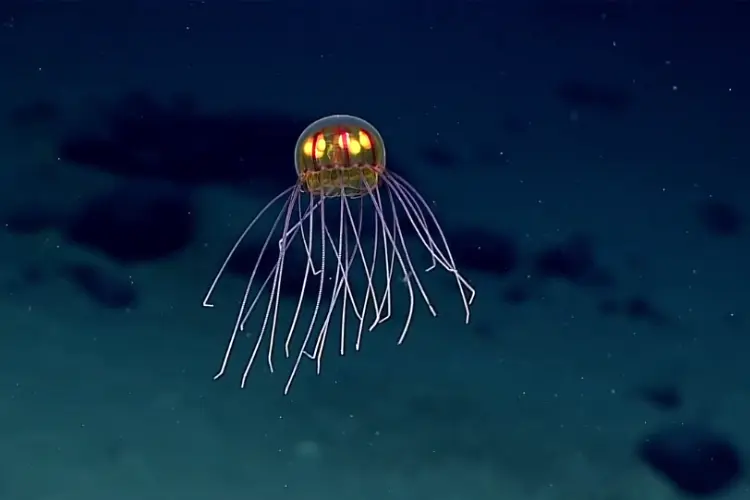
The deep sea officially begins at 200 meters (656 feet) below the surface, a boundary known scientifically as the twilight or dysphotic zone. Beyond this depth, sunlight is almost completely filtered out, leaving the ocean in perpetual, ink-black darkness. Temperatures plummet to an average of 4°C (39°F), creating a cold, desolate landscape across vast abyssal plains.
The Crush of Pressure
Water is heavy, and gravity pulls it downward with unrelenting force. Ocean pressure climbs rapidly, increasing by one atmosphere for every 10 meters (32.8 feet) of descent.
- At sea level, a human experiences one atmosphere of pressure.
- At a depth of 200 meters (the threshold of the deep sea), the pressure reaches 21 atmospheres—the cumulative weight of the air above and the water column pressing down from all sides.
- In the deepest trenches, such as the Mariana Trench, pressures exceed 1,000 atmospheres, equivalent to the weight of an elephant balanced on a postage stamp.
The Great Blind Spot
Because of the combination of near-total darkness, freezing temperatures, crushing pressures, and the sheer volume of the world’s oceans, scientists have visually observed less than 0.001 percent of the deep seafloor. Our ignorance of this biome is staggering, yet this hidden realm plays an outsized role in regulating the health of the entire planet.
Official Statements and Environmental Imperatives
The collection of deep-sea data is foundational to planetary health. Deep-sea observation systems, such as the Ocean Observatories Initiative (OOI), track dynamic coastal environments, complex marine food webs, and the massive ocean conveyor belt currents that dictate global climate patterns.
Data streamed from these deep-sea networks allow researchers to:
- Predict seismic events and map underwater fault lines.
- Forecast extreme weather patterns and tropical storm trajectories.
- Monitor the health and migration patterns of global commercial fisheries.
- Anticipate coastal flooding driven by sea-level rise and thermal expansion.
However, as our ability to monitor the deep ocean improves, the threats facing it are multiplying at an alarming rate. Chief among these modern perils is deep-sea mining.
Industrial mining syndicates and corporate entities have increasingly set their sights on the abyssal plains to extract rare earth minerals, polymetallic nodules, and rich deposits of copper, cobalt, nickel, and manganese. Environmental organizations have sounded the alarm, noting that deep-sea mining could trigger catastrophic, irreversible environmental degradation.
Dredging the seafloor creates massive sediment plumes that choke filter-feeding organisms, disrupt delicate benthic ecosystems, destroy ancient coral gardens, and release sequestered carbon back into the water column. Furthermore, the sonic noise pollution generated by heavy industrial machinery threatens marine mammals that rely on echolocation to navigate and hunt.
Future Outlook: The Fight to Protect the Final Frontier
The path forward for deep-sea exploration is fraught with a paradox: as technology grants us unprecedented access to the abyss, commercial interests seek to industrialize and exploit those very same fragile environments before science even has the chance to catalog them.
Preserving the deep sea requires a concerted, global commitment. Policymakers, scientists, and conservationists must prioritize robust marine protections that supersede short-term economic gains. Organizations like the Ocean Conservancy remain at the forefront of this struggle, actively pushing back against executive overreach, regulatory loopholes, and commercial mineral leasing initiatives that jeopardize the future of our oceans.
The deep sea is not a distant, lifeless void; it is the beating heart of Earth’s climate engine and a cradle of astonishing biological diversity. Defending it requires public awareness, political advocacy, and an unwavering commitment to exploration built on conservation rather than exploitation.
Take Action Today
The fight to protect our oceans from the looming threat of industrial deep-sea mining depends on collective action. Add your voice to the movement, demand accountability from lawmakers, and stand up for the preservation of Earth’s most mysterious, vital biome before it is too late.