




September 18, 2026
Executive Overview
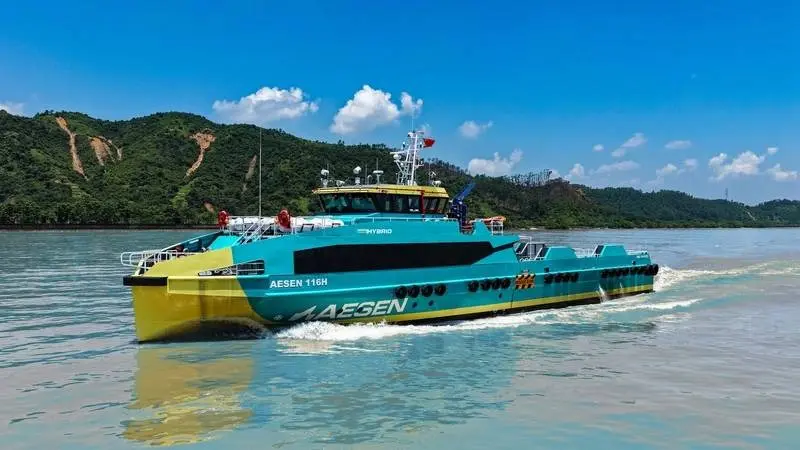
The global offshore energy sector is undergoing a profound structural transition. Driven by stringent international decarbonization mandates and a corporate-wide push among energy majors to slash Scope 3 emissions, the maritime logistics supply chain is under intense pressure to modernize. In a decisive response to these evolving market dynamics, maritime technology innovator Aesen has officially introduced the Aesen 116H, a next-generation hybrid crew boat engineered to transform offshore personnel transportation and infield logistics operations.
The debut of the Aesen 116H marks a major technological milestone in the fast crew supplier (FCS) and crew transfer vessel (CTV) segments. By seamlessly combining an advanced parallel hybrid propulsion system, an intelligent proprietary energy management platform, and next-generation bridge visualization technologies, the vessel directly addresses the dual imperatives of the modern offshore industry: maximizing operational efficiency while radically reducing environmental impact.
With estimated fuel savings of 30 to 40 percent compared to conventionally powered crew boats, the Aesen 116H represents a highly viable commercial and environmental pathway forward for offshore vessel operators servicing oil, gas, and offshore wind installations worldwide.
Technical Deep-Dive: Inside the Aesen 116H Hybrid Architecture
At the core of the Aesen 116H’s disruptive performance is its highly sophisticated hybrid propulsion system. Traditionally, fast crew boats rely on high-horsepower, medium-speed diesel engines operating continuously across a broad spectrum of load profiles—many of which are highly inefficient. The Aesen 116H dismantles this paradigm by integrating a high-capacity lithium-ion Energy Storage System (ESS) alongside high-efficiency diesel prime movers.
+-----------------------------------------------------------------------+
|                       AESEN 116H PROPULSION MODES                      |
+------------------------------------+----------------------------------+
| Pure Electric Mode                 | Zero-emission harbor transit,    |
|                                    | low-speed standby, and docking.  |
+------------------------------------+----------------------------------+
| Conventional Diesel Mode           | High-speed open-water transit at |
|                                    | optimal engine load curves.      |
+------------------------------------+----------------------------------+
| Hybrid Boost Mode                  | Combined diesel and battery power|
|                                    | for maximum speed and heavy seas.|
+------------------------------------+----------------------------------+
| Peak Shaving & Regeneration        | Batteries absorb load spikes and |
|                                    | recharge via shaft generators.   |
+------------------------------------+----------------------------------+
Intelligent Energy Management System (EMS)
The operational backbone of the vessel is its proprietary Energy Management System (EMS). The EMS acts as the digital brain of the ship, continuously monitoring power demand, battery state-of-charge (SoC), and engine performance in real time. Rather than requiring manual intervention from the bridge crew, the EMS automatically and dynamically allocates load between the diesel engines and the battery banks.
During low-speed operations—such as port maneuvering, standby duties near offshore platforms, or dynamic positioning (DP) holding—the EMS transitions the vessel into Pure Electric Mode. This eliminates unnecessary idling of the main diesel engines, a major source of fuel wastage and wet stacking in conventional fleets. When high-speed transit is required, the diesel engines engage, operating at their sweet spot on the fuel consumption curve, while the battery system provides auxiliary "peak shaving" to absorb sudden load spikes caused by wave impact and rough seas.
Weight Optimization and Hydrodynamic Efficiency
Integrating heavy battery packs into high-speed crew boats has historically presented a significant engineering hurdle, as added weight directly degrades vessel speed and fuel efficiency. Aesen’s naval architects overcame this challenge by utilizing an advanced, lightweight marine-grade aluminum hull design combined with optimized hydrodynamic modeling. The hull form is specifically engineered to minimize drag and wave-making resistance, effectively offsetting the physical footprint of the Energy Storage System while maintaining the high-speed transit capabilities required for rapid personnel deployment.
Operational Resilience: Multi-Layered Redundancy and Safety
In the demanding environment of offshore operations, technical failure is not merely an expensive inconvenience; it is a critical safety hazard. Recognizing the high-stakes nature of offshore personnel transfer, Aesen has designed the 116H around a strict multi-layered redundancy philosophy.
Redundant Power and Propulsion Lines
The vessel’s electrical and mechanical architectures are isolated into independent, parallel systems. In the event of a catastrophic failure in one of the main diesel engines or battery banks, the remaining systems instantly assume the load without loss of maneuverability or vital shipboard power. This high degree of fault tolerance ensures that the vessel can safely complete its mission or return to port under its own power, even in adverse weather conditions.
Smart Window Technology: Revolutionizing Bridge Situational Awareness
Among the most innovative features onboard the Aesen 116H is its proprietary Smart Window technology. Designed to augment the captain’s situational awareness during critical operational phases, this system transforms the bridge windows into interactive, high-definition information displays.
+-----------------------------------------------------------------+
|                  SMART WINDOW INTEGRATION MATRIX                |
+-----------------------------------------------------------------+
| [Augmented Reality HUD] -> Overlays real-time telemetry on glass|
| [Thermal Imaging]       -> Projects night-vision feeds          |
| [Proximity Sensors]     -> Displays distance to platform legs    |
| [Environmental Data]    -> Live wind, wave, and current vectors |
+-----------------------------------------------------------------+
By overlaying real-time telemetry, thermal imaging, radar feeds, and proximity data directly onto the physical glass viewing ports, the Smart Window system eliminates the need for watch officers to constantly look down at isolated console screens. This is particularly crucial during night operations, heavy fog, or high-sea docking maneuvers alongside offshore platforms or wind turbine transition pieces, where split-second decisions rely on uninterrupted visual contact with the surrounding environment.
Supporting Context & Metrics: A Comparative Analysis
To appreciate the market-disrupting potential of the Aesen 116H, it is necessary to analyze its performance metrics against conventional diesel-mechanical fast crew boats currently dominating the global fleet.

| Performance Parameter | Conventional Diesel Crew Boat | Aesen 116H Hybrid Crew Boat | Operational Impact / Savings |
|---|---|---|---|
| Average Fuel Consumption | 100% (Baseline) | 60% – 70% | 30% to 40% reduction in fuel costs |
| CO2 Emissions (Annual) | ~1,800 Metric Tons | ~1,150 Metric Tons | Over 650 Metric Tons saved per vessel/year |
| Engine Maintenance Interval | Standard (~2,000 hours) | Extended (~3,500+ hours) | 40% reduction in engine wear-and-tear |
| Low-Speed Operations | Diesel idling (high emissions) | Pure Electric (zero emissions) | Elimination of harbor emissions & noise pollution |
| Bridge Visibility | Traditional glass & console screens | Integrated Smart Window HUD | Dramatically reduced risk of collision/incident |
Economic Viability and Total Cost of Ownership (TCO)
While hybrid vessels typically command a higher initial capital expenditure (CAPEX) compared to their conventional counterparts, the Aesen 116H is designed to deliver a rapid return on investment (ROI). The 30 to 40 percent reduction in fuel consumption represents a massive reduction in operational expenditure (OPEX), particularly in regions characterized by volatile fuel pricing or carbon taxation.
Furthermore, because the hybrid system utilizes battery power for low-speed maneuvering and standby duties, the run-time hours on the main diesel engines are dramatically reduced. This directly translates to extended maintenance intervals, lower spare parts consumption, and minimized vessel downtime, substantially lowering the Total Cost of Ownership over the vessel’s operational lifecycle.
Industry Drivers and Regulatory Alignment
The launch of the Aesen 116H is timed to capitalize on a confluence of regulatory and market pressures reshaping the maritime industry.
The IMO Decarbonization Mandate
The International Maritime Organization (IMO) has established clear, binding targets to reduce the greenhouse gas (GHG) emissions of international shipping. With goals aimed at reducing carbon intensity by at least 40% by 2030 and striving toward net-zero emissions by or around 2050, regional regulators are increasingly penalizing carbon-intensive assets. In Europe, the inclusion of the maritime sector in the EU Emissions Trading System (EU ETS) has made carbon emissions a direct, bottom-line financial liability for vessel operators.
Offshore Wind Expansion and Charterer Demands
Simultaneously, the explosive growth of the offshore wind energy sector in the North Sea, the northeastern United States, and East Asia has created a unique class of charterers. Developers of offshore wind farms are highly sensitive to the carbon footprint of their supply chains; employing a high-emission diesel crew boat to service a green energy asset presents an ideological and public relations contradiction.
Consequently, tier-one offshore wind developers and oil majors alike are increasingly writing strict emission limits into their charter party agreements, giving a distinct competitive advantage—and often a charter premium—to hybrid and low-emission vessels like the Aesen 116H.
Official Statements and Industry Commentary
Highlighting the strategic vision behind the vessel’s development, a senior engineering representative from Aesen remarked on the design philosophy that shaped the 116H:
"The offshore energy market no longer accepts the compromise between environmental sustainability and operational reliability. With the Aesen 116H, we have engineered a vessel that proves you can achieve both. By treating the energy storage system, the diesel engines, and the digital bridge interface as a single, cohesive ecosystem, we have delivered a tool that slashes fuel bills and emissions while actually improving the safety and comfort of the crew and passengers onboard."
Maritime industry analysts have also noted the potential impact of the vessel’s proprietary visualization technology. A leading marine safety consultant commented:
"Bridge ergonomics and situational awareness are the front lines of marine accident prevention. The integration of Smart Window technology on the Aesen 116H represents a major leap forward. By projecting critical sensor data directly into the operator’s line of sight during close-quarters maneuvering, we are removing cognitive load from the captain at the exact moment they need maximum focus. This technology will undoubtedly set a new standard for offshore vessel design."
Future Outlook: The Road to Net-Zero Offshore Logistics
The introduction of the Aesen 116H is not merely a localized product launch; it is a harbinger of the broader technological evolution sweeping through the global workboat fleet. As battery energy density continues to improve and charging infrastructure becomes more prevalent at offshore substations and ports, the marine industry’s transition toward electrification will only accelerate.
Aesen has designed the 116H with a forward-looking, modular architecture. The vessel’s physical spaces and electrical systems are engineered to be "future-proof." As alternative zero-emission power sources—such as hydrogen fuel cells or solid-state batteries—mature and become commercially viable, the modular power bays of the Aesen 116H can be retrofitted to accommodate these new technologies without requiring a complete redesign of the hull or propulsion train.
By delivering immediate, substantial fuel and emission reductions today while providing a clear upgrade path for tomorrow, the Aesen 116H stands at the vanguard of the green maritime revolution. For offshore operators looking to navigate the complex waters of energy transition, the Aesen 116H offers a powerful, proven, and highly profitable course forward.