









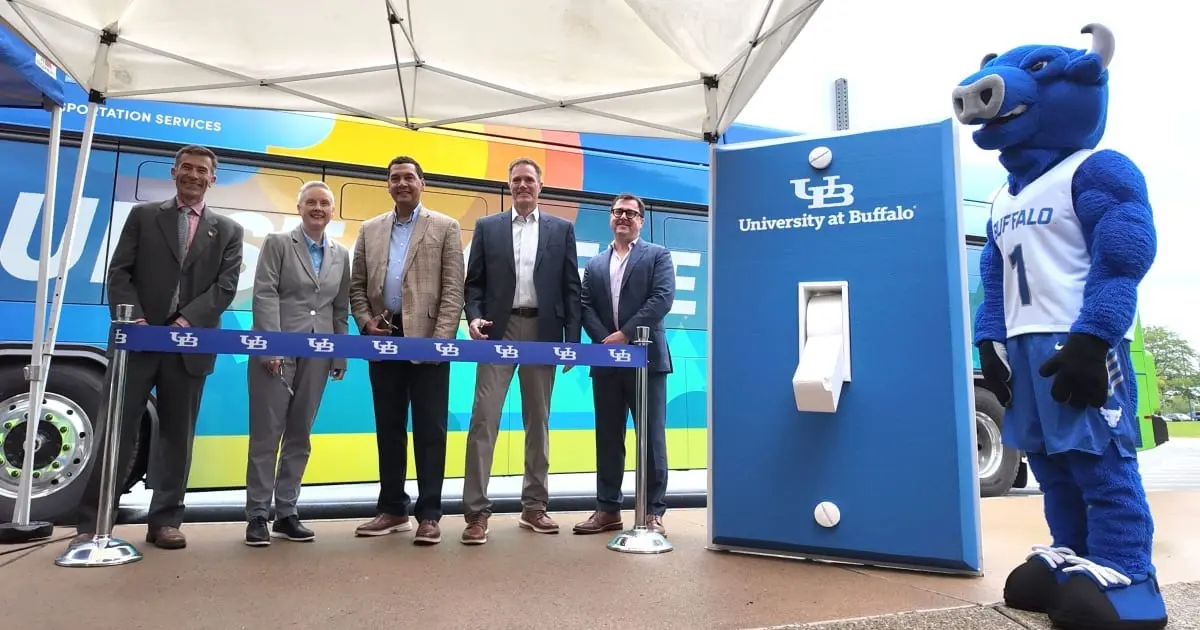
BUFFALO, N.Y. — In a milestone that bridges environmental ambition with heavy-duty logistical execution, the University at Buffalo (UB) has officially deployed its first cohort of battery-electric buses. Marking a definitive pivot away from fossil-fuel dependency, the university introduced eight state-of-the-art, 40-foot electric vehicles into its bustling "UB Stampede" campus transportation network.
The rollout—celebrated in the presence of students, university administrators, and local civic leaders—represents much more than a routine fleet upgrade. It is the tangible manifestation of a meticulously planned, multi-year decarbonization strategy. Developed in close coordination with transportation solutions provider WeDriveU and fleet electrification specialist Zenobē, the deployment serves as a masterclass in modern institutional sustainability, proving that rigorous environmental targets can be met without compromising the safety, reliability, or scale of mass transit operations.
Executive Overview
For decades, higher education institutions have grappled with the dual mandate of expanding campus accessibility while shrinking their ecological footprints. At UB, this challenge is magnified by scale: the UB Stampede system is a vital logistical artery, moving approximately 16,000 passengers daily across sprawling academic and residential sectors. Historically, this high-frequency demand was met exclusively by diesel-powered transit buses, contributing a significant share of the university’s localized greenhouse gas emissions.
The arrival of the first eight battery-electric buses marks the inaugural phase of a sweeping transition designed to completely overhaul the Stampede fleet. Under UB’s aggressive "10 in 10" roadmap, the university has committed to achieving a fully zero-emissions campus by the year 2030.
This initial deployment is not merely symbolic. By replacing diesel combustion engines with zero-emission battery technology, the university anticipates eliminating nearly 6,000 metric tons of carbon dioxide equivalent ($textCO_2texte$) emissions. This operational shift translates to a staggering 55.6% reduction in greenhouse gas emissions for the Stampede service alone. To contextualize the environmental dividend, project officials note that the emissions cut is mathematically equivalent to permanently removing approximately 1,395 passenger cars from public roadways.
The success of day-one operations underscores a broader paradigm shift in institutional transit: the era of treating fleet electrification as an experimental pilot program is over. Through synchronized public-private partnerships, UB, WeDriveU, and Zenobē have delivered a complex, highly integrated transit solution on schedule, establishing a blueprint for universities and municipalities nationwide.
Detailed Chronology: From Blueprint to Asphalt
The realization of UB’s electric transit network was neither accidental nor instantaneous. It was the product of a deliberate, multi-stage developmental timeline that prioritized infrastructural readiness over superficial rollouts.
The Foundation: Strategic Selection (June 2024)
The genesis of the current operational model crystallized in June 2024, when UB officially selected WeDriveU to assume managerial control of its campus transportation network. Recognizing that scaling up electrification required specialized operational acumen, UB integrated WeDriveU’s day-to-day transit management expertise with Zenobē’s bleeding-edge fleet electrification and charging infrastructure capabilities.
Rather than treating vehicle procurement and charging infrastructure as siloed silos, the tripartite coalition adopted an integrated planning model from day one. The core objective was clear: build the charging ecosystem around the immutable realities of the Stampede’s daily operating schedules, rather than forcing the university’s transit operations to awkwardly adapt to nascent technology.
Infrastructural Buildout at the Buffalo Depot
Before a single electric bus touched university asphalt, immense engineering and logistical efforts were concentrated off-road. Ten high-capacity chargers were installed at WeDriveU’s Buffalo customer service and maintenance center.
However, Christopher Austin, director of Parking and Transportation Services at UB, emphasized that procuring chargers and plugging them into a wall is a fraction of the challenge. The logistical blueprint demanded a comprehensive audit of:
- Grid Capacity: Evaluating available power at the bus depot to ensure peak-load demands could be safely handled without straining local municipal utilities.
- Charging Topography: Designing automated, predictable charging schedules that seamlessly interlock with driver shift rotations and mandatory maintenance windows.
- Future-Proofing: Constructing an expandable physical footprint capable of supporting escalating numbers of heavy-duty chargers as diesel buses are progressively retired over the next four years.
Real-Time Software Integration
Crucial to the deployment’s day-one reliability was the integration of Zenobē’s proprietary software architecture. The platform introduces advanced digital oversight to the physical fleet, featuring:
- 24/7 Monitoring: Continuous diagnostics tracking battery health, thermal management systems, and individual charger performance.
- Optimized Scheduling: Algorithms that dictate precisely when and how long buses must plug in to maintain state-of-charge thresholds without disrupting route timetables.
- Dynamic Load Management: An automated system that actively balances available yard power against the total energy demands of the parked fleet, preventing grid bottlenecks and lowering operational energy costs.
This digital nervous system grants fleet managers unprecedented visibility, ensuring that every vehicle leaving the yard is charged, conditioned, and ready for high-capacity passenger service.
Supporting Context & Metrics: The Mathematics of Sustainability
The transition of a heavy-duty transit fleet is fundamentally a numbers game. To justify multi-million-dollar capital investments, institutions must balance upfront infrastructure expenditures against long-term ecological returns and lifecycle maintenance savings.
Emissions Reductions Breakdown
The deployment of the initial eight 40-foot electric buses yields quantifiable environmental metrics that directly support UB’s overarching Climate Action Plan:
- Carbon Offset: An estimated 5,984 metric tons of carbon dioxide equivalent ($textCO_2texte$) avoided over the operational lifecycle of the initial rollout phase.
- Relative Reduction: A 55.6% drop in greenhouse gas emissions specifically attributable to the UB Stampede transit network compared to legacy diesel operations.
- Equivalency Scale: The pollution reduction matches the annual carbon output of roughly 1,395 standard passenger vehicles operating on American roads.
Maintaining Operational Integrity
A primary historical anxiety surrounding electric bus adoption has been "range anxiety" and the fear of diminished service reliability during extreme weather events—a particularly acute concern in Western New York, where Buffalo winters bring heavy snowfalls and sub-zero temperatures.
To mitigate these risks, UB’s strategic calculus explicitly rejected the notion of sacrificing service levels for the sake of sustainability. The university’s transit leadership insisted that passenger capacity, schedule frequency, and route coverage remain completely uncompromised.
By implementing Zenobē’s dynamic thermal pre-conditioning and smart-charging protocols, the buses draw power while still connected to depot infrastructure in the early morning hours. This warms both the cabin and the battery pack using grid power rather than draining the high-voltage traction batteries, preserving maximum vehicle range before the doors even open for the first morning commuters.
Official Statements: Perspectives from Leadership
The successful rollout elicited strong commendations from key stakeholders across the academic, municipal, and corporate spheres, highlighting the collaborative synergy required to execute large-scale infrastructural decarbonization.
Christopher Austin, Director of Parking and Transportation Services at UB:
"As part of our Climate Action Plan, this is an important milestone because it moves our sustainability goals from planning into daily operation. Students and staff can now see and experience that transition every day as they move around campus. At the same time, we need to continue providing the safe, reliable transportation our campus community depends on while reducing our environmental impact. These first eight buses show that those goals can go hand in hand."
Austin expanded on the intricacies of system-level planning:
"Electrification isn’t simply a matter of replacing a diesel bus with an electric one. You have to think about the entire operating system around the vehicle: where and when buses charge, how charging fits around daily service, the power available at the yard, and how the infrastructure will support additional electric buses as the fleet grows. We also needed to make sure we were building around the realities of our operation rather than asking the operation to adapt around the technology."
Matt Curwood, Vice President of Business Development for Transit at Zenobē North America:
"Fleet operators and institutions need confidence that their electric buses will be ready to perform every day. Zenobē’s giving that certainty through thoughtful planning, reliable charging infrastructure, and long-term operational support."
Tim Wayland, Chief Commercial Officer at WeDriveU:
"We’re proud to provide the University at Buffalo community with safe, dependable, and innovative transportation solutions and congratulate UB on this incredible achievement. Together with UB, Zenobē, and WeDriveU’s local operations team, we’re showing the impact on campuses and communities by transitioning to zero-emission fleets."
Wayland also took a moment to honor the frontline workers who breathe life into the transit system daily:
"WeDriveU’s bus drivers, maintenance team, and other operations staff do a fantastic job and enjoy getting Stampede riders everywhere they need to go. They have a lot of pride knowing they’re impacting the campus, community, and environment in positive ways."
Future Outlook: The Road to 2030
While the debut of the first eight battery-electric buses is a watershed moment, university leadership views this deployment not as a destination, but as an advanced laboratory for ongoing refinement.
Data-Driven Scaling
Over the coming months, UB will systematically harvest and analyze real-world operational telemetry from the new fleet. Engineers and logistics managers will evaluate:
- Route-Specific Energy Consumption: How different topographical profiles, passenger load factors, and stop-and-go frequencies impact battery depletion rates.
- Seasonal Variance: Performance metrics logged across transitioning weather conditions—crucially tracking how upstate New York’s harsh winter climate influences heating demands and overall vehicle range.
- Depot Charging Patterns: How effectively automated charging windows harmonize with driver shift changes and routine maintenance schedules.
These empirical insights will directly inform the subsequent phases of the fleet transition. Under the "10 in 10" roadmap, UB will steadily phase out remaining diesel buses in synchronized waves over the next four years, scaling up charging infrastructure at the WeDriveU customer service center in parallel.
A Seamless Passenger Experience
Ultimately, university administrators emphasize that while the engineering behind the scenes is revolutionary, the experience for the end-user should feel entirely natural.
As Austin succinctly noted regarding the student and staff commuter base:
"For riders, our goal is for that transition to feel seamless: they’ll see more electric buses entering the Stampede fleet, but the expectation for safe and reliable service doesn’t change."
Through visionary institutional planning, robust technological partnerships, and meticulous operational execution, the University at Buffalo is successfully redefining what clean, modern campus mobility looks like—paving a clear, electrified highway toward a sustainable 2030 and beyond.