









Executive Overview
When modern travelers conjure images of historic ghost towns, their minds typically wander to the sun-baked, wind-scoured ruins of the American West. Ramshackle wooden saloons and abandoned mining shacks silhouette against desert horizons in popular imagination. Yet, along the lush, moss-draped banks of North Carolina’s lower Cape Fear River lies a ghost town of an entirely different character. Here, enveloped by coastal woodlands and maritime humidity, the remnants of a once-thriving colonial port stand in quiet defiance of time.
The Brunswick Town/Fort Anderson State Historic Site offers a rare, multi-layered historical narrative that spans over two and a half centuries. It is a landscape defined by duality: beneath the canopy of ancient oaks and Spanish moss rest the archaeological foundations of a colonial trade hub established in 1726, which was burned to the ground by British forces during the American Revolution. Layered directly over these colonial ashes are the formidable earthen fortifications, trenches, and artillery batteries of Fort Anderson, a strategic Confederate stronghold constructed during the American Civil War to protect the vital port of Wilmington.
Today, this dual-identity site operates as a premier state historic site managed by the North Carolina Department of Natural and Cultural Resources. Providing a seamless blend of archaeology, military history, and serene coastal nature walks, the site serves as an accessible, deeply educational day-trip destination for visitors traveling from Wilmington, North Carolina, or Myrtle Beach, South Carolina. Free to enter and rich in ongoing archaeological discoveries, Brunswick Town/Fort Anderson offers an immersive look at the layers of conflict, commerce, and community that shaped the early American South.

Detailed Chronology: From Colonial Port to Civil War Bastion
To truly understand the eerie beauty of Brunswick Town/Fort Anderson, one must trace its evolution through two distinct, pivotal eras of American history. The site’s geographical advantages—situated on high bluffs overlooking a sweeping bend of the Cape Fear River—made it a coveted location for both 18th-century merchants and 19th-century military strategists.
[1726] Foundation of Brunswick Town
   │
   ├──► [1730s-1750s] Rise as a naval stores export hub & de facto colonial capital
   │
   ├──► [1776] Burned down by British troops during the Revolutionary War
   │
   ├──► [1861] Confederate forces erect Fort Anderson on the colonial ruins
   │
   └──► [1865] Union capture of Fort Anderson; site falls into long-term abandonment
The Rise and Fall of Brunswick Town (1726–1776)
Brunswick Town was founded in 1726 by Maurice Moore, an enterprising colonist who envisioned a thriving commercial port on the lower Cape Fear River. Situated strategically to capture the trade of the developing hinterlands, the town quickly grew into a bustling economic engine. By the mid-18th century, Brunswick had established itself as a premier center for the export of naval stores—crucial maritime products such as tar, pitch, turpentine, and lumber harvested from the vast pine forests of the North Carolina coastal plain.
Beyond its economic prowess, Brunswick assumed significant political gravity. It served as the de facto seat of North Carolina’s colonial government during the eras when royal governors chose to reside at Russellborough, the grand mansion built within the town limits. Governors such as Arthur Dobbs and William Tryon utilized the town as their administrative base, making Brunswick the epicenter of royal authority in the colony.
However, the town’s prominence was short-lived. As the rival port city of Wilmington grew rapidly upstream, drawing away commerce and residents, Brunswick began a slow economic decline. The final death knell sounded during the American Revolutionary War. In 1776, British troops under the command of royal loyalists and naval forces targeted the vulnerable port, setting fire to its structures. The town was systematically burned to the ground, leaving behind crumbling brick chimneys, scorched earth, and structural foundations that would soon be swallowed by the encroaching maritime forest.

The Civil War Chapter: Fort Anderson (1861–1865)
Nearly a century after its fiery destruction, the abandoned site found a new, urgent purpose as the American Civil War tore the nation apart. In 1861, recognizing the defensive advantages offered by the high river bluffs and the winding approach of the Cape Fear River, the Confederate Army selected the ruins of Brunswick Town as the foundation for a major defensive installation: Fort Anderson.
Designed to protect Wilmington—the Confederacy’s last major open port supplying General Robert E. Lee’s beleaguered army—Fort Anderson was an engineering feat of its era. Confederate soldiers and enslaved laborers constructed massive sand earthworks, defensive moats, and artillery batteries directly over the buried archaeological remains of the colonial town. For years, the fort successfully guarded the river approaches, facilitating blockade running that kept vital supplies flowing into the South.
The strategic importance of Fort Anderson culminated in February 1865 during the Wilmington Campaign. Facing overwhelming Union naval bombardment and a coordinated land assault by Federal troops under the command of General Jacob D. Cox, the Confederate garrison was forced to evacuate the fort on February 19, 1865. Union forces quickly occupied the stronghold, using it as a staging ground for the final push toward Wilmington. Following the conclusion of the war, the fortifications were abandoned, allowing nature to reclaim the battle-scarred landscape once more.
Supporting Context & Metrics: Archaeology, Nature, and Accessibility
The Brunswick Town/Fort Anderson State Historic Site spans hundreds of acres of protected land, functioning simultaneously as a public park, an active archaeological laboratory, and a thriving wildlife sanctuary.
Archaeological Significance and Ongoing Research
What sets Brunswick Town/Fort Anderson apart from many other historical parks is the preservation and accessibility of its archaeological layers. Because the colonial town was never heavily rebuilt upon after 1776, and because the Civil War earthworks largely preserved the soil layers beneath them, the site is an extraordinary time capsule for historical archaeologists.
- Excavation Continuity: Active digs and field schools are frequently conducted on the grounds, often in partnership with regional universities. Visitors regularly witness students and professional archaeologists unearthing artifacts ranging from colonial-era ceramics and glassware to Civil War munitions and uniform buttons.
- The Visitor Center Repository: The park’s modern visitor center houses an extensive collection of recovered artifacts. Key highlights include items used by colonial merchants, domestic goods from Russellborough, and military relics from Fort Anderson, including the authentic Confederate battle flag that once flew over the ramparts.
Architectural Landmarks on Site
Visitors following the self-guided trail network encounter several prominent, haunting structural remnants:
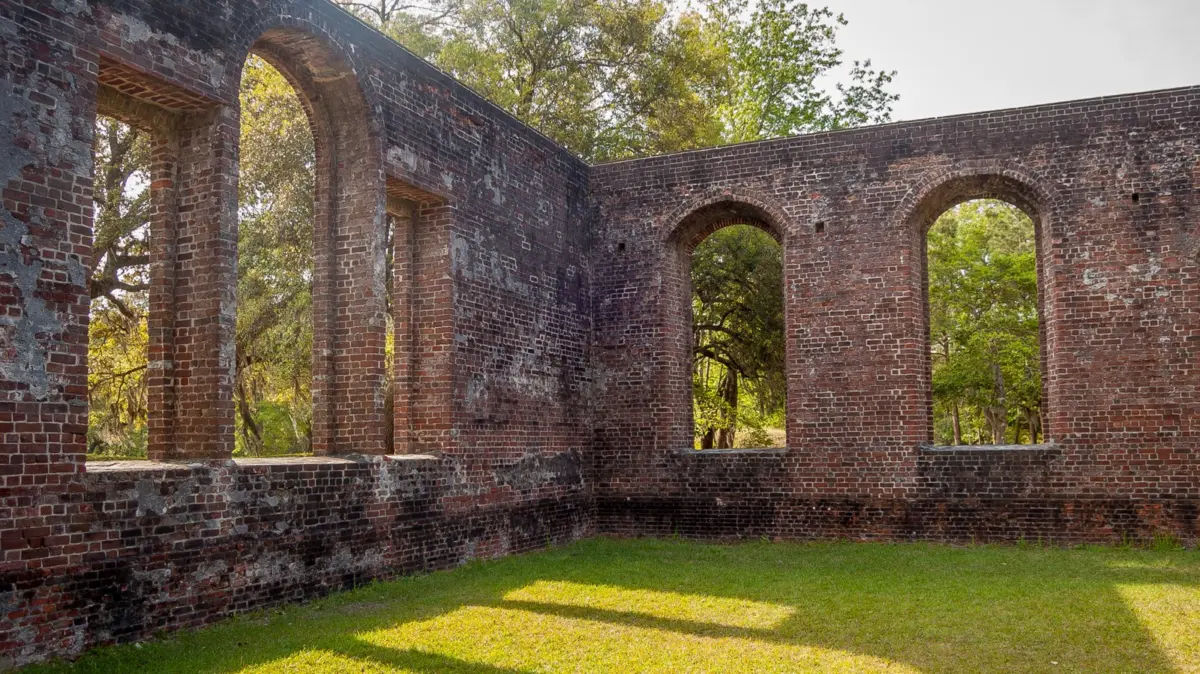
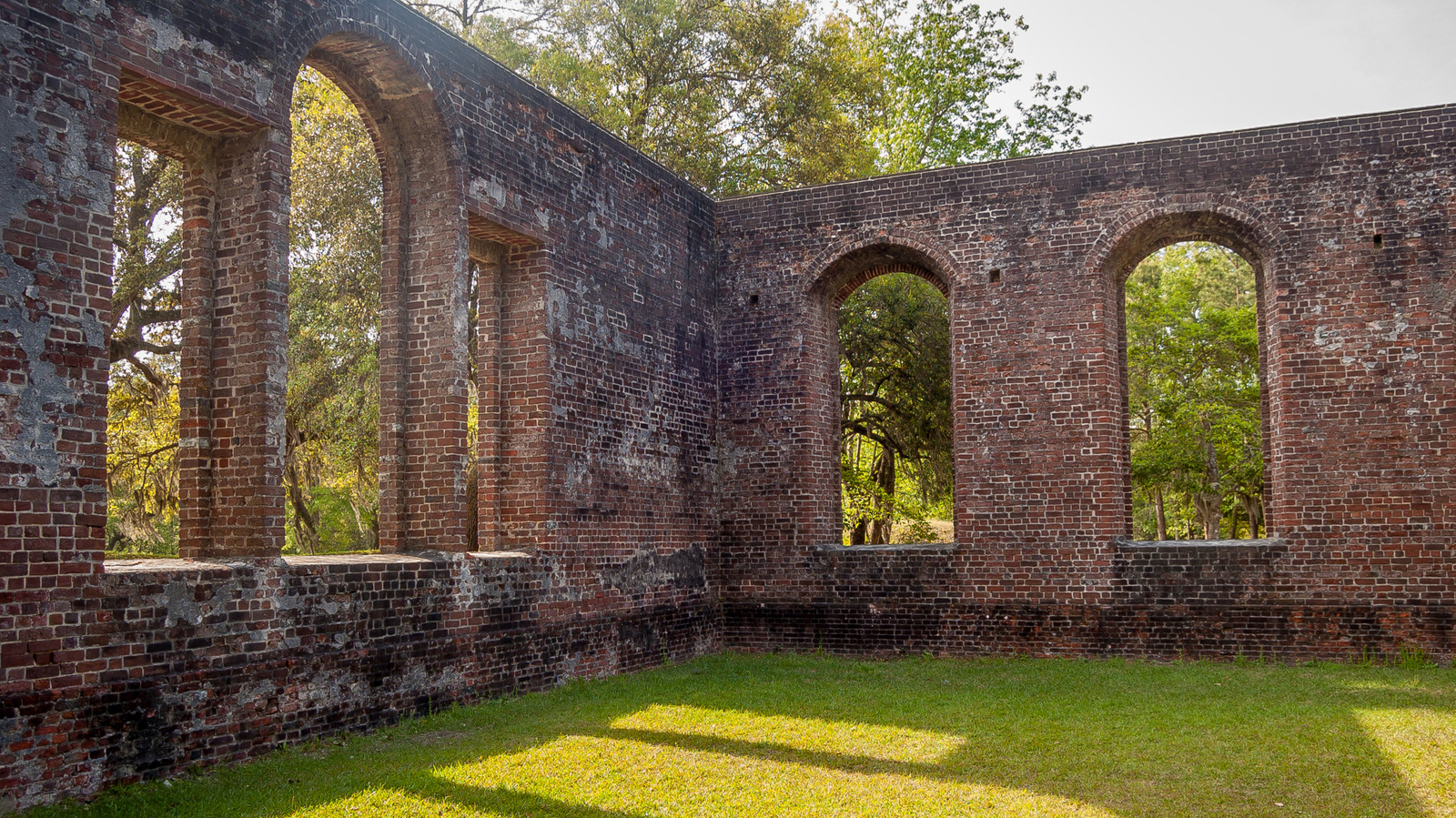
- St. Philip’s Church: The most iconic landmark of the site. Built in the mid-18th century as an ambitious parish church for Brunswick, its roofless red-brick walls still rise dramatically toward the sky. Arched window openings frame views of the surrounding moss-draped trees, creating an atmosphere that is equal parts melancholic and picturesque.
- Russellborough Foundations: The subterranean brick and stone foundations of the royal governor’s residence offer a tangible sense of the scale of colonial administration on the Cape Fear.
- The Confederate Earthworks: Well-preserved parallel lines of sandy ramparts and battery emplacements snake through the woods, bearing silent witness to 1860s military engineering.
Flora, Fauna, and Ecological Metrics
The site’s location along the tidal Cape Fear River provides a rich estuarine and maritime forest habitat, making it a premier destination for naturalists and birdwatchers.
- Avian Biodiversity: According to the North Carolina Department of Natural and Cultural Resources, the park is a vital migratory and breeding sanctuary. From April through October, the dazzling, jewel-toned painted bunting is frequently spotted flashing vibrant reds, blues, and yellows through the woodland canopy.
- Proximity to Regional Eco-Parks: The site complements other nearby natural escapes. It sits just a 30-minute drive from Wilmington and forms part of a broader coastal tourism corridor that includes Carolina Beach State Park, known for its carnivorous Venus flytraps, extensive hiking trails, and boating facilities along the Cape Fear estuary.
| Metric / Feature | Details |
|---|---|
| Location | Lower Cape Fear River, Brunswick County, North Carolina |
| Admission Fee | Free (nominal fees apply for guided group tours) |
| Key Historical Eras | Colonial Era (1726–1776); American Civil War (1861–1865) |
| Distance from Wilmington | ~30 minutes by car |
| Distance from Myrtle Beach | ~1.5 hours by car |
| Primary Architectural Ruin | St. Philip’s Church (roofless brick walls dating to c. 1768) |
Official Statements and Expert Perspectives
The preservation and interpretation of the Brunswick Town/Fort Anderson site represent a delicate balance between active historical research and public accessibility. State officials and site historians emphasize the unique pedagogical value of a location where two distinct centuries of American heritage collide.
In educational briefings published by the North Carolina Department of Natural and Cultural Resources, site curators frequently highlight the continuous learning environment fostered by the grounds:
"Sites like Brunswick Town/Fort Anderson remind us that history is never truly finished or completely buried. Every shovel of earth turned by our archaeological teams reveals new dimensions of how early Carolinans lived, traded, and struggled, while the earthworks of Fort Anderson stand as a monument to the immense human drama of the Civil War."
Archaeological field supervisors working at the site echo this sentiment, noting that the dual-layer nature of the park provides an unmatched living classroom:
"When visitors walk our trails, they aren’t just looking at static monuments behind glass. They are walking across an active archaeological archive. It is rare to find a location where the footprint of colonial commerce and the footprint of 19th-century total warfare are preserved side-by-side in such pristine, natural seclusion."
Future Outlook: Preservation, Tourism, and Education
As heritage tourism continues to evolve in the Carolinas, the Brunswick Town/Fort Anderson State Historic Site is poised for continued growth as a regional cultural anchor. Future initiatives by the North Carolina Department of Natural and Cultural Resources focus on expanding digital interpretive tools, enhancing trail accessibility, and securing long-term funding for ongoing archaeological conservation.
Sustainable Tourism and Community Integration
With its proximity to rapidly growing metropolitan and coastal hubs like Wilmington, Leland, and Myrtle Beach, the historic site faces the dual challenge of accommodating rising visitor numbers while safeguarding fragile archaeological deposits. Park management utilizes a self-guided trail map system alongside educational signage to minimize foot traffic impact on sensitive earthworks and ruin foundations.
Furthermore, partnerships with local historical societies and educational institutions ensure that student field schools will remain a fixture of the park’s summer operations. These programs not only advance academic research into colonial trade networks and Civil War fortifications but also provide visitors with a rare, transparent view of the scientific methodology behind historical preservation.
A Timeless Coastal Legacy
Whether approached as a peaceful nature retreat, a pilgrimage for Civil War enthusiasts, or an exploratory journey into the lost colonial foundations of North Carolina, Brunswick Town/Fort Anderson delivers an unforgettable experience. As the Spanish moss sways in the coastal breeze above the ruined brick arches of St. Philip’s Church, the site stands as an enduring testament to the resilience of the land—a place where the echoes of empire, revolution, and civil conflict are forever interwoven with the quiet beauty of the Cape Fear wilderness.