








Executive Overview
The global transition toward a renewable-dominated grid relies on an essential predicate: the ability to store electricity efficiently over multi-hour intervals. While lithium-ion battery energy storage systems (BESS) have rapidly matured into standard, highly modular commodities, alternative long-duration and alternative-medium storage concepts continue to vie for market share. Among these, solid-mass gravity storage—championed by firms like Energy Vault—has long fascinated both investors and engineers with its apparent simplicity.
However, a rigorous performance and economic teardown of Energy Vault’s flagship Rudong project in China reveals a sobering reality. When subjected to the same baseline operational requirements as a contemporary BESS—specifically, a 25 MW / 100 MWh four-hour service window—the Rudong gravity-storage facility requires vastly superior capital expenditure, sprawling land footprints, intensive heavy machinery, and a massive initial construction carbon footprint.
Rather than serving as a proof-of-concept for an impending revolution in mechanical storage, Rudong has instead answered a fundamental engineering question: while block-based gravity storage can unquestionably be engineered at utility scale, its whole-system economics, machinery wear-and-tear, and embodied carbon debts struggle to justify themselves against the relentless efficiency and declining costs of chemical batteries.
Detailed Chronology: From Concept to the Rudong Reality
The Evolution of Energy Vault’s Mechanical Architecture
Energy Vault’s corporate history mirrors the volatile trajectory of the broader clean-technology sector over the past decade. The company initially gained market attention with a novel, albeit mechanically exposed, concept: a six-arm crane system designed to stack massive composite blocks in an open-air array. Recognizing the logistical vulnerabilities, weathering challenges, and visual impact of the crane-and-block architecture, the firm pivoted toward a more enclosed, industrial design known as the EVx architecture.
During the height of the cleantech SPAC (Special Purpose Acquisition Company) boom, Energy Vault went public, generating significant capital reserves. Yet, even as it pursued public markets, the company began integrating conventional lithium-ion battery projects into its commercial pipeline. Today, Energy Vault operates primarily as an over-capitalized, executive-compensation-heavy battery storage integrator, with its proprietary gravity-storage technology accounting for only a minor fraction of its broader commercial portfolio.
The Construction and Testing Ground of Rudong
To evaluate whether solid-mass gravity storage could compete on an industrial scale, the Rudong project in China served as an ideal testing ground. Crucially, the project removed many of the external excuses frequently levied against first-of-a-kind (FOAK) energy ventures.
Built inside China—a nation boasting deep, mature domestic supply chains for concrete, steel, industrial motors, and power electronics—Rudong benefited from an ideal operational environment. The project enjoyed robust government support, sophisticated grid coordination, and the execution capabilities of an experienced local construction partner. If stacking and lowering solid masses inside a purpose-built structural tower could ever achieve commercial competitiveness with chemical batteries, Rudong was built in about as favorable an environment as the global market could provide.


According to initial project timelines, full grid interconnection was anticipated by the end of 2023. However, public project pages have continued to classify aspects of the system as commissioning well beyond initial targets, underscoring the subtle complexities inherent in managing massive mechanical infrastructures.
Supporting Context & Metrics: Gravity Versus Electrochemical Storage
The Physical Footprint: Machine Scale Versus Storage Output
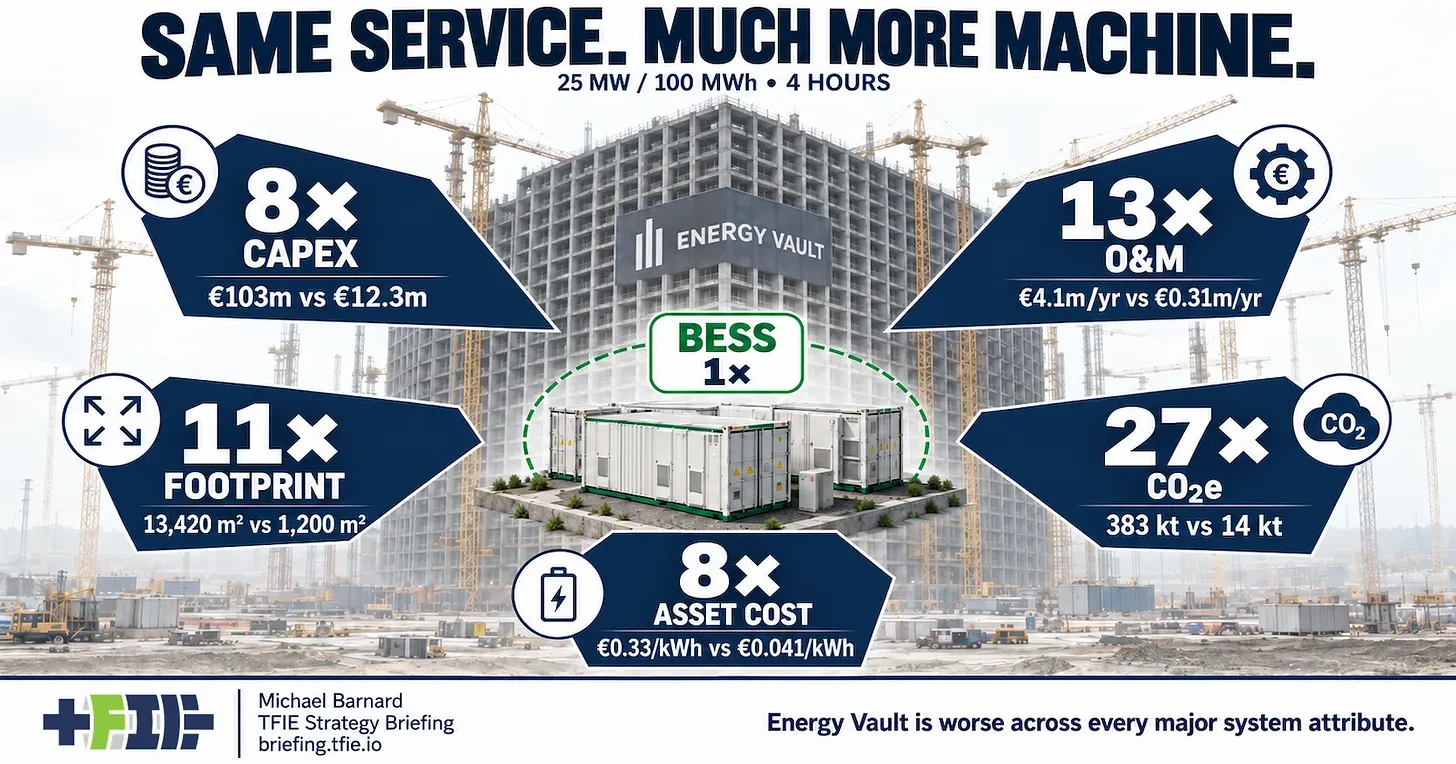
The most striking takeaway from the Rudong facility is the disproportionate scale of the engineering required to achieve a relatively standard block of electricity storage. Rated at 25 MW with a 100 MWh capacity—delivering four hours of continuous full-output discharge—the facility is an extraordinary feat of heavy machinery.
The Rudong structure towers approximately 148 meters high. It houses more than 12,000 individually cast blocks (each nominally weighing 25 tons), 96 synchronized mechanical lifts, and thousands of deep bored piles driven into the earth to stabilize the immense structural load.
To contextualize this physical footprint, consider a contemporary BESS utilizing standardized modular blocks, such as Sungrow’s PowerTitan 2.0. A comparable 100 MWh installation built around this technology packs 5 MWh of battery capacity and 2.5 MW of power conversion into self-contained 20-foot AC blocks. A complete 100 MWh station utilizing this electrochemical architecture requires a footprint of only about 1,200 square meters.
By contrast, the tower footprint of the Rudong gravity installation alone consumes roughly eleven times that total land area.
Capital Expenditure and Embodied Carbon
Detailed strategic analyses, such as those produced by TFIE Strategy Briefings, highlight the stark economic and environmental divergence between the two approaches:
- Capital Expenditure (CapEx): The core capital expenditure required to construct the Rudong gravity structure is estimated at roughly eight times that of an equivalent contemporary Chinese BESS delivering the identical four-hour service profile.
- Operating and Maintenance (O&M) Costs: Mechanical systems featuring tens of thousands of moving parts, heavy-duty transmissions, brakes, and computer-controlled lifts inherently demand higher ongoing maintenance expenditures than solid-state electrochemical modules.
- Embodied Carbon Debt: While Energy Vault correctly notes that the individual blocks can be cast from low-value mineral wastes and construction spoils (though still requiring protective coatings and steel reinforcement), the storage medium is not the storage system. Constructing the artificial mountain requires massive inputs of reinforced concrete and structural steel. Consequently, the civil engineering carbon debt per kilowatt-hour (kWh) rivals the life-cycle emissions profile of natural gas generation facilities during their initial construction phases.
Official Statements & Industry Perspectives
Proponents of mechanical storage point to undeniable component-level advantages. Unlike lithium-ion chemistries, the inert mineral blocks utilized in gravity systems do not experience electrochemical degradation, are entirely immune to thermal runaway events, and possess a physical lifespan that can theoretically stretch across many decades without experiencing capacity fade.

However, industry analysts and engineering critics emphasize that longevity at the material level does not automatically translate to system-level superiority. As energy market experts frequently observe, the fundamental premise of "raising blocks when electricity is cheap and lowering them when it is needed" sounds deceptively simple on paper. In practice, that simplicity evaporates the moment an operator attempts to orchestrate the precise, continuous movement of thousands of 25-ton objects over decades of intensive duty cycles.
Energy Vault’s own corporate transition speaks volumes regarding the economic viability of pure mechanical storage. The company’s contemporary project registry has evolved to include conventional battery systems and, in some cases, complex microgrid configurations, illustrating a pragmatic acknowledgment that the market demands the lowest cost-per-kWh storage medium available, regardless of whether it is mechanical or chemical.
Future Outlook: The Road Ahead for Long-Duration Grid Storage
The rise of standardized, utility-scale battery systems has fundamentally shifted the baseline against which all alternative storage technologies must be measured. In markets like China, four-hour battery storage has transitioned from an exotic, high-cost frontier into routine, highly commoditized infrastructure procured through transparent, highly competitive markets.
For utilities, independent power producers, and institutional investors, the primary question centers on risk-adjusted returns and system complexity. Why accept the substantial civil engineering risks, elevated capital costs, massive land requirements, and high operational maintenance liabilities of a mechanical gravity tower when compact, manufactured battery modules can deliver identical four-hour grid services with proven modular scalability?
Ultimately, while the Rudong project successfully proves that gravity-storage architecture can be engineered and constructed at utility scale, it simultaneously underscores the economic and physical limits of mechanical energy storage in a world dominated by rapidly advancing electrochemical alternatives. Unless future iterations can dramatically reduce structural footprints and capital intensity, artificial mountains are destined to remain expensive monuments to engineering ambition rather than the backbone of the global clean energy transition.