









Executive Overview
For years, energy analysts, climate advocates, and pragmatic engineers have watched with growing disbelief as hydrogen proposals for impossible applications—ranging from residential heating and passenger cars to routine urban transit—continued to flood boardrooms and government policy desks. To many outsiders, the phenomenon looked like collective madness. Why would major corporations and sovereign states pour billions of dollars into an energy carrier plagued by glaring thermodynamic disadvantages, soaring capital expenditures, and complex supply chain hurdles, when direct electrification via renewables and batteries offered a far cheaper, more efficient alternative?
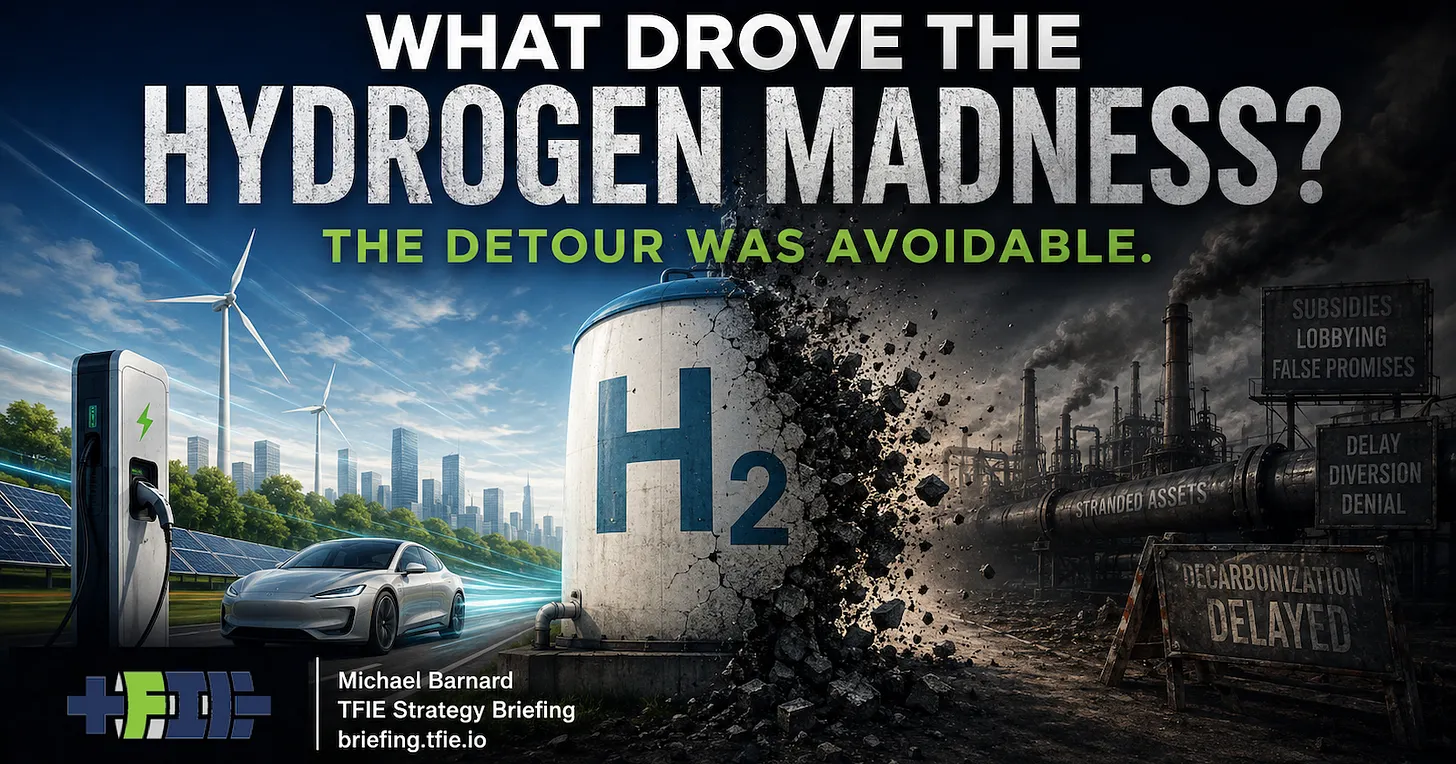
In hindsight, characterizing the global hydrogen push as mere technical ignorance or mass delusion misses the mark entirely. The survival of the hydrogen economy, long after its economic and thermodynamic justifications had frayed, was never really about physics. It was about preservation.
Incumbent industrial players, legacy automakers, gas utilities, and institutional policymakers discovered that championing hydrogen provided a politically viable mechanism to protect existing assets, retain specialized workforces, and delay disruptive transitions. What looked like irrational energy policy from the outside was, in reality, a masterclass in rational organizational self-interest. By examining the structural incentives, institutional momentum, and the glaring absence of "stopping rules" in policy design, we can finally understand how the great hydrogen detour persisted—and where the molecule genuinely belongs in a decarbonized future.

Detailed Chronology: From Thermodynamic Warning to Institutional Lock-In
The Early Warnings: Physics Versus Ambition
The fundamental thermodynamic constraints of hydrogen have never been a secret. As early as 2003, rigorous academic critiques of the emerging "hydrogen economy" mapped out the punishing efficiency losses inherent in the molecule lifecycle. To produce, compress, transport, store, and ultimately reconvert hydrogen back into usable energy requires a staggering amount of electricity. Compared to the direct use of electrons in battery-electric vehicles or heat pumps, hydrogen is intrinsically far more energy-intensive.
Yet, as renewable energy costs plummeted over the next two decades, proponents argued that cheap "green" hydrogen—generated via water electrolysis powered by wind and solar—would overcome these thermodynamic hurdles. The technical reality, however, stubbornly refused to align with the hype.
The Economic Seesaw and Escalating Costs
By the early 2020s, the economic contradictions of green hydrogen became mathematically inescapable. Electrolysis plants demand ultra-cheap electricity to remain competitive, yet complex industrial electrolyzer facilities also require high utilization rates to amortize their steep capital costs. Unfortunately, the cheapest hours of wind and solar generation are inherently intermittent.
If a facility operates only when renewable power is dirt-cheap and abundant, the plant sits idle for much of the year, driving up the annualized cost of production. Conversely, if operators attempt to run the plant continuously by overbuilding renewable capacity, incorporating massive grid storage, or purchasing electricity during peak pricing hours, the cost of the resulting hydrogen skyrockets.

Furthermore, public discourse often conflated the cost of the electrolyzer stack with the total capital expenditure of the complete facility. A functioning green hydrogen plant requires an extensive array of balance-of-plant infrastructure: transformers, rectifiers, water treatment systems, cooling towers, gas purification units, high-pressure compressors, specialized piping, complex safety controls, and significant local grid upgrades. By 2025, real-world project tracking revealed that actual capital expenditures were dramatically outrunning major institutional forecasts, with observed costs surging anywhere from 60% to over 300% above initial projections.
The Missing Stopping Rules
Despite these widening economic chasms, the political and corporate momentum behind hydrogen accelerated. This persistence highlights a critical failure in modern policy design: the complete absence of "stopping rules."
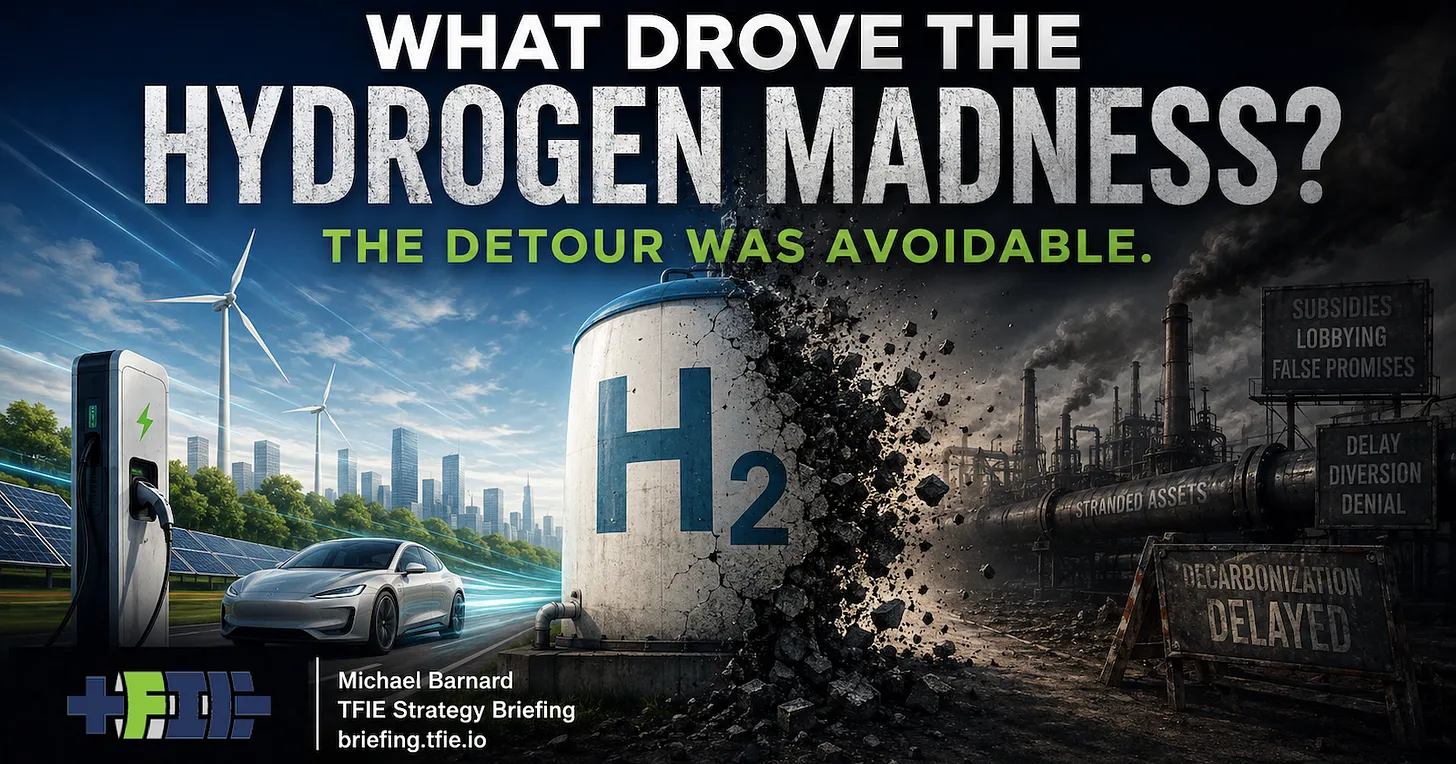
In rational project management, a stopping rule is a predefined threshold or evaluation metric that triggers the termination of an initiative if core assumptions fail. In the hydrogen saga, these rules vanished. When green hydrogen proved too expensive to produce, governments stepped in with production subsidies. When end-users balked at high prices, policymakers introduced demand-side mandates. When refueling stations sat empty due to a lack of fuel-cell vehicles, more subsidies were funneled into building additional stations.
Even empty pipelines without committed throughput were defended as essential foundational infrastructure needed to stimulate the very production and demand that would eventually justify them. Each intervention was evaluated in isolation, allowing the foundational question—should hydrogen be serving this application at all?—to quietly disappear from the agenda.
Supporting Context & Metrics: Protecting the Incumbent Empire
To understand why institutions clung so tightly to hydrogen, one must examine the existential threat posed by direct electrification to legacy industries.
The Gas Sector’s Strategic Dilemma
For multinational oil and gas corporations, local gas distribution utilities, and pipeline operators, a rapid global shift toward direct electrification represents an existential crisis. If heating, transportation, and industrial processes run directly on electricity, the long-term strategic value of natural gas reserves, extensive transmission pipelines, processing plants, and subsurface storage caverns plummets toward zero.
Hydrogen emerged as a lifeline. By rebranding natural gas as "blue hydrogen" (produced via steam methane reforming paired with carbon capture and storage) or envisioning future grids running on "green hydrogen," gas companies found a way to keep their core assets relevant. Pipelines could remain molecule pipelines, carbon capture technologies gained a vital new market justification, and legacy subsurface engineering competencies retained their value well into the 2030s and 2040s. The executives steering these strategies were far from ignorant of hydrogen’s poor economics; indeed, some of the most sophisticated thermodynamic modeling sat quietly inside their own corporate research departments.
The Legacy Automotive Trap
A parallel dynamic unfolded within the legacy automotive sector. The transition to battery-electric vehicles (BEVs) fundamentally rewrites the rules of competitive advantage. It shifts industrial supremacy away from complex internal combustion engines, fuel injection systems, multi-speed transmissions, exhaust emissions controls, and traditional engine-block manufacturing, redirecting value toward battery chemistry, electric motors, power electronics, advanced software architecture, and high-voltage thermal management.
For automakers deeply invested in global supply chains centered around the internal combustion engine, embracing hydrogen combustion or hydrogen fuel-cell passenger vehicles offered a much more comfortable bridge. These technologies allowed massive swaths of the existing industrial manufacturing ecosystem—and the specialized supplier networks tied to them—to remain active. While protecting industrial regions, suppliers, and manufacturing workforces is a legitimate macroeconomic and social policy concern, utilizing inefficient propulsion technologies merely to delay an unavoidable industrial transformation carries a devastating opportunity cost.
Official Statements and Institutional Audits
As billions of public dollars flowed into national and regional hydrogen strategies, independent oversight bodies began to scrutinize the empirical foundations of these policies.
One of the most damning assessments came from the European Court of Auditors (ECA). In its comprehensive review of European Union hydrogen policy, the ECA concluded that the bloc’s ambitious production and consumption targets had been established without sufficiently robust analytical backing. The auditors found that multi-billion-euro funding commitments, sweeping industrial mandates, and regional manufacturing roadmaps were frequently formulated in a vacuum, driven more by political urgency and industrial lobbying than by rigorous cost-benefit analyses.

Despite such high-level warnings from institutional watchdogs, the policy train had already left the station. Once government subsidies, municipal fleets, regional tax credits, and international trade agreements incorporated these unvetted targets, an entire industrial ecosystem organized around them. Careers, academic research grants, corporate divisions, and political platforms became inextricably linked to the hydrogen narrative, making a strategic retreat politically perilous for leaders who had staked their reputations on the transition.
Future Outlook: Right-Sizing the Molecule Economy
Where does the hydrogen sector stand today, and what does its future look like now that the dust of the initial hype cycle has settled?
The most significant evolution in modern energy analysis is the recognition that hydrogen is not a universal, drop-in replacement for electrons. It is an industrial chemical feedstock, not a general-purpose fuel for heating homes, powering passenger cars, or providing seasonal grid storage.
Where Hydrogen Actually Belongs
Hydrogen retains a critical, irreplaceable role in decarbonizing sectors where the molecule itself—rather than the energy it carries—is chemically required:
- Ammonia Production: Synthesizing green ammonia for zero-carbon fertilizers is vital for global food security.
- Methanol and Chemical Synthesis: Existing industrial chemical pathways must replace fossil-derived hydrogen with clean alternatives.
- Green Steel (Direct Reduction): Using low-carbon hydrogen as a reducing agent to strip oxygen from iron ore represents a promising pathway for decarbonizing heavy industry.
In these specific applications, the chemical properties of hydrogen justify paying the unavoidable economic and thermodynamic premium associated with low-carbon production.
Lessons for the Clean Energy Transition
The great hydrogen detour serves as a sobering case study for the entire clean tech movement. It demonstrates how institutional self-interest, legacy asset protection, and uncritical policy targets can distort capital allocation on a massive scale.
As the world presses forward with the energy transition, policymakers and investors must remain vigilant. Technologies must be evaluated not by how effectively they preserve yesterday’s industrial empires, but by how efficiently they deliver clean, affordable, and reliable energy for tomorrow. By separating genuine industrial necessities from corporate life-support systems, the global economy can finally move past the hydrogen madness and focus on the unglamorous, highly effective work of direct electrification.