






Executive Overview
The intersection of marine conservation, recreational boating, and federal regulation has reached a critical juncture. For nearly two decades, the North Atlantic right whale vessel-speed rule—enacted originally in 2008 by the National Oceanic and Atmospheric Administration (NOAA)—has served as a primary bulwark against vessel strikes, which remain one of the leading causes of injury and mortality for one of the world’s most critically endangered marine mammals. However, these longstanding regulations, which mandate blanket 10-knot speed restrictions for vessels 65 feet and longer within designated Seasonal Management Areas (SMAs) along the United States Eastern Seaboard, are increasingly viewed by the maritime industry as blunt instruments ill-suited to the realities of modern marine engineering and navigational electronics.
In response to these challenges, New Jersey-based luxury sportfish builder Viking Yacht Company has spearheaded a high-stakes campaign urging NOAA to accelerate its efforts to modernize the federal framework. Bolstered by a recent executive order signed on September 17, which directs the Department of Commerce and NOAA to harness cutting-edge technological advancements in marine mammal avoidance, Viking is advocating for a shift away from static, blanket restrictions. Instead, the builder argues for a dynamic, technology-driven approach that integrates real-time detection, artificial intelligence, and advanced data-sharing systems.
This comprehensive report examines the mounting pressure on federal regulators, the genesis and evolution of Viking’s Whale and Vessel Safety (WAVS) Taskforce, the technological innovations poised to transform whale protection, and the broader economic and ecological implications of transitioning from mandatory speed caps to targeted, tech-enabled mitigation strategies.
Detailed Chronology: From 2008 Regulations to Modern Executive Action
To understand the current debate surrounding North Atlantic right whale protections, it is essential to trace the regulatory timeline that shaped contemporary marine policy along the U.S. East Coast.
The 2008 Baseline
In October 2008, NOAA enacted a landmark final rule designed to reduce the likelihood of deaths and serious injuries to North Atlantic right whales resulting from collisions with vessels. The core of this regulation required all vessels measuring 65 feet (19.8 meters) and greater in overall length to operate at speeds of 10 knots or less in specific seasonal areas along the Atlantic seaboard. While conservationists lauded the rule as a vital safety net for a population hovering perilously close to extinction—with current estimates placing the remaining population at fewer than 370 individuals—the maritime, commercial fishing, and recreational boating sectors expressed immediate concern over the economic and operational impacts of rigid speed limits.
The Evolution of the Stalemate
For more than a decade, the 10-knot rule remained largely static, even as vessel design, propulsion technology, and marine electronics advanced by leaps and bounds. Sportfishing vessels, tugs, commercial ferries, and mega-yachts were subjected to the same generalized restrictions, regardless of real-time whale visibility, weather conditions, or empirical data regarding whale migration paths. Industry stakeholders argued that blanket speed limits penalized responsible operators and failed to leverage the sophisticated detection capabilities that were rapidly proliferating across the marine electronics market.
The 2022 Fort Lauderdale Watershed Moment
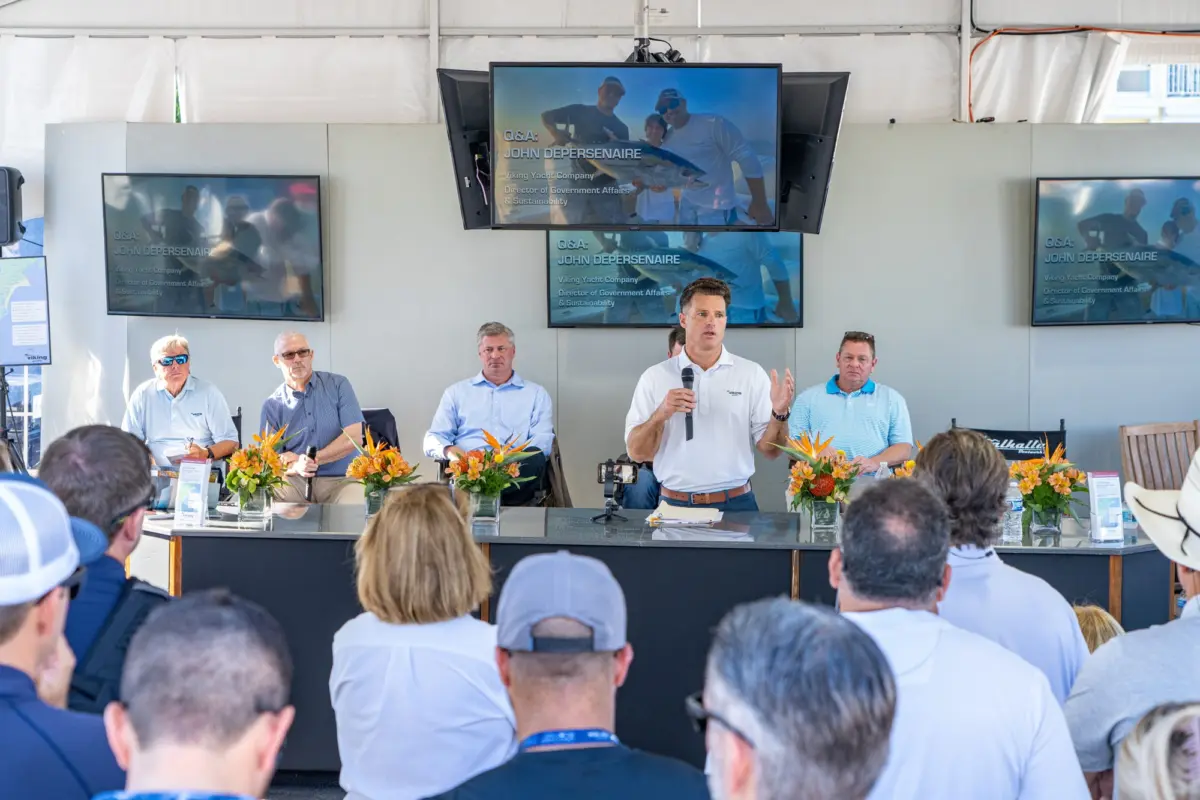
Recognizing that the debate had reached an impasse, Viking Yacht Company stepped into the vacuum during the 2022 Fort Lauderdale International Boat Show. At a widely attended press conference, Viking officially launched its comprehensive effort to address the vessel-speed issue through technological innovation. Spearheaded by John DePersenaire, Viking’s Director of Government Affairs and Sustainability, the company announced the formation of the Whale and Vessel Safety (WAVS) Taskforce. This initiative signaled a decisive pivot from passive compliance to active, industry-led problem-solving.
The March 2025 Advance Notice of Proposed Rulemaking (ANPR)
Momentum shifted on the regulatory front in March, when NOAA formally opened an Advance Notice of Proposed Rulemaking. The agency invited public comment, scientific data, and industry input regarding potential modifications to the existing right whale speed regulations. Crucially, NOAA signaled a willingness to explore alternatives to static seasonal restrictions, opening the door for technology-based strike-avoidance measures and dynamic management areas that could adjust in real time based on confirmed marine mammal sightings.
The September 17 Executive Order and Immediate Follow-Up
The regulatory landscape shifted dramatically on September 17, when a decisive executive order was signed directing the Department of Commerce and NOAA to actively integrate private-sector technological advancements into marine mammal avoidance protocols. Seizing on this executive mandate, Viking Yacht Company moved with swift administrative precision. On September 18—just 24 hours after the executive order was issued—Viking dispatched a formal letter to NOAA Administrator Neil Jacobs. The letter urged the agency to prioritize the ongoing rulemaking process and forge direct partnerships with the private companies currently developing and testing whale-detection systems.
Supporting Context & Metrics: The WAVS Taskforce and Technological Innovation
At the heart of Viking’s advocacy is not mere administrative critique, but empirical data gathered through rigorous, hands-on testing. The Whale and Vessel Safety Taskforce represents a unique collaboration between a premier boatbuilder, marine electronics manufacturers, tech developers, and conservation scientists.
The WAVS Testing Platform
The task force utilizes a specialized 24-foot Contender research vessel serving as a mobile laboratory on the water. This platform has been outfitted with a suite of advanced sensors designed to push the boundaries of marine mammal detection:
- High-Resolution Thermal Imaging: Infrared cameras capable of detecting subtle thermal differentials created by a whale’s blow or surface breach, even in low-visibility conditions or nighttime operations.
- Advanced Marine Radar: Customized radar algorithms tuned to identify anomalous surface returns and biological signatures distinct from wave clutter, channel markers, or other vessels.
- Artificial Intelligence (AI) Classification Software: Machine learning models trained on vast libraries of marine mammal imagery and acoustic data to automatically differentiate between right whales, other cetaceans, sea turtles, and debris with minimal false-positive rates.
- Real-Time Data Sharing Networks: Communications hardware designed to instantly relay detection coordinates to nearby vessels, effectively creating an automated, peer-to-peer warning grid.
Bridging Conservation and Modern Boating
The core premise of the WAVS Taskforce is that modern recreational and commercial vessels are vastly different from those operating in 2008. Today’s high-end sportfishing yachts and cruising vessels are equipped with integrated glass-bridge electronics, sophisticated autopilots, and high-speed processing power capable of running complex AI diagnostics in real time.
By proving that automated detection systems can spot marine mammals faster and more reliably than human lookouts relying solely on visual sweeps, the task force aims to provide NOAA with a scientifically validated alternative to blanket speed caps. Under a technology-integrated framework, boaters would be permitted to maintain safe, efficient operational speeds in areas where real-time monitoring confirms no whales are present, while automatically throttling down or receiving automated hazard warnings when approaching active marine mammal corridors.
Official Statements and Industry Perspectives
The campaign to modernize the right whale rules has elicited strong statements from industry leaders who argue that conservation and maritime commerce can—and must—coexist through the application of modern engineering.
Pat Healey, President and CEO of Viking Yacht Company
As the head of one of the world’s leading manufacturers of custom and semi-custom sportfishing yachts, Pat Healey has been a vocal proponent of constructive engagement with federal regulators. Reflecting on the multi-year journey of the WAVS initiative, Healey emphasized the necessity of progress:
"We have been working on this since 2022 because technology has to be part of the solution. We want to protect the whales, we want to make boating safer, and we want a rule that reflects how today’s recreational boats operate."
Healey’s stance underscores a fundamental frustration within the marine manufacturing sector: the disconnect between outdated regulatory enforcement mechanisms and the sophisticated safety suites standard on modern vessels.
John DePersenaire, Director of Government Affairs and Sustainability
Elaborating on the strategic vision of Viking’s recent correspondence with NOAA leadership, John DePersenaire highlighted the profound shift in technological capability that has occurred over the past eighteen years:
"Technology has emerged as a way to address this important conservation issue without unnecessarily restricting boaters. We have made great progress since the rule took effect 18 years ago, and it’s time to acknowledge that progress and modernize the rule accordingly."
DePersenaire’s remarks point to an underlying principle of adaptive management: regulations should evolve in tandem with the tools available to society. By refusing to treat conservation and industrial efficiency as mutually exclusive, Viking has positioned itself as a bridge between federal oversight and private-sector ingenuity.
Future Outlook: What Lies Ahead for NOAA’s Rulemaking Process
As NOAA digests the input gathered from the March Advance Notice of Proposed Rulemaking and responds to the newly issued executive order, the maritime community stands at a critical crossroads. However, navigating the federal bureaucratic process requires adherence to established statutory procedures.
The Path to Rulemaking
Any substantive modifications proposed by NOAA cannot be enacted overnight. Following the collection of preliminary feedback and the integration of executive directives, the agency must draft a formal Notice of Proposed Rulemaking (NOPR). This document will outline the specific technological standards, alternative management zones, and monitoring protocols under consideration.
Public Comment and Scrutiny
Once the NOPR is published in the Federal Register, it will trigger a mandatory public comment period. This window will allow commercial fishermen, recreational boaters, marine electronics developers, environmental organizations, and state wildlife agencies to submit technical critiques, scientific data, and operational feedback. Given the high stakes—balancing the survival of an endangered whale species against the economic viability of multi-billion-dollar coastal marine industries—the public comment phase is expected to draw intense interest and rigorous debate.
The Ultimate Goal: A Dynamic, Smart-Ocean Framework
The long-term vision articulated by Viking Yacht Company and supported by the broader marine technology sector is the establishment of a dynamic regulatory ecosystem. Rather than enforcing rigid 10-knot restrictions across vast swaths of the Atlantic for months at a time, future management could rely on:
- Dynamic Management Areas (DMAs): Temporary speed-restriction zones triggered only when acoustic monitors or verified sensor networks detect right whale presence in a specific locale.
- Certified Technological Exemptions: Provisions allowing vessels equipped with NOAA-approved thermal imaging, radar, and AI detection arrays to maintain normal operating speeds outside of active DMAs, provided safety protocols are actively monitored.
- Collaborative Data Ecosystems: Public-private partnerships where real-time sightings from commercial shipping, recreational vessels, and aerial surveys are aggregated into centralized marine spatial planning databases accessible via standard chartplotter displays.
Conclusion
The advocacy led by Viking Yacht Company demonstrates that the future of marine wildlife conservation does not lie in static restrictions that ignore technological evolution. By championing proactive research, investing in real-time detection systems, and engaging constructively with federal regulators under the impetus of recent executive action, the maritime industry is charting a course toward smarter, more effective stewardship. As NOAA weighs its next regulatory steps, the integration of innovation and conservation offers a promising blueprint for protecting North Atlantic right whales while preserving the heritage and vitality of coastal navigation.