









Executive Overview
The transportation sector in North America stands at a complex and demanding juncture. As urban density increases, infrastructure funding cycles shift, and communities grapple with the realities of an aging population, the leadership guiding public transit agencies, federal oversight bodies, and private engineering firms must adapt in lockstep.
METRO’s latest compilation of industry movements—commonly tracked under the People Movement banner—captures a vital series of executive appointments and leadership changes across the public transit, motorcoach, freight, and people-mobility sectors.
From the appointment of a permanent General Manager and CEO at the Metropolitan Atlanta Rapid Transit Authority (MARTA) to high-level strategic shifts within the Federal Motor Carrier Safety Administration (FMCSA), engineering giants like HDR and WSP, and specialized innovators such as SilverRide and Wabtec, the personnel decisions made today are foundational to tomorrow’s mobility landscape.
This report provides an in-depth examination of these key appointments, detailing the professional backgrounds of the leaders involved, the operational challenges they inherit, and the strategic implications their new roles hold for the broader transportation ecosystem.
Detailed Chronology of Key Appointments
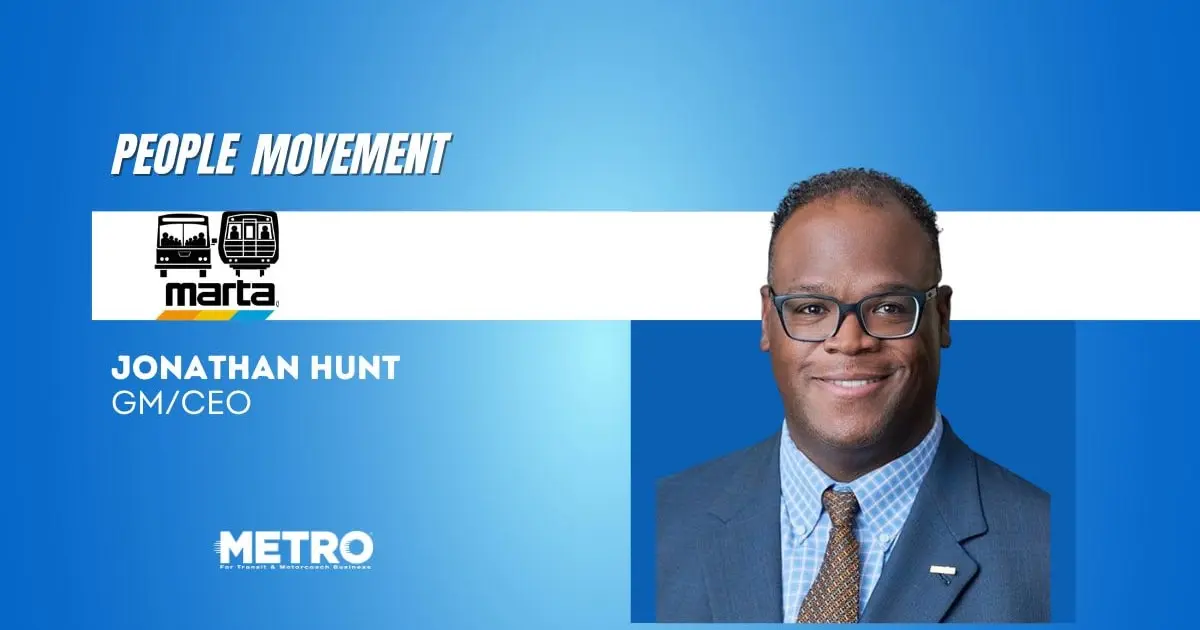
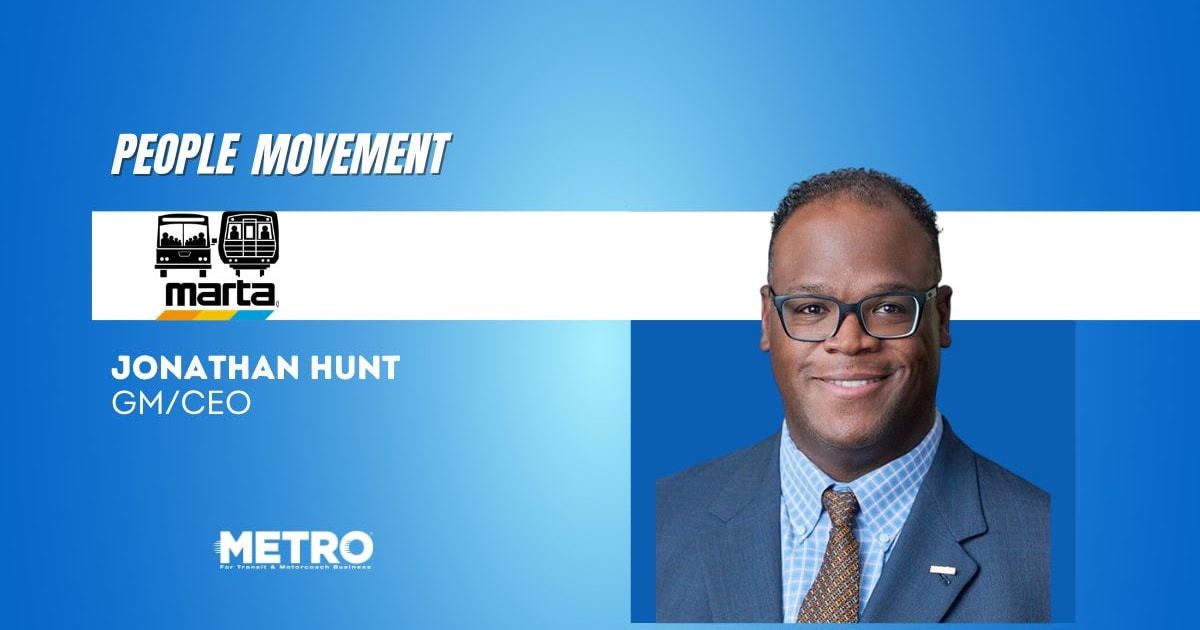
MARTA Selects Jonathan Hunt as Permanent GM/CEO
The Board of Directors of the Metropolitan Atlanta Rapid Transit Authority (MARTA) officially named Jonathan Hunt as the organization’s permanent General Manager and Chief Executive Officer. Hunt’s ascent to the permanent role follows a productive tenure as interim GM/CEO, a position he assumed in August 2025 following the departure of former chief Collie Greenwood. Prior to stepping into the executive suite, Hunt anchored MARTA’s legal division as its chief legal counsel.
Hunt’s institutional knowledge of MARTA runs deep. Having joined the authority in 2014, he spent more than a decade navigating its complex legal, corporate, and real estate landscapes. He progressed through the ranks from chief of corporate law and real estate to deputy chief counsel, and ultimately chief legal counsel.
During his interim leadership, Hunt guided the agency through several high-visibility milestones:

- The comprehensive redesign of MARTA’s bus network to improve frequency and connectivity.
- The transition and replacement of the authority’s legacy Breeze fare payment system.
- The implementation of Atlanta’s inaugural Bus Rapid Transit (BRT) line.
- The operational, safety, and customer experience oversight required during the heavy transit demands of the FIFA World Cup matches hosted in the city.
Beyond his localized impact in Georgia, Hunt is actively engaged in the national transit dialogue, serving on the national board of the American Public Transportation Association (APTA) and chairing its Legal Affairs Committee.
FMCSA Welcomes Steve Dowling as Chief Safety Officer
At the federal level, the U.S. Department of Transportation (USDOT) announced the appointment of Steve Dowling as the Chief Safety Officer for the Federal Motor Carrier Safety Administration (FMCSA). Dowling brings more than 35 years of combined industry expertise and law enforcement leadership to the agency, positioning him to tackle critical commercial motor vehicle (CMV) safety challenges.
Dowling transitions to the FMCSA from Covenant Logistics, where he served as senior director of safety. During his tenure there, he played an instrumental role in driving three consecutive years of record crash-rate reductions by enforcing rigorous safety performance metrics and operational accountability.
Before his private-sector contributions, Dowling enjoyed a distinguished career with the California Highway Patrol (CHP), culminating in his role as Chief of the Valley Division. In that capacity, he commanded an 850-person operational force across the greater Sacramento region, overseeing 20 operational commands, a commercial vehicle enforcement facility, and three communications centers spanning 10 counties. Notably, Dowling served as Incident Commander of the Emergency Operations Center during several historic natural disasters, including the devastating 2018 Camp Fire in Paradise, California.
As chief safety officer, Dowling will spearhead FMCSA’s core safety initiatives, collaborating closely with federal, state, and private-sector stakeholders to reduce crashes, fatalities, and injuries involving large trucks and buses while maintaining the efficient flow of interstate commerce.
HDR Restructures Leadership: Islam and Stapleton Take on Expanded Roles
Global infrastructure firm HDR has announced two major appointments designed to bolster its multidisciplinary delivery capabilities. Rashed Islam, PE, has been named professional services director for transportation, while Jeff Stapleton, PE, assumes the role of program management lead for Canada.
Based in Austin, Texas, Islam will oversee HDR’s integrated infrastructure delivery model, which synthesizes dozens of specialized transportation services executed by more than 5,000 engineering, construction, program management, environmental, planning, and advisory professionals. Islam’s mandate includes working alongside practice leaders to accelerate professional growth, elevate technical standards, enforce stringent quality assurance and risk-management protocols, and guide the firm’s integration of emerging technologies and alternative project delivery methods.
In Canada, Jeff Stapleton operates out of Burlington, Ontario, where he will leverage HDR’s comprehensive suite of program management and transportation assets to support clients managing complex, multi-year infrastructure investments. Stapleton’s leadership encompasses a broad spectrum of services, ranging from project controls and engineering design to environmental compliance, utility coordination, systems architecture, and traffic engineering. His work focuses on establishing robust program governance frameworks to ensure accountability and successful project outcomes across diverse provincial and municipal markets.
Wabtec Names Rajas Joshi Vice President, Business Unit Bus
Wabtec Corporation has appointed Rajas Joshi as vice president of its Transit Power & Mobility Components business unit, succeeding Bob Gallant.
Joshi enters the role as a seasoned executive with over two decades of international leadership experience managing global manufacturing operations and intricate supply chains spanning North America, Europe, and Asia. Wabtec leadership highlighted Joshi’s unique combination of large-scale corporate management and private equity execution discipline, traits that are expected to drive top-line growth and market agility within the transit bus components segment.
WSP Appoints Gloria M. Shepherd Strategic Advisor
WSP in the U.S. has expanded its advisory and planning practice by welcoming Gloria M. Shepherd as a national planning and project delivery strategic advisor.
Shepherd joins WSP after an illustrious, three-decade career in public-sector transportation policy, planning, and program management. Most recently, she served as the executive director of the Federal Highway Administration (FHWA), where she was instrumental in overseeing the administration and allocation of more than $350 billion in federal highway funds. Her extensive public-sector network includes close partnerships with state departments of transportation, metropolitan planning organizations (MPOs), tribal governments, and municipal agencies. At WSP, Shepherd will provide high-level counsel on complex infrastructure projects, fortify client relationships, and champion initiatives focused on sustainability, community resilience, and modern mobility outcomes.
SilverRide Appoints Sooketoo Bhuta Chief Product & Technology Officer
Reflecting the growing intersection of specialized mobility and healthcare, SilverRide Inc. announced the appointment of Sooketoo Bhuta as its Chief Product & Technology Officer (CPTO). Reporting directly to CEO Jeff Maltz, Bhuta will oversee the company’s comprehensive product, data, and technology innovation strategy, managing the multi-year roadmap for the platform that drives SilverRide’s assisted transportation network.
As specialized transportation transitions from a localized, niche offering into essential public infrastructure, SilverRide is investing heavily in its technological foundation. Bhuta’s core objectives include scaling the company’s data infrastructure, accelerating the integration of artificial intelligence and workflow automation across billing and platform support, and deepening interoperability with healthcare and paratransit ecosystems. Furthermore, Bhuta will evaluate expansion pathways into adjacent services designed to facilitate aging in place and community mobility access.
Supporting Context, Metrics, and Industry Trends
The clustering of these high-level moves across disparate sectors underscores several overarching macroeconomic and structural realities currently defining the transportation industry:
- The Digital and AI Transformation of Transit Operations: The appointments of leaders like Sooketoo Bhuta at SilverRide and the ongoing technological updates at MARTA (such as the Breeze fare payment modernization) highlight how software architecture, data analytics, and automation are no longer peripheral to transit—they are central to operational survival and fiscal sustainability.
- Regulatory Rigor and Safety Enforcement: With Steve Dowling at the FMCSA and Gloria M. Shepherd at WSP bringing deep regulatory and federal oversight backgrounds, agencies and private partners are signaling a renewed commitment to stringent safety standards, risk mitigation, and compliance amid rising traffic fatalities and complex supply chain demands.
- Alternative Project Delivery Models: The expansions at HDR under Rashed Islam and Jeff Stapleton emphasize the industry-wide shift toward integrated program management. As federal infrastructure funding flows through programs established by legislation like the Infrastructure Investment and Jobs Act (IIJA), transit agencies increasingly rely on private-sector partners to navigate project delivery risks, cost overruns, and supply chain constraints.
Official Statements and Industry Commentary
Leadership transitions of this magnitude invariably draw reflections from executive boards and professional associations on the state of the industry:
- On Jonathan Hunt’s permanent appointment at MARTA: Board representatives emphasized his steady hand during the operational pressures of the summer tourist influx and complex network overhauls, noting that his dual background in law and executive management provides the exact institutional stability required for MARTA’s next growth phase.
- On Steve Dowling’s arrival at FMCSA: Federal transportation officials underscored that commercial motor vehicle safety requires a blend of frontline law enforcement experience and private-sector logistics efficiency—qualities Dowling developed across his career with the California Highway Patrol and Covenant Logistics.
- On SilverRide’s technological scaling: CEO Jeff Maltz noted that as the demographic realities of an aging population demand more reliable assisted transportation, technology must evolve from simple dispatch software into a robust, automated mobility ecosystem capable of seamless integration with healthcare providers and transit partners.
Future Outlook: Navigating the Road Ahead
As these newly appointed executives settle into their respective roles, the metrics of their success will be judged by their ability to deliver projects on time, enhance passenger and commercial safety, and integrate emerging technologies into legacy systems.
- For Public Agencies: Leaders like Jonathan Hunt at MARTA and advisors like Gloria M. Shepherd at WSP must balance capital expansion projects with fiscal responsibility, ensuring that multi-billion-dollar federal and local investments translate into tangible improvements in daily rider experience, equity, and regional connectivity.
- For Regulatory Bodies: Steve Dowling and the FMCSA face the continuous challenge of leveraging data-driven enforcement to drive down commercial vehicle crash rates without unnecessarily bottlenecking the movement of freight across national supply chains.
- For Private Mobility and Engineering Providers: Firms like HDR, Wabtec, and SilverRide are positioned to capitalize on structural changes in how cities build infrastructure and how vulnerable populations access mobility. By investing in integrated project delivery, advanced manufacturing supply chains, and AI-driven platforms, these organizations will play an indispensable role in shaping a safer, more connected, and resilient transportation future.